


ams-ST joint NFC solution integrated into arm-based wearable reference design
 Published2016.03.09 19:27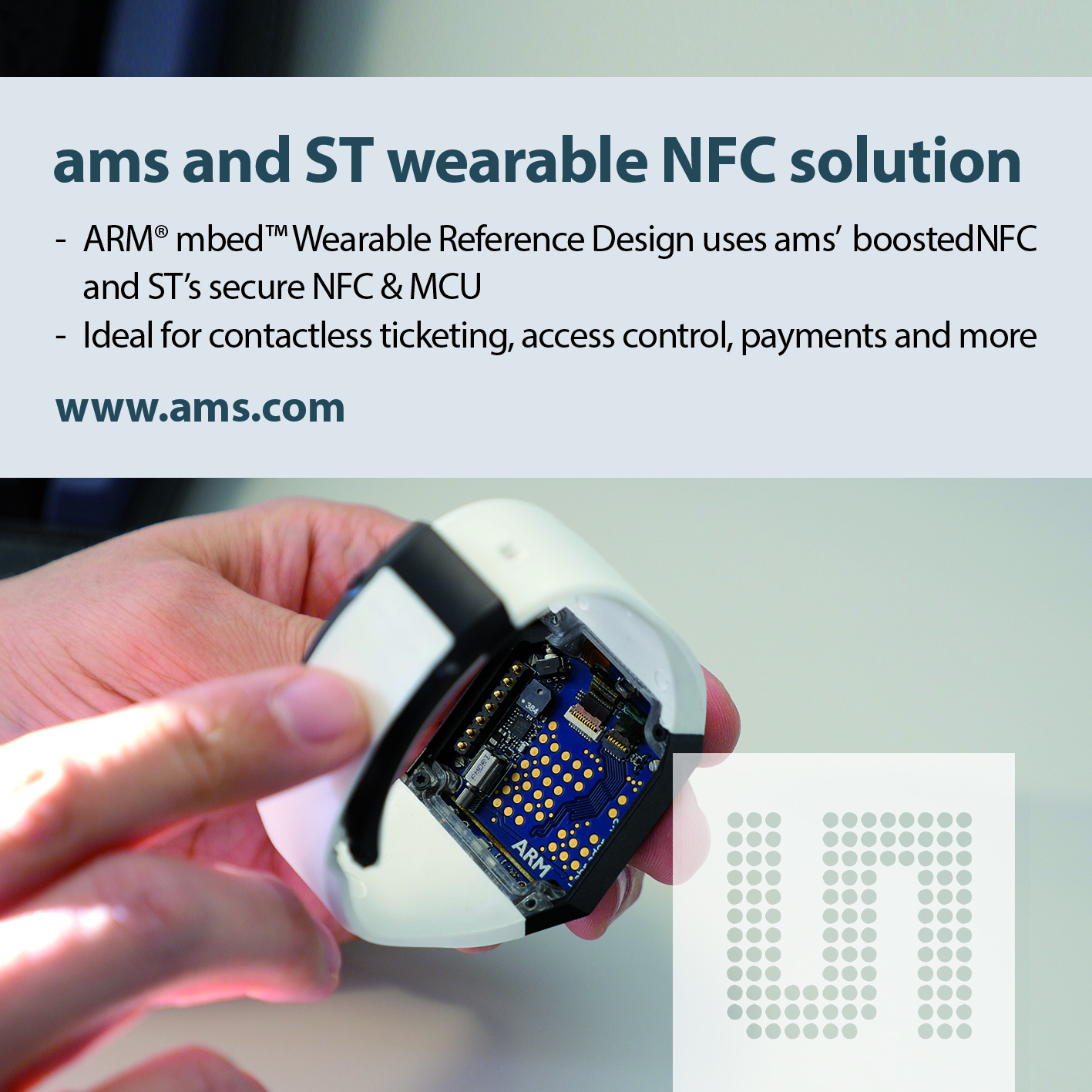
STMicroelectronics (ST), a global semiconductor company that supplies semiconductors for a wide range of electronic applications to ARM, announced that the two companies' joint NFC solution has been incorporated into ARM's new wearable reference design, providing secure, high-performance NFC and microcontroller capabilities.
This NFC solution, jointly developed by ST and ams, consists of ST's ST54E, which provides an NFC controller and a Secure Element based on the global platform standard version 2.2 in a System-in-Package (SiP) format, and ams's AS39230 NFC analog front-end featuring BoostedNFC technology. This joint NFC solution is particularly suitable for ultra-small battery-powered products such as wearable devices and smartphones.
ams's BoostNFC technology has overcome the problems that existing NFC devices face when operating with small antennas in demanding RF transmission environments. The ams/ST solution exceeds EMVCo requirements suitable for the RF performance needed for contactless payment methods, even when operating with antennas much smaller than 100mm².
Because ST’s SiP comprehensively supports all major NFC security standards worldwide, the ARM mbed wearable reference design can support the types of secure transactions required in various IoT (Internet of Things) applications, including contactless payment, automatic toll collection, and access control, as well as those not covered here.
The joint solution from ams/ST has very low average power consumption, which enables extended battery operating time per charge, i.e., charging intervals. This characteristic is possible because power cycling can be perfectly configured for both the BoostNFC front end and the NFCC.
The NFC system utilizes the unique technology of the ams AS39230, which implements active load modulation. This feature boosts the transmission signal of the NFC frontend to enable the wearable reference design to surpass the performance of contactless cards with antennas that are typically about 40 times larger in the 'Operating Volume'—the area where the wearable reference design interacts with the NFC reader.
The tight compatibility between each discrete component of ST and ams provides complex power saving performance. The ST54E switches to Deep Power-Down mode when out of the NFC RF field, while the AS39230 quickly switches to active power mode, which consumes much less power, with an average current consumption of only 18µA. The software for the ams/ST solution is optimized for low-power microcontrollers based on ARM technology. Because it offers a modular design, users can choose to compile only the modules suitable for the use cases supported by the device, which is useful for reducing system memory requirements and optimizing the resource footprint. The software stack optionally supports peer-to-peer (P2P) and reader/writer functions, and enables over-the-air (OTA) updates while the device is in the field.
The ST54E has received full approval, allowing developers to use NFC devices in card emulation, P2P, and tag reader modes compliant with NFC Forum standards. Furthermore, it is suitable for use in applications requiring global approval, including those under the Common Criteria (CC), EMVCo, GlobalPlatform, Visa, Mastercard, Amex, Discover, and the People's Bank of China (PBoC). The security performance of this mbed wearable reference design is enhanced by a separate fingerprint reader. The fingerprint reader utilizes ST's STM32F411 Dynamic Efficient microcontroller based on an ARM Cortex®-M4 core and performs image processing and identification functions.
Comments
Related news

ams Launches Next-Generation NFC Interface Tag IC
2015.05.21by 명세환 기자

ams' Boost NFC adopted in STM32
ams, a specialist in high-performance sensors and analog ICs, has announced that STMicroelectronics has adopted ams's validated boosted NFC technology in the integrated system development board for the STM32 family of mainstream microcontrollers.
2015.11.29by
ST Mass-produces MCUs that enhance efficiency for power-sensitive IoT devices
STMicroelectronics (hereinafter ST) has begun mass production of the ultra-high-efficiency ARM® Cortex®-M0+ microcontroller STM32L0. In addition, ST provides a rich development ecosystem including low-cost boards and free software tools, which helps reduce application power consumption significantly during development and minimize time-to-market for products.
2016.03.03by
ST, Connected Cars Protected from Hacking with Built-in Security Elements in MCUs
ST announced that chips such as its latest security microcontrollers will be responsible for the safety of connected cars, which are expected to reach approximately 150 million to 250 million units by 2020. ST's new security microcontrollers (ST32G512A, ST33G1M2A) provide these protection functions by leveraging ST's market-leading security technology expertise and have obtained AEC-Q100 certification, which is a rigorous automotive quality standard. In connected cars, security microcontrollers handle authentication in a manner similar to the SIM in smartphones.
2016.03.07by 명세환 기자

Intel Unveils Next-Generation 'Core Ultra Series 3' and vPro Platform for Enterprise PCs
Intel has officially unveiled the "Intel Core Ultra Series 3" for next-generation enterprise PCs and the latest vPro platform, addressing a wide range of demands from enterprise notebooks to high-performance workstations.
2026.03.26by 배종인 기자











