



Maxim, Transceiver ICs ··· Support Mass Production of Modules for Data Centers and Wireless Access
 Published2016.03.17 10:09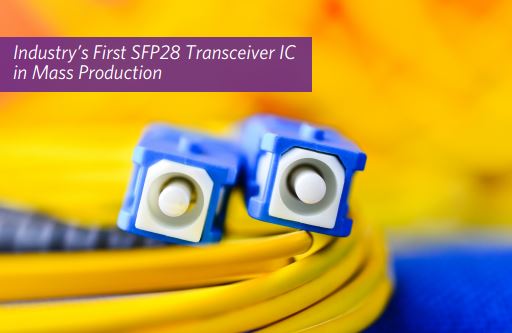
Heat shielding for the laser using Maxim transceiver chips and TO-CAN optical technology
Maxim Integrated Products Korea announced that it will mass-produce the industry's first SFP28 transceiver integrated circuit (IC) that supports transistor outline (TO)-can.
By using Maxim SFP28 transceivers, module manufacturers for data center and wireless fronthaul applications do not need to install drivers within the Transmit Optical Subassembly (TOSA). This allows them to protect sensitive lasers from heat, simplify the production process, and increase profitability.
Maxim SFP28 transceivers support advanced Digital Eye Tuning capabilities utilizing inexpensive TO-CAN-based optics. By using TO optics and a single transceiver and controller IC, SFP28 modules can be designed simply in the same way as SFP+ modules.
SFP28 optical modules for data center and wireless front-haul applications must support high performance, low power, and a wide temperature operating range at a lower price than existing SFP+ modules. Maxim’s 28.1Gbps low-power transceiver IC, which meets these requirements, features a CDR (Clock and Data Recovery Circuit) and a laser driver in the transmit path, and a high-sensitivity limiting amplifier and a CDR in the receive path.
Andrew Sharath, Director of Business Management at Maxim Integrated, said, “The Maxim SFP28 transceiver, developed with proven 100Gbps technology, enables high-bandwidth interconnection. “Maxim SFP28 ICs, already supplied to customers in mass production, enable cost-effective upgrades for enterprises, hyperscale data centers, and wireless access networks,” he said.
Dale Murray, a senior analyst at Light Counting Market Research, stated, “As the module market moves from 10Gbps to 25Gbps per lane, demand for SFP28 modules is expected to increase significantly over the next five years,” adding, “Maxim will meet this demand by simplifying module design and lowering costs through its newly released transceiver ICs.”
Comments
Related news

Maxim Integrated Expands Automotive Ecosystem with Solutions Compatible with All Wireless Systems
As the automotive industry rapidly advances, the collaboration between processor-centric digital semiconductors and high-performance analog semiconductors that comprise the ecosystem is being increasingly emphasized for the implementation of cutting-edge automotive systems. In line with these key trends in in-vehicle electronics, Maxim Integrated has been expanding its investments in a broad portfolio of analog ICs for automotive applications. This includes LED headlights, software-defined radio (SDR), gigabit multimedia serial link (GMSL) solutions, battery management ICs, and power management ICs. Maxim's automotive ICs are being supplied to numerous major global automotive manufacturers and automotive suppliers.
2015.08.13by 명세환 기자

Maxim Ships 1 Billionth Flexible, High-Integration Automotive Solution
Maxim announced that it has shipped its 1 billionth integrated circuit (IC) used in electronic devices such as automotive infotainment, safety systems, Keyless Go (enabling door opening/closing without removing the car key), and powertrains. Maxim's integrated products are widely utilized in automotive subsystems where size has been reduced and reliability has been enhanced.
2015.12.17by
Maxim simplifies design of isolated RS-485 transceiver family
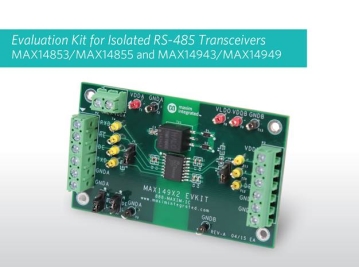
Maxim announced that it has simplified power and data isolation design by integrating a transformer driver and LDO (Low Drop Out) regulator into its isolated RS-485 transceiver product family.
2016.03.02by 명세환 기자

Intel Unveils Next-Generation 'Core Ultra Series 3' and vPro Platform for Enterprise PCs
Intel has officially unveiled the "Intel Core Ultra Series 3" for next-generation enterprise PCs and the latest vPro platform, addressing a wide range of demands from enterprise notebooks to high-performance workstations.
2026.03.26by 배종인 기자

ROHM Launches ESD Protection Diode Compatible with High-Speed Interfaces of 10Gbps or Higher
Semiconductor specialist ROHM has developed the 'RESDxVx series' of ESD (electrostatic discharge) protection diodes capable of responding to next-generation high-speed data communication environments exceeding 10Gbps, simultaneously enhancing both signal quality maintenance required in high-speed interfaces and IC protection performance.
2026.03.26by 배종인 기자











