



Vicor Launches AC-PoL Development Kit with PoL Buck Regulator Functionality
 Published2016.03.23 13:53
Vicor (Branch Manager Jung Ki-cheon) has launched the AC-PoL (Point-of-Load) development kit (ACPoLDKit).
The company states that this development kit features the industry's thinnest profile while boasting superior performance and the highest power density among power components. Power system designers can now use this development kit to rapidly and conveniently design and manufacture prototype boards, system interconnects, energy storage, and thermal management components.
The ACPoLDKit consists of ▲an AC Front-End (ACFE) chassis and a Point-of-Load (PoL) chassis. The AC Front-End (ACFE) receives power from the AC line and delivers up to 400 W through an isolated and regulated distribution bus, while the Point-of-Load (PoL) chassis▲receives the distribution bus voltage and generates three independent regulated PoL output values.
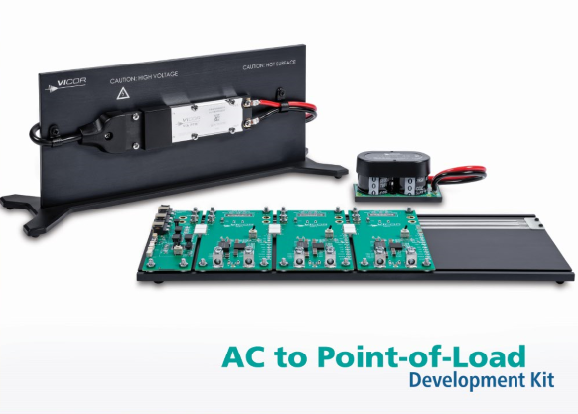
The development kit is available in two versions: 24VDC and 48VDC, both of which include bus hold-up capacitor assemblies and all auxiliary components including AC wiring.
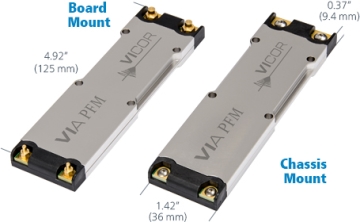
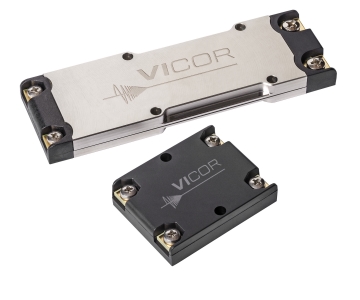
The ACFE chassis is mounted with Vicor's AIM1714 and PFM4414 modules in Vicor's compact and thermally robust 9mm thick VIA package. The AIM module provides full-wave rectification, Class B conducted EMI filtering, as well as input surge protection.
The PFM, which receives input power from the AIM, provides power factor correction functionality and delivers fully isolated and regulated 24VDC or 48VDC up to 400W to downstream PoL regulators.
Power system designers can rapidly implement the entire AC-DC front-end system through the AIM/PFM combination within a portion of the previous "1U" solution space. Both the AIM and PFM are available for board and chassis mounting. This enables system designers to maximize final system density by using chassis for mounting and cooling surfaces.
The PoL chassis consists of a combination of three independent PoL demo boards and one power input interface. The power interface receives regulated 24 or 48VDC power from the ACFE chassis and redistributes it to the three PoL demo boards.
The three PoL demo boards are each configured with 3.3V, 5V, and 12V PI133/P135xxVicor Cool-Power Zero-Voltage Switched (ZVS) buck regulators and are mounted in 10 x 14mm or 10 x 10mm LGA SiP packages respectively.
Vicor's Cool-Power ZVS buck regulators, operating at up to 96% power conversion efficiency from a 48V distribution bus, enable compact PoL system implementation with unprecedented power density and end-to-end system efficiency.
The newly launched ACPoLDKit provides everything necessary to test and evaluate the characteristics and benefits of Vicor's end-to-end modular power system solutions and power component approach.
Vicor's "generalized" power component design methodology and online Power Bench tool enable power system engineers to rapidly design and implement complete power systems that deliver field-proven reliability and predictability along with industry-leading performance, density, efficiency, and cost-effectiveness.
Related news
Vicor, High-Density Isolated AC-DC Front-End with PFC Function
Vicor has launched a new product line of high-density PFM™ AC-DC front-end modules. Supporting universal AC input of 85-264VAC and PFC function, this new module provides 400WDC output at maximum efficiency of 93% with fully isolated 24 or 48VDC output voltage, boasting unprecedented power density of 127 W/in³ (8 W/cm³) in a 9 mm VIA Package and best-in-class performance.
2016.01.07by 명세환 기자

Intel Unveils Next-Generation 'Core Ultra Series 3' and vPro Platform for Enterprise PCs
Intel has officially unveiled the "Intel Core Ultra Series 3" for next-generation enterprise PCs and the latest vPro platform, addressing a wide range of demands from enterprise notebooks to high-performance workstations.
2026.03.26by 배종인 기자

ROHM Launches ESD Protection Diode Compatible with High-Speed Interfaces of 10Gbps or Higher
Semiconductor specialist ROHM has developed the 'RESDxVx series' of ESD (electrostatic discharge) protection diodes capable of responding to next-generation high-speed data communication environments exceeding 10Gbps, simultaneously enhancing both signal quality maintenance required in high-speed interfaces and IC protection performance.
2026.03.26by 배종인 기자
ST Launches 75V Drive IC Targeting 48V Industrial Motor Driving
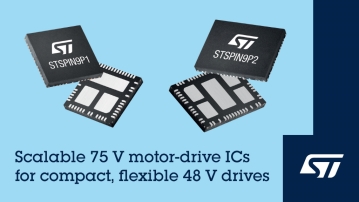
ST Microelectronics has unveiled the 'STSPIN9P' series of 75V motor drive ICs tailored for 48V-class industrial drive system design. The new product family is characterized by half-bridge and full-bridge configurations that enable design scalability according to motor type and output conditions. Power supply circuits, protection functions, and current sensing circuits are integrated on-chip to simplify system configuration, and the devices are designed to support applications up to 500W maximum. The company plans to provide reference designs and demo boards to support development and evaluation in industrial automation, robotics, pumps, fans, lighting, and textile machinery.
2026.03.26by 배종인 기자











