


Multi-connectivity chip developers, capture the smart home IoT market
 Published2016.05.27 11:07
With the smart home market based on the Internet of Things (IoT) expected to grow rapidly, interest in IoT connectivity communication technology that links smart devices is rising again.
According to market research forecasts, the smart home market, which enables the use of smart devices such as home appliances, lighting, networks, security, temperature, and entertainment in conjunction with various services, is expected to exceed $110 billion in 2019. The number of connected smart home devices is projected to reach 7 billion by 2020.
The problem lies in the communication technology that connects these devices. Currently, various technologies such as WiFi, Bluetooth , Zigbee , Z-Wave, and Thread are being used as communication standards known as Home IoT connectivity technology, each highlighting its own advantages. These technologies coexist, cooperating, competing, or keeping each other in check.
Since it is difficult to support all application fields with a single technology for the mixed use of smart devices in the home, solutions are being sought by resolving wired and wireless communication issues through RF or PLC communication, or by utilizing multi-connectivity chips supported by semiconductor companies.
In particular, major semiconductor companies are actively developing chips that support multi-connectivity in line with the expansion of the IoT market. These companies have introduced multi-chips that provide complex support, such as those that support Bluetooth over WiFi, WiFi over Zigbee, Zigbee, Bluetooth, and proprietary standards, as well as those that add Threads.
First, Broadcom unveiled a new low-power combo chip for mobile platforms and accessories at CES 2016. The newly announced BCM43012 offers three times longer battery life compared to existing combo chips and features significantly reduced Wi-Fi power consumption, allowing OEMs to leverage increased Wi-Fi throughput and range. Accessories using integrated Wi-Fi can connect directly to the cloud without a smartphone relay. This product supports enhanced proximity and location capabilities by providing WLAN functions with 802.11mc and TurboQAM data speeds of up to 96Mbps.
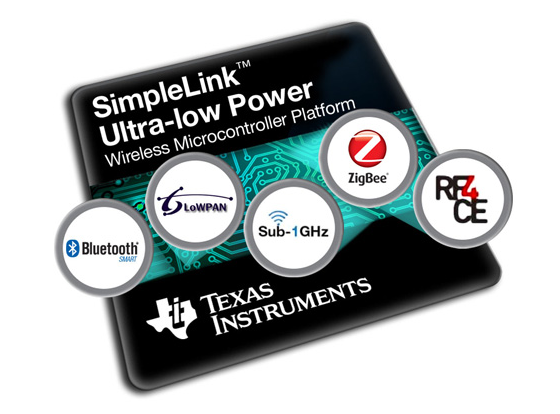
▲ TI SimpleLink Wireless Platform
Qualcomm joined the Internet of Things (IoT) market last year with the launch of the DragonBoard 410C. The DragonBoard 410C is a computer that packs all major components into a size slightly larger than a credit card and is based on the Snapdragon 410 processor. Using the DragonBoard 410C, users can directly develop IoT products. In particular, it is equipped with numerous features not found in other low-cost board computers, such as Wi-Fi, Bluetooth, location tracking, and a 64-bit Snapdragon. The location tracking function supports iZat, which combines GPS and mapping technology, and is expected to be used in robots, drones, and wearable devices.
GainSpan, a U.S. company, is renowned for integrating Wi-Fi and Zigbee. The single-chip GS2000, combining Wi-Fi and Zigbee, supports smart home connectivity technology for smart energy metering, medical, high-end audio, video, and security applications. The GS2000 supports both IPv4 and IPv6, extending IP connectivity anywhere. Wi-Fi provides local connectivity with smartphones over the Internet, while Zigbee IP extends IP range by connecting more battery-powered devices. This product also includes multiple standard RF and 802.11b/g/n and handles multiple Mbps via UART.
In contrast, TI (Texas Instruments)’s SimpleLink wireless platform enables the development of products supporting various wireless connectivity standards using the same RF design on a single chip. The SimpleLink ultra-low power platform supports Bluetooth Low Energy (BLE), ZigBee, 6LoWPAN, Sub-1GHz, ZigBee RF4CE™, and native modes up to 5Mbps. This platform integrates an ARM Cortex-M3 MCU, flash/RAM, analog-to-digital converter (ADC), peripherals, sensor controllers, and robust built-in security features all onto the chip.
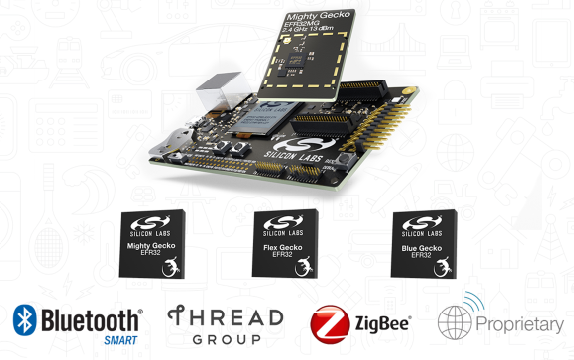
Silicon Labs' Multiprotocol Wireless Gecko SoC
For example, this platform has the CC2640 for Bluetooth Smart and the CC2630 for 6LoWPAN and ZigBee, and the CC2650 wireless MCU, which supports various 2.4GHz technologies including Bluetooth Smart, 6LoWPAN, ZigBee, and RF4CE, is available. There are also other products of the platform, such as the CC1310 for Sub-1GHz operation and the CC2620 for ZigBee RF4CE.
Silicon Labs' multiprotocol wireless Gecko SoC supports Zigbee, Thread, Bluetooth Smart, and proprietary protocols to implement IoT connectivity features. Silicon Labs' new Wireless Gecko SoC products integrate a powerful ARM Cortex-M4 core, energy-friendly Gecko technology, a 2.4 GHz radio with up to 19.5 dBm transmit output, and state-of-the-art hardware encryption. The Wireless Gecko SoC products simplify the development, setup, debugging, and low-energy design of wireless products, featuring the best Thread and Zigbee stacks for mesh networks, intuitive wireless interface software for proprietary protocols, and Bluetooth Smart for point-to-point access.
The company emphasized that the Wireless Gecko portfolio provides customers with a one-stop shop for essential elements for implementing multi-protocol IoT connectivity, offering the most balanced combination of protocols suitable for various customer applications, ranging from Bluetooth Smart to Thread, Zigbee, and proprietary stacks.
As single-chip technology supporting multi-connectivity advances, development competition among semiconductor companies is expected to intensify in the future.
Comments
Related news
.jpg)

Zigbee Alliance to Launch Solutions for Smart Homes and IoT in Q3
ZigBee Alliance announced that it is collaborating with Thread Group to develop an end-to-end solution for IP-based Internet of Things (IoT) networks. This solution will be part of ZigBee Alliance's comprehensive range of product development specifications, technologies, branding, and certification programs. ZigBee Alliance is a non-profit organization formed by institutions that create open global standards, which define IoT used in consumer, commercial, and industrial applications.
2016.01.06by 신윤오 기자
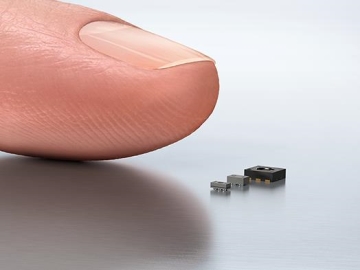
Environmental sensors that meet IoT are expanding in all directions, including “indoor car environments, mobile, and smart homes”
As Internet of Things (IoT) technology spreads, demand for environmental sensors such as temperature/humidity sensors, gas sensors, and pressure sensors is rapidly increasing. This is because demand for sensors that meet requirements such as ultra-miniaturization and low power consumption is surging in order to collect object information across various IoT application fields. In particular, smart environmental sensors are high-functionality, high-precision, high-convenience, and high-value-added sensors that combine sensing elements with intelligent signal processing to perform data processing, automatic calibration, self-diagnosis, and decision-making functions. Environmental sensors include temperature/humidity sensors, gas/pressure sensors, as well as dust sensors, ultraviolet sensors, and water quality sensors, and these sensors support real-time environmental monitoring regarding the effects of environmental pollutants in environmental media such as water and atmosphere, humans, and ecosystems.
2016.03.21by 신윤오 기자
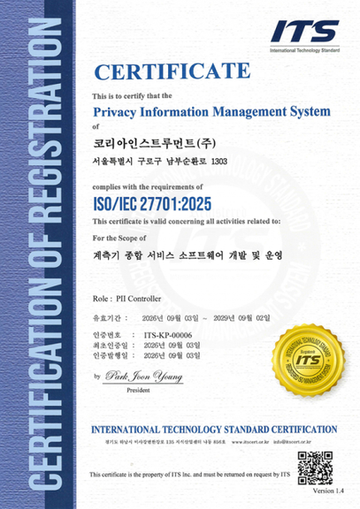
Korea Instrument, KOLAS Accredited Calibration Agency First to Simultaneously Acquire ISO/IEC 27,001·27,701
Korea Instrument has become the first among KOLAS accredited calibration agencies to simultaneously acquire ISO/IEC 27,001 and ISO/IEC 27,701 certifications. Through its proprietary platforms CWIZ Enterprise and CWIZ Partners, the company has embedded information security and personal data protection requirements across all business processes including customer information, equipment data, and calibration reports, with plans to continuously advance its management system through regular audits and security inspections.
2026.10.12by 배종인 기자

TeamViewer One, IT Incident Automation Workflow and Resolution Center Enhanced
TeamViewer has added IT incident automation capabilities and an advanced Resolution Center to its integrated digital workplace management platform 'TeamViewer ONE'. Recurrent service disruptions, configuration errors, and capacity shortages are automatically handled according to preset policies, and device status verification through script deployment can be managed in a unified interface, significantly reducing repetitive tasks for IT teams.
2026.10.12by 배종인 기자











