


Radar sensors provide road obstruction information, designated as a new transportation technology.
 Published2016.06.07 11:31
The Ministry of Land, Infrastructure and Transport (Minister Kang Ho-in) announced that it has designated four new transportation technologies (No. 31 to 34), including a road obstacle detection system using radar sensors that can reduce the impact of traffic accidents.
The 32nd new traffic technology (real-time emergency situation detection system based on radar sensors) is a technology that uses information collected through radar sensors installed on the road to recognize, analyze, and judge obstacles on the road (stopped vehicles, vehicles driving in the wrong direction, fallen objects, etc.) and provide the information to drivers and road managers.
With the currently operating CCTV , equipment performance deteriorates at night and in bad weather, and visibility is poor, making it difficult to detect a burglary in real time. Accordingly, the emergency situation detection system, which can be operated in various road environments, ensures performance day and night and in bad weather, detects emergency situations on a 5-lane road up to 1 km away, and directly detects individual vehicles, obstacles, pedestrians, etc. to provide accurate location and speed (within approximately 5 seconds) .
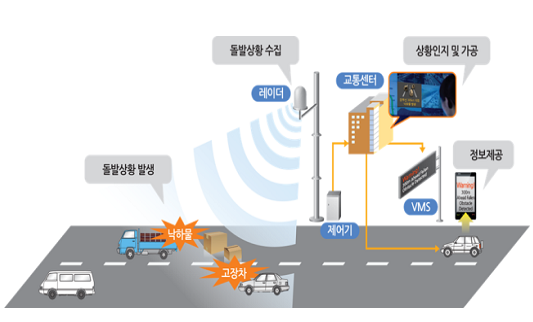
An official from the Ministry of Land, Infrastructure and Transport said, "It is expected that the efficiency of road management and operation will increase by automatically detecting unexpected situations on the road in real time and all weather and providing information about this to drivers and road managers in real time, thereby preventing primary and secondary accidents and alleviating road congestion."
In addition, the No. 31 new traffic technology (center divider and guardrail end treatment facility equipped with break-away supports) is a technology that installs shock-separating (break-away) supports at the ends of center dividers and guardrails, so that when a vehicle collides with it, the bolts connecting the upper and lower supports are detached and the rails of the center divider and guardrail overlap in sequence, thereby gradually dispersing and absorbing the impact.
No. 33 New Traffic Technology (Asphalt Concrete Lane Painting and Road Marking Technology by Applying Room Temperature Curing Paint with a Weight Ratio (%) of Acrylic Main and Sub-materials at 50:50 Using a Two-Component, Two-Process Lane Painting Equipment) is a technology for applying a room temperature curing paint for lane painting with a weight ratio (%) of acrylic main and sub-materials at 50:50 using a two-component, two-process lane painting equipment (main and sub-materials)This is a technology for applying asphalt concrete lane painting and road marking at room temperature using a two-nozzle sprayer and a V-shaped nozzle.
No. 34 Transportation New Technology (Full-Section Ultra-Rapid-Curing Concrete Manhole Lifting Repair Method Equipped with Multi-Shaped Pavement Cutting Equipment and Height-Adjustable Device) is a manhole lifting repair method that applies a pavement cutting technology using equipment capable of cutting circular and straight lines, a technology using a six-point height-adjustable device, and full-section ultra-rapid-curing concrete with a pipe cooling device installed.
Meanwhile, with this designation of new transportation technologies, developers will be given benefits such as obtaining a New Technology Certification Mark (NET), receiving extra points when participating in bidding, and receiving protection of new technologies for a certain period (typically 5 to 7 years), and an official from the Ministry of Land, Infrastructure and Transport predicted that the development of various new transportation technologies will be activated in the future.
Comments
Related news
The future of autonomous vehicles is all in Google's 'AI-powered autonomous vehicle' patents.
Kim Dimension-yong, director of ASPEC Future Technology Management Research Institute, a leading futurologist in Korea, has published a "Patent Analysis Report on Google's Artificial Intelligence-based Autonomous Vehicles." The subject of the report issued by Director Kim this time is autonomous vehicles, which have been receiving increasing attention recently. With regard to Google's Self-Driving Car (SDC) project, including semi-autonomous cars and autonomous cars, the report identifies 250 Google patents registered with the U.S. Patent and Trademark Office from 2009 through December 31, 2015, and provides insights by organizing and analyzing 110 of the most important patents across multiple categories.
2016.04.11by 신윤오 기자
Why did Google's self-driving car spend 3.85 million kilometers on road tests?
Dr. Cha Won-yong, a representative futurologist in Korea and CEO/Director of ASPEC Future Technology Management Research Institute, revealed this through his recently published book titled "Intensive Patent Analysis of Google's AI-based Autonomous Vehicles," stating that "most of Google's patents are aligned with Levels (L) 3 and 4 as defined by the American SAE," and "patents related to software design capabilities for artificial intelligence (AI)-machine learning (ML)-deep learning (DL), which is the core of autonomous vehicles, and patents regarding situations, responses, and learning that occur during actual road testing based on this foundation." Dr. Cha identified 250 Google patents from 2009 through December 31, 2015, related to Google's Self-Driving Car (SDC) project, specifically semi-autonomous cars (Self-Autonomous Car) and autonomous cars (Autonomous Car), and analyzed 110 important patents among them. Most of these patents are sensor systems (Sensor System), autonomous driving computer systems (Autonomous Driving Computer System), which are core to autonomous vehicles, and authentication systems between users and autonomous vehicles when commercialized.
2016.05.02by 신윤오 기자
[CPU Planning ②] The goal is to expand the application of domestic cores in the field of autonomous vehicle image recognition
The Aldebaran CPU core is a core independently developed by the Electronics and Telecommunications Research Institute (ETRI). The name is derived from Aldebaran, the first-magnitude star representing Taurus in the constellations. This processor provides integrated ADE (Application Development Environment) that includes a CPU core based on power consumption minimization microarchitecture and an open source (GNU)-based software toolchain to enhance interoperability with enterprises. As computational functionality and learning capability for optimization in given situations are required, the development of hardware-based MCUs capable of efficiently calculating intelligent algorithms is increasingly demanded. To meet these requirements, the Electronic Components Research Institute developed the MENSA core.
2016.05.16by 신윤오 기자
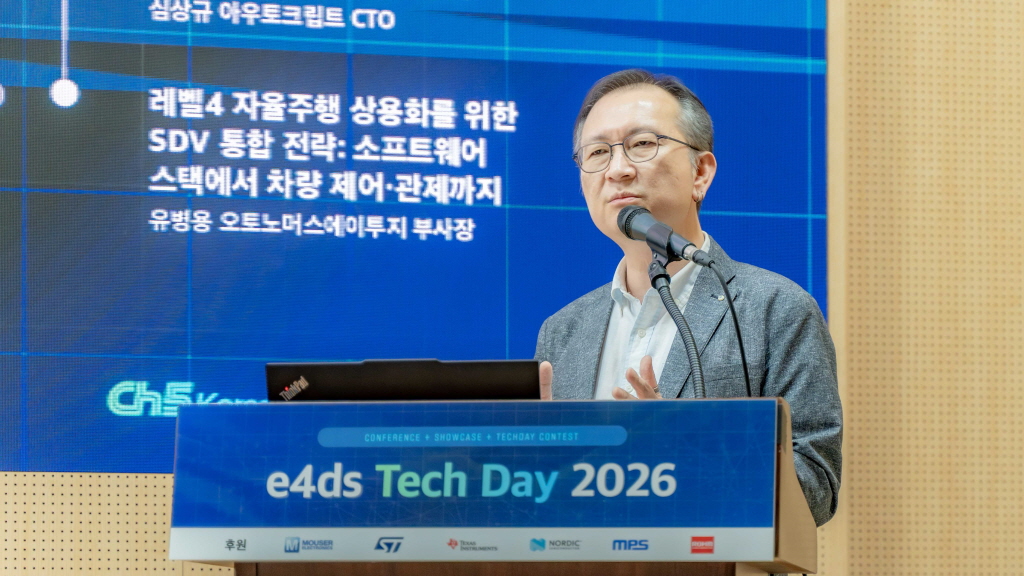
[e4ds Tech Day 2026 ⑨] Sim Sang-gyu, Autocrypt CTO: "In the Physical AI Era, Automotive Security Must Extend Beyond the Vehicle"
At e4ds Tech Day 2026, Sim Sang-gyu, CTO of Autocrypt, explained automotive cybersecurity strategies in the era of Physical AI and SDV (Software-Defined Vehicle). Automobiles are evolving as part of an ecosystem connected to AI, cloud, chargers, IoT, and robots, and he emphasized that the scope of security must expand beyond the vehicle interior to the entire connected environment. In particular, AI model tampering, adversarial attacks, OTA updates, and EV charger hacking were identified as major threats. He explained that response measures require zero trust, AI model integrity protection, intrusion detection, Security by Design and Default, and full lifecycle security management, and that proactive security system establishment beyond regulatory compliance is critical for securing future mobility competitiveness.
2026.10.12by 배종인 기자

Practical HIL Construction Strategy for Automotive and Off-Highway Controller Validation
As vehicle E/E architecture transitions to zonal structures and shifts to software-defined vehicles (SDV), the number of controllers (ECUs) requiring validation and software complexity are surging dramatically. Meanwhile, real vehicle testing cannot provide repeated verification under identical conditions and entails lead time and safety concerns. This white paper explains the principles of HIL (Hardware-in-the-Loop) validation and the structure of the NI platform composed of PXI, SLSC, and VeriStand, and through two actual implementation cases—Camera Record & Replay HIL for In-Cabin Monitoring Controller (ICMU) and Forklift Controller (VCU) HILS—describes how controller-level regression testing becomes possible. Additionally, it explicitly states application boundaries and limitations, such as lack of A2B support.
2026.10.12by 편집부











