


STMicroelectronics and Mobileye Explore the Path to "Fully Autonomous Driving"
 Published2016.06.21 12:16
Sample shipments of fifth-generation SoC products are expected in the first half of 2018, with vehicles from 25 automakers expected to be equipped with them.
Mobileye and STMicroelectronics (ST) announced that they will jointly develop Mobileye's next-generation (5th generation) SoC family, the EyeQ5, which will function as the central computer for sensor fusion in Fully Autonomous Driving (FAD) vehicles starting in 2020.
EyeQ5 will be designed with advanced 10nm or below FinFET technology nodes to achieve power consumption and performance targets and will feature 18 of Mobileye’s proven, innovative next-generation vision processor cores along with eight multithreaded CPU cores.
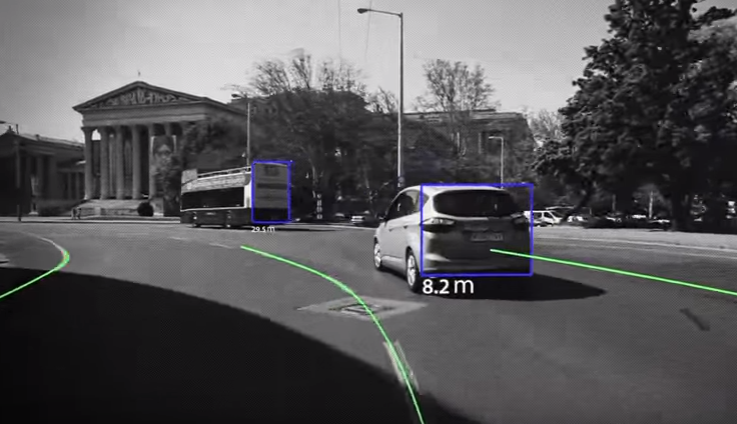
<Mobileye video capture>
This integration delivers up to eight times the performance of the current fourth-generation EyeQ4. Furthermore, the EyeQ5 delivers over 12 Tera Operations per Second (TOPS) of compute performance while consuming less than 5W, enabling passive cooling even at this exceptional performance. Engineering samples of the EyeQ5 are scheduled to be available in the first quarter of 2018.
The long-standing collaboration between Mobileye and ST continued in the development of the EyeQ5. ST's extensive experience in automotive-grade designs will support cutting-edge physical layer implementations, specialized memory, and high-speed interfaces, and will support the System-in-Package (SiP) design to ensure the EyeQ5 meets the highest automotive standards and meets the full quality process. ST will also contribute to the product's overall safety and security architecture.
“EyeQ5 is designed to serve as the central processor for future fully autonomous vehicles, combining the sheer compute density of approximately 20 high-resolution sensors with enhanced functional safety,” said Professor Amnon Shashua, Mobileye co-founder, CTO and Chairman. “EyeQ5 continues the legacy of Mobileye that began with EyeQ1 in 2014. Building on our deep understanding of computer vision processing, we have developed a highly optimized architecture that supports high-density compute at power levels below 5 watts, enabling passive cooling in automotive environments.”
“Each generation of our EyeQ technology has proven its value to drivers in the market, and ST has proven its value as a manufacturing, design, and R&D partner to Mobileye since our collaboration on the EyeQ1,” said Marco Monti, Executive Vice President and General Manager, Automotive and Discrete Group, STMicroelectronics. “As we work together toward the fifth generation of our industry-leading ADAS (Advanced Driver Assistance System) technology, ST will continue to deliver safer and more convenient smart driving experiences.”
Comments
Related news
Why did Google's self-driving car spend 3.85 million kilometers on road tests?
Dr. Cha Won-yong, a representative futurologist in Korea and CEO/Director of ASPEC Future Technology Management Research Institute, revealed this through his recently published book titled "Intensive Patent Analysis of Google's AI-based Autonomous Vehicles," stating that "most of Google's patents are aligned with Levels (L) 3 and 4 as defined by the American SAE," and "patents related to software design capabilities for artificial intelligence (AI)-machine learning (ML)-deep learning (DL), which is the core of autonomous vehicles, and patents regarding situations, responses, and learning that occur during actual road testing based on this foundation." Dr. Cha identified 250 Google patents from 2009 through December 31, 2015, related to Google's Self-Driving Car (SDC) project, specifically semi-autonomous cars (Self-Autonomous Car) and autonomous cars (Autonomous Car), and analyzed 110 important patents among them. Most of these patents are sensor systems (Sensor System), autonomous driving computer systems (Autonomous Driving Computer System), which are core to autonomous vehicles, and authentication systems between users and autonomous vehicles when commercialized.
2016.05.02by 신윤오 기자
[CPU Planning ②] The goal is to expand the application of domestic cores in the field of autonomous vehicle image recognition
The Aldebaran CPU core is a core independently developed by the Electronics and Telecommunications Research Institute (ETRI). The name is derived from Aldebaran, the first-magnitude star representing Taurus in the constellations. This processor provides integrated ADE (Application Development Environment) that includes a CPU core based on power consumption minimization microarchitecture and an open source (GNU)-based software toolchain to enhance interoperability with enterprises. As computational functionality and learning capability for optimization in given situations are required, the development of hardware-based MCUs capable of efficiently calculating intelligent algorithms is increasingly demanded. To meet these requirements, the Electronic Components Research Institute developed the MENSA core.
2016.05.16by 신윤오 기자
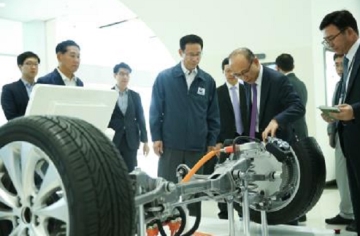
Localization of key components is necessary for the commercialization of autonomous vehicles
Choi Jeong-ho, Vice Minister of Land, Infrastructure and Transport, visited Hyundai Mobis's Mabok Research Institute on the 3rd, which became the first automotive parts supplier to receive temporary autonomous vehicle operation approval. He was briefed on the autonomous vehicle-related research and development initiatives being pursued at the institute. At a roundtable discussion attended by Hyundai Mobis Executive Vice President Jeong Seung-gyun and research institute officials, Vice Minister Choi encouraged them, stating, "I appreciate the efforts of those who have worked on technology development to make today's Hyundai Mobis possible."
2016.06.07by 명세환 기자

[e4ds Tech Day 2026 ⑨] Sim Sang-gyu, Autocrypt CTO: "In the Physical AI Era, Automotive Security Must Extend Beyond the Vehicle"
At e4ds Tech Day 2026, Sim Sang-gyu, CTO of Autocrypt, explained automotive cybersecurity strategies in the era of Physical AI and SDV (Software-Defined Vehicle). Automobiles are evolving as part of an ecosystem connected to AI, cloud, chargers, IoT, and robots, and he emphasized that the scope of security must expand beyond the vehicle interior to the entire connected environment. In particular, AI model tampering, adversarial attacks, OTA updates, and EV charger hacking were identified as major threats. He explained that response measures require zero trust, AI model integrity protection, intrusion detection, Security by Design and Default, and full lifecycle security management, and that proactive security system establishment beyond regulatory compliance is critical for securing future mobility competitiveness.
2026.10.12by 배종인 기자

Practical HIL Construction Strategy for Automotive and Off-Highway Controller Validation
As vehicle E/E architecture transitions to zonal structures and shifts to software-defined vehicles (SDV), the number of controllers (ECUs) requiring validation and software complexity are surging dramatically. Meanwhile, real vehicle testing cannot provide repeated verification under identical conditions and entails lead time and safety concerns. This white paper explains the principles of HIL (Hardware-in-the-Loop) validation and the structure of the NI platform composed of PXI, SLSC, and VeriStand, and through two actual implementation cases—Camera Record & Replay HIL for In-Cabin Monitoring Controller (ICMU) and Forklift Controller (VCU) HILS—describes how controller-level regression testing becomes possible. Additionally, it explicitly states application boundaries and limitations, such as lack of A2B support.
2026.10.12by 편집부











