


Number of IoT connected devices to grow at an annual average of 23% through 2021
 Published2016.06.29 06:47
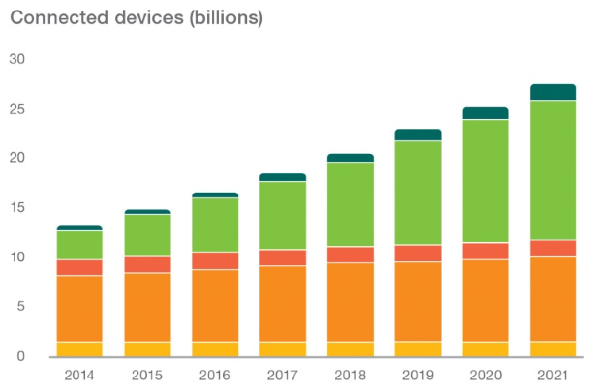
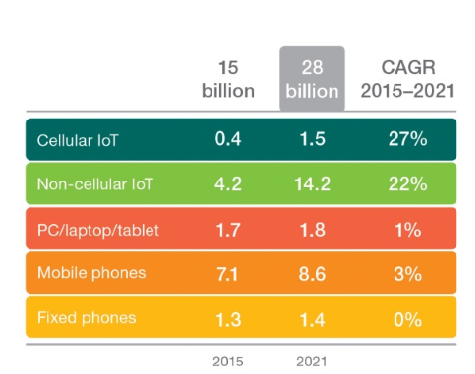
By 2021, approximately 28 billion connected devices will emerge.
Between 2015 and 2021, cellular IoT will show the highest growth rate, and the number of IoT connected devices is expected to grow at an average annual rate of 23%. By 2021, approximately 28 billion connected devices will exist, of which about 16 billion will be IoT devices.
Western Europe will lead the IoT market, with the number of IoT devices increasing fourfold by 2021. This growth will be driven primarily by regulatory decisions regarding demand for intelligent utility meters and connected cars, including the EU e-Call directive to be implemented in 2018.
Rima Qureshi, Senior Vice President and Chief Strategy Officer at Ericsson, said, “The IoT is growing rapidly now due to falling device prices and the emergence of innovative applications. With the commercialization of 5G networks in 2020, additional features such as connectivity and network slicing for an exponentially increasing number of devices will be provided to support seamless IoT services.”
The number of smartphone subscriptions continues to increase and will exceed the number of feature phone subscriptions in the third quarter of this year. The number of smartphone subscriptions, currently around 3.4 billion, is expected to double to 6.3 billion by 2021. Additionally, according to the report, the current number of mobile subscribers has reached 5 billion, which is evidence of the remarkable growth of mobile technology achieved in a relatively short period.
According to the details of the report, cellular data usage by teenagers to watch videos on smartphones increased by 127% over a 15-month period, demonstrating a dramatic shift in viewing behavior. Between 2011 and 2015, the time teenagers spent watching TV or videos on traditional TV screens was halved, while the time spent watching on smartphones increased by 85%. The fact that teenagers, the future leaders, use the most data on smartphones for video viewing signifies that they are the most important generation for telecommunications operators to keep a close eye on.
In 2016, we are passing the long-awaited milestone of commercial LTE networks supporting a maximum data downlink speed of 1Gbps. Devices supporting 1Gbps will rapidly spread to other regions, starting with Korea, the United States, Japan, and China in the second half of 2016. Mobile users will be able to enjoy content in a very short time thanks to this enhanced technology, which will enable downlink speeds that are more than two-thirds faster than today's fastest speeds.
Teenagers' use of cellular data to watch videos on smartphones increased by 127% over 15 months.
Global Growth Story: Mobile broadband subscriptions will quadruple in the Middle East and Africa between 2015 and 2021; mobile data traffic will grow 15-fold in India by 2021, and mobile traffic in the U.S. will increase by about 50% in 2016 alone, despite it being the most mature market.
Continuous growth of data traffic: Between the first quarter of 2015 and the first quarter of 2016, global mobile data traffic increased by 60% due to the increase in smartphone subscriptions and data consumption per subscriber. By the end of 2021, approximately 90% of mobile data traffic will be generated by smartphones.
Rapid growth in LTE subscriptions during Q1 2016: Driven by demand for improved user experiences and faster networks, 150 million new subscriptions were added during the first quarter, bringing the total number of LTE subscriptions worldwide to 1.2 billion. LTE networks with a maximum speed of 1 Gbps are expected to be commercialized within 2016.
Spectrum harmonization needed among countries planning early 5G implementation: 5G is expected to launch sooner than anticipated, and spectrum harmonization is needed among countries planning early implementation. It must be done separately from the WRC-19 process, which focuses on spectrum for commercial 5G implementation after 2020.
Comments
Related news
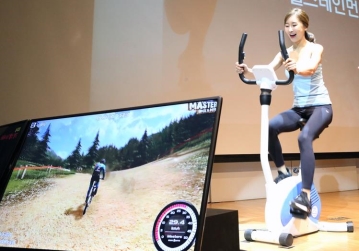
Telecom companies' "living room war" ignites as they seek to capture the home IoT market.
Following SK Telecom and LG U+, KT is making a full-fledged entry into the IoT home market, and fierce competition is expected to unfold among Korea's leading telecom operators in the "living room war" for IoT homes. As smart home devices are expected to lead the IoT market, the proportion of smart home-related devices is projected to rise from 26.6% in 2015 to 34.4% in 2016 and 39.9% in 2017. The domestic smart home market is expected to grow at an average annual rate of 22.2% from 2014 to 2019, reaching 23.4 trillion won by 2019. Telecom operators, home appliance manufacturers, and IT platform companies are providing smart convergence appliances, smart healthcare, smart TV, and home entertainment services.
2016.03.14by 신윤오 기자
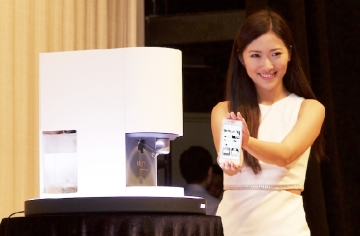
What are the 5 conditions for the success of IoT products?
The Korea Trade Association recently released a report titled 'Success Strategies for Smart Products Integrating Overseas IoT Technology,' introducing five strategies: ▲Connect objects that customers need ▲Provide personalized services ▲Add smart to smart through combination with different technologies and infrastructure ▲Encourage smartification of existing products through enhanced compatibility ▲Provide economic incentives to customers. The report, which emphasizes the need to strengthen data usability, states that it is important not merely to apply IoT technology to products, but to add smartness to existing products by delivering clear value unique to IoT technology in areas where customers require it.
2016.04.11by 신윤오 기자
[Reporter's Notebook] What will short-range wireless communication be that will take over IoT homes?
As short-range communication networks such as WiFi and Bluetooth have come into the spotlight as necessary communication means for home automation applications to be connected, competition between different communication technologies has become inevitable. The main short-range communications currently applied to IoT devices for home automation include WiFi, Bluetooth, ZigBee, and THREAD. Each of these communication technologies has advantages and disadvantages in terms of power consumption, range, and scalability, and is expanding its domain.
2016.04.25by 신윤오 기자
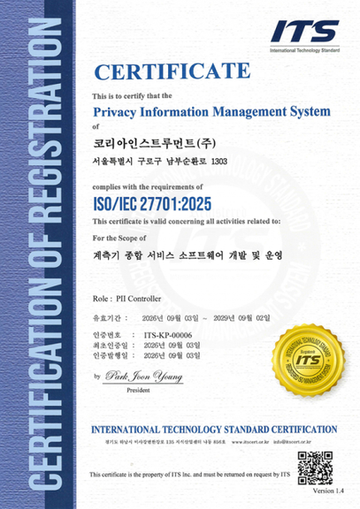
Korea Instrument, KOLAS Accredited Calibration Agency First to Simultaneously Acquire ISO/IEC 27,001·27,701
Korea Instrument has become the first among KOLAS accredited calibration agencies to simultaneously acquire ISO/IEC 27,001 and ISO/IEC 27,701 certifications. Through its proprietary platforms CWIZ Enterprise and CWIZ Partners, the company has embedded information security and personal data protection requirements across all business processes including customer information, equipment data, and calibration reports, with plans to continuously advance its management system through regular audits and security inspections.
2026.10.12by 배종인 기자
TeamViewer One, IT Incident Automation Workflow and Resolution Center Enhanced
TeamViewer has added IT incident automation capabilities and an advanced Resolution Center to its integrated digital workplace management platform 'TeamViewer ONE'. Recurrent service disruptions, configuration errors, and capacity shortages are automatically handled according to preset policies, and device status verification through script deployment can be managed in a unified interface, significantly reducing repetitive tasks for IT teams.
2026.10.12by 배종인 기자











