


The city selected as the best smart city in the Asia-Pacific region is
 Published2016.09.13 12:03
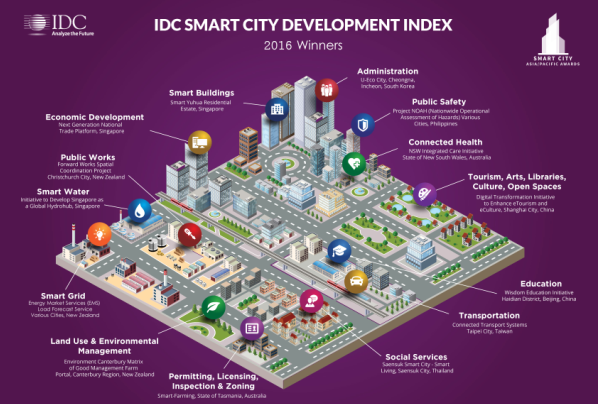
IT market analysis and consulting firm IDC announced that it selected Singapore and New Zealand as the top smart city winners in the Asia-Pacific region (excluding Japan) for 2016. These countries were selected as winners in three categories each across a total of 14 items.
IDC launched the Smart City Development Index for the Asia-Pacific region last year, and as part of this study, it is conducting the 'Smart City Asia Pacific Awards' (SCAPA) by selecting representative smart city projects in the Asia-Pacific region.
IDC’s Smart City Asia Pacific Awards (SCAPA) subdivided smart cities into 14 functional categories—transportation, utilities, smart buildings, smart grids, smart water, administration, economic development, land use and environmental management, licensing and permitting, inspection and urban planning zoning, public safety, education, travel, arts, libraries, culture, public spaces, connected health, and social welfare—selected three nominees for each category, and conducted the process through research (50%) including public voting by the Asia-Pacific public and internal evaluation (IDC research team 25%, advisory committee 25%).
Gerald Wang, Principal Researcher for the Asia-Pacific region at IDC Government Insights, stated, “Strong smart city momentum is building in the Asia-Pacific region as many countries view smart cities as foundational innovations leading the next stage of e-Government evolution.” He explained that by increasing citizen-led innovation and driving local industries, smart cities will ultimately contribute to enhancing social and economic sustainability.
Researcher Wang continued, “This year’s Smart City Awards nominees and winning cities are climate change and global He added, “It highlighted the impact of the trade slowdown, which is raising concerns about environmental sustainability and operational efficiency, and furthermore, about citizens’ living standards and the future sustainability of cities in the Asia-Pacific region.”
Comments
Related news

Cisco Releases Global Mobile Data Traffic Forecast Report
Cisco Korea has released the 2015-2020 "Visual Networking Index (VNI)" global mobile data traffic forecast report, which analyzes worldwide mobile trends.
2016.02.15by
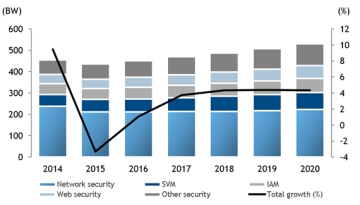
The domestic IT security market contracted by 4.1% last year compared to the previous year, but the future outlook is bright.
According to a recent domestic IT security product market outlook report published by Korea IDC (CEO Hong Yu-suk), the domestic IT security product market last year was tallied at 437 billion won, a 4.1% decrease compared to the previous year. The network security segment, which includes firewalls and UTM equipment, is analyzed to have led the overall IT security product market decline, falling approximately 10% year-over-year due to market saturation. The domestic IT security product market is projected to grow at a compound annual growth rate (CAGR) of 3.2% over the next five years, exceeding 500 billion won by 2019 and reaching a scale of 530 billion won in 2020.
2016.04.07by 신윤오 기자
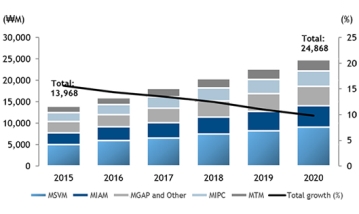
Mobile Security Industry Growth Outlook: Will Adoption of Cloud-Based EMM Solutions Increase?
According to the "Domestic Enterprise Mobile Security Software Outlook Report 2016-2020" recently published by Korea IDC (CEO Hong Yu-suk), the domestic enterprise mobile security software market last year was estimated at approximately 14 billion won. Furthermore, this market is projected to grow at an average annual rate of 12.2% over the next five years, forming a market scale of 25 billion won by 2020. The report predicts that as smart work environments become more commonplace, enterprises will review various mobile security solutions to support company-wide mobile operations based on stronger security policies. With smart devices extending beyond PCs, smartphones, and tablets to include recently emerging wearable devices such as smartwatches, the range of smart device control has expanded, and the areas requiring management are growing accordingly. This situation calls for enterprise-level device management. Consequently, interest in the adoption and implementation of cloud-based EMM solutions is expected to increase progressively.
2016.06.14by 김수지 기자
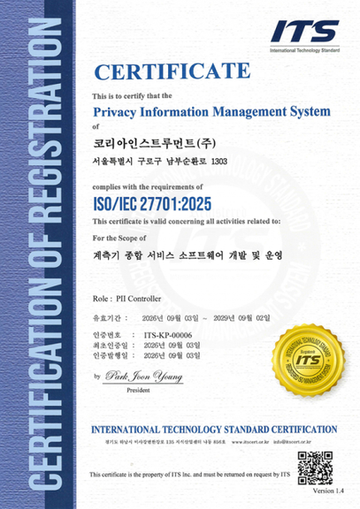
Korea Instrument, KOLAS Accredited Calibration Agency First to Simultaneously Acquire ISO/IEC 27,001·27,701
Korea Instrument has become the first among KOLAS accredited calibration agencies to simultaneously acquire ISO/IEC 27,001 and ISO/IEC 27,701 certifications. Through its proprietary platforms CWIZ Enterprise and CWIZ Partners, the company has embedded information security and personal data protection requirements across all business processes including customer information, equipment data, and calibration reports, with plans to continuously advance its management system through regular audits and security inspections.
2026.10.12by 배종인 기자

TeamViewer One, IT Incident Automation Workflow and Resolution Center Enhanced
TeamViewer has added IT incident automation capabilities and an advanced Resolution Center to its integrated digital workplace management platform 'TeamViewer ONE'. Recurrent service disruptions, configuration errors, and capacity shortages are automatically handled according to preset policies, and device status verification through script deployment can be managed in a unified interface, significantly reducing repetitive tasks for IT teams.
2026.10.12by 배종인 기자











