



What are the top 10 predictions to watch out for since 2017?
 Published2016.10.20 11:34
Gartner Inc., a global IT advisory firm, has announced 10 major predictions to watch for 2017 and beyond. Gartner’s 2017 major predictions evaluate the fundamental impact of the secondary effects resulting from the three ongoing digital revolutions: experience and engagement, business innovation, and digital capability enhancement.
“Gartner’s key strategic technology outlooks consistently provide provocative predictions on what may occur in the most critical areas of technological evolution. The concept of digital disruption, which has evolved into a wave of constant change redefining entire markets and industries, is key to future performance,” said Daryl Plummer, Executive Vice President, Gartner Fellow and Chief Research Officer. “Last year, Gartner predicted that digital change would arrive rapidly. This year, the acceleration will continue, and secondary effects that broadly impact people and technology may occur.”

The 'top 10 strategic predictions' announced by Gartner at the Gartner Symposium/ITxpo are as follows.
1) In 2020, 100 million consumers will shop using augmented reality
The popularity of augmented reality (AR) applications such as Pokémon GO will lead AR into the mainstream technology, and more retailers will try to incorporate AR into the shopping experience. As mobile devices have become a habit, the boundaries between the physical and digital worlds are blurring. Businesses and retailers will need to develop mechanisms to leverage these habits to improve the shopping experience. Layering digital information—such as text, images, videos, and audio—into the physical world using AR applications is one way to build deeper relationships with customers in stores or other locations. For example, consumers can use the IKEA catalog app to visualize furniture they wish to purchase in their own homes. AR apps, which incorporate real-world elements, are differentiated from virtual reality (VR) in this respect.
2) In 2020, 30% of internet search sessions will be performed without a screen.
New audio-centric technologies like Google Home and Amazon Echo enable access to information through conversation anywhere, creating new platforms based on voice-driven interactions. Because vocal interactions eliminate the need to use hands and eyes to search, they have expanded the uses of search to include topics such as driving, cooking, walking, socializing, exercising, and operating machinery. As a result, we will be able to access online information instantly almost all the time we are awake.
3) In 2019, 20% of brands abandoned their mobile apps
Many brands are realizing that mobile application adoption rates, customer engagement, and return on investment (ROI) are significantly lower than expected relative to the investment. New approaches are emerging that offer various levels of engagement approaching traditional applications with low barriers to installation and limited investment, support, and marketing costs. Many companies will evaluate this experience by comparing it to underperforming applications and choose to reduce losses by shutting down the apps.
4) In 2020, algorithms positively changed the behavior of over 1 billion workers worldwide
Contextualization algorithms are making groundbreaking advancements by incorporating various behavioral interventions from fields such as psychology, social neuroscience, and cognitive science. Humans sometimes behave irrationally when their emotions are heightened. Algorithms can positively alter such behavior by enhancing intelligence with information stored in large-scale collective memory systems that have undergone socialization and testing. Through this, workers can 'remember' everything and receive timely information they have never experienced before, enabling them to handle their tasks objectively and fostering a greater sense of gratitude for life. While the use of algorithms may seem unsettling, they can bring about changes across various industries when utilized to influence positive outcomes.
5) In 2022, the value of blockchain-based businesses will reach $10 billion.
Blockchain technology is the next-generation revolution in transaction recording. The blockchain ledger provides all stakeholders with an immutable, shared view of every transaction. Therefore, stakeholders involved in a transaction can respond immediately, knowing that the established blockchain record cannot be altered. Any form of value exchange can occur within minutes, rather than days. Blockchain applications can unleash cash, reduce transaction costs, and accelerate business processes. Although blockchain is not yet mature, it is attracting product and capital investment.
6) In 2021, 20% of individual activities were linked to one or more of the top 7 digital companies
Based on revenue and market capitalization, the current top seven digital companies include Google, Apple, Facebook, Amazon, Baidu, Alibaba, and Tencent. As the digitalization of the physical world, as well as finance and healthcare, accelerates, a significant number of activities in which individuals participate are expected to become interconnected. This digital convergence suggests that relevant digital companies may be involved in all activities. Digital companies are projected to account for a substantial portion of personal activities, ranging from mobile apps, payments, and smart agents like Amazon Alexa to digital ecosystems such as Apple HomeKit, WeChat Utility, and City Services.
7) In 2019, for every $1 companies invested in innovation, an additional $7 in expenditure was required for execution.
A significant number of companies have regarded the adoption of a bimodal IT approach as a priority and a crucial first step in driving innovation. The most critical factor in implementing digital business is close alignment between Mode 1 and Mode 2 organizations. However, in most cases, the deployment costs of a Mode 2 "ideated solution" are not necessarily determined during the conception phase, nor are Mode 1 costs considered during the initial funding phase. Designing, implementing, integrating, operating, and managing an ideated solution can incur higher costs than the initial innovation costs. Accordingly, Gartner predicted that for every dollar companies spend during the digital transformation/conceptualization phase, they will spend an average of $7 to build solutions.
8) In 2020, the increase in demand for data center storage due to the Internet of Things (IoT) was less than 3%.
With approximately 21 billion endpoints expected to be in use in 2020, there is a high likelihood that data will be generated explosively in the IoT sector. Of the data center HDD and SSD capacity projected to reach about 900 exabytes by 2020, storage for individual IoT sensors is expected to account for only 0.4%, while storage for multimedia sensors is projected to reach 2%, totaling 2.3%. This suggests that while providing key data-driven business value and insights through IoT, it is essential to maintain ease of management in terms of storage infrastructure.
9) By 2022, the use of IoT can save $1 trillion annually in costs associated with maintenance, services, and consumer goods.
IoT offers excellent cost-saving benefits for maintenance and consumables. However, implementing this requires a secure and robust IoT adoption capable of supporting cost reductions for 10 to 20 years, ensuring that savings are not absorbed by rising management costs. For example, this includes low-cost monitoring systems equipped with simple sensors that report defined characteristics to an analytics server. Such analytics are used to identify patterns in vast amounts of data and recommend maintenance based on actual usage and status, rather than elapsed time or predicted conditions. Separately, Digital Twins are emerging. Digital twins collect near-real-time data feeds from sensor-enhanced real-world twins and utilize them along with other data sources, such as weather, historical data, algorithms, and smart machine analysis, to update simulations that reflect the physical state of the twin.
10) In 2020, approximately 40% of all employees could reduce healthcare costs with fitness trackers
It appears that a significant number of companies will hire fitness program managers. Based on close collaboration between these managers and HR personnel, fitness trackers are expected to be included in employee benefits. Healthcare providers can save lives and reduce costs by leveraging data from wearable fitness trackers that alert users to health risks. Wearables provide vast amounts of data that can be analyzed in real-time, or accessed by doctors and other healthcare professionals to analyze situational information and medical history with the patient's consent.
Comments
Related news
What are the promising technologies for the future and business items advantageous for SMEs?
The Korea Institute of Science and Technology Information (KISTI), which has been announcing promising future technologies every year, unveiled technology sectors that will transform the coming future this year as well. KISTI also presented promising commercialization items that will open new opportunities for small and medium-sized enterprises and startup companies. The ten promising future technologies selected this time include ▲bioprinting ▲synthetic cell technology ▲body augmentation technology ▲medical virtual reality application technology ▲soft wearable technology ▲lightweight materials technology for automobiles ▲industrial internet ▲visible light-based next-generation communication technology (Li-Fi) ▲intelligent cyber security ▲chameleon environment-responsive materials, and others.
2016.09.19by 신윤오 기자
Wafer shipments projected to record moderate annual growth through 2018
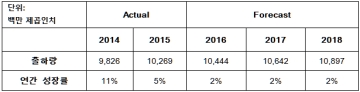
The Semiconductor Equipment and Materials International (SEMI) recently announced its annual silicon wafer shipment forecast for the semiconductor industry. The report contains forecasts for silicon demand between 2016 and 2018. According to SEMI's projections, the total area shipments of polished and epitaxial silicon wafers are forecast at 10.444 billion square inches in 2016, 10.642 billion square inches in 2017, and 10.897 billion square inches in 2018 (see table). Total wafer shipments this year are expected to exceed the record levels achieved in 2015, and this elevated level of shipments is projected to continue in 2017 and 2018 as well.
2016.10.14by 신윤오 기자
Dear partners, the promising future technologies that Samsung Electronics views are
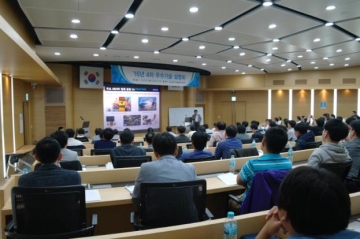
Samsung Electronics held the "2016 Fourth Session of Future Promising Technology Briefing" for partner companies on the 17th at the Suwon Win-Win Cooperation Academy Education Center. The "Outstanding Technology Briefing," which began in 2009, is a forum where Samsung Electronics shares future promising technology trends to strengthen the technological competitiveness of partner companies. Starting this year, it has been expanded to four sessions per year. At this briefing, approximately 140 participants attended, including representatives from 65 partner companies in the first and second sessions and research and development staff members, and a total of six outstanding technologies were introduced.
2016.10.17by 김수지 기자

ESP32 Development Environment Selection and GPS Application Implementation
The ESP32 is a microcontroller that integrates Wi-Fi, Bluetooth, 12-bit ADC, capacitive touch, PWM, DAC, and UART in a single SoC. However, the abundance of features does not by itself solve the designer's problems. The real challenges lie in selecting the appropriate development environment, determining which pins can be used and which must be avoided, and converting raw data from modules into usable information. This document addresses ESP32 peripheral constraints (ADC2 and Wi-Fi coexistence limitation, UART1 occupancy, ADC non-linear regions), the trade-offs between Arduino IDE and ESP-IDF, and the process from connecting NEO-6M/NEO-M8N GPS modules to UART2, parsing NMEA sentences, and visualizing routes in Google Earth, all organized based on documented references.
2026.10.12by 편집부

MIPI CSI-2, DSI-2, C-PHY, D-PHY Test Solution Technical White Paper
The MIPI interface adopts a burst mode that transitions between low-power (LP) and high-speed (HS) states for low-power consumption, and in return, strict timing rules are imposed on state transitions. Additionally, the high-speed section operates as a packet-based protocol with headers, ECC, and CRC, so verification engineers must handle waveforms and protocols simultaneously. Traditional configurations combining general-purpose oscilloscopes and AWGs reveal limitations in setup complexity, measurement uncertainty, and lack of reproducibility when faced with these requirements. This white paper, based on webinar materials, organizes the structure of this problem and describes how the SV5C-DPTXCPTX generator for receiver testing and SV5C-DPRXCPRX analyzer for transmitter testing integrate state transition testing, stressed eye testing, and protocol analysis into a single bench, along with their application boundaries.
2026.10.12by 편집부











