



Domestic PC shipments in the third quarter reached 1.02 million units, up 3.5% year-on-year.
 Published2016.11.14 07:10
As the proportion of indirect sales increases, channel collaboration and expanding product exposure are important.
According to a recent analysis of the domestic PC market by IDC Korea, domestic PC shipments in the third quarter of 2016 reached 1.02 million units, a 3.5% increase year-on-year. This is encouraging when compared to the 3.9% decline in global PC shipments during the same period.
The education sector shipped 67,000 units, a 45.2% increase from the previous year, and the cumulative total from January to September was 230,000 units, a 66.5% growth compared to 137,000 units during the same period last year. As education offices have been continuously replacing outdated desktops in school practice rooms since the beginning of the year, the volume of shipments in the education sector in 2016 is expected to surpass that of the public sector.
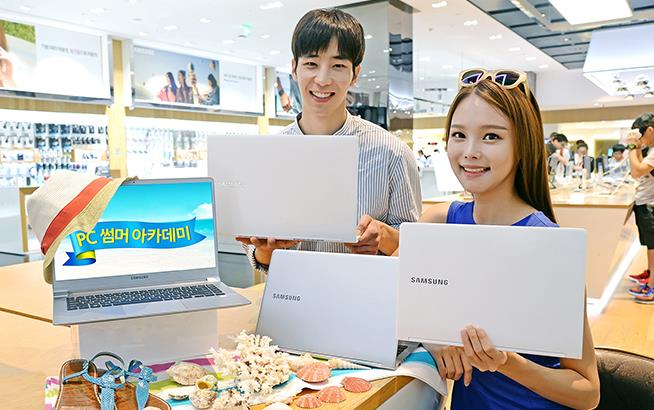
▲ Samsung Electronics PC Summer Academy held last July (Reference photo)
The consumer segment shipped 549,000 units, growing 5.8% year-over-year, and there is high demand for budget gaming laptops equipped with external graphics cards priced from 800,000 won to 1.2 million won. For consumer desktops, all-in-ones declined by 25.2% year-on-year, while general desktops grew by 4.7% year-on-year as the user base enjoying graphics-enhanced games expanded, and products equipped with mainstream Core i5 and FX processors and external graphics cards GTX, R9, and RX are popular.
On the other hand, the public and corporate sectors shipped 64,000 and 344,000 units, respectively, declining by 9.9% and 2.7% year-on-year; despite bids from the National Police Agency and the financial sector, they recorded negative growth due to a reduction in overall IT spending.
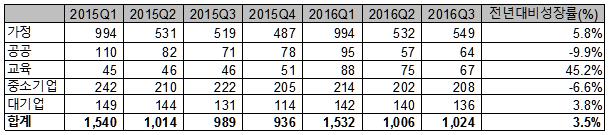
▲ PC shipments by domestic market, Q1 2015–Q3 2016 (thousands of units, Source: IDC, 2016)

▲ Domestic PC shipments by channel, Q1 2015–Q3 2016 (thousands of units, Source: IDC, 2016)
The channel is gradually shifting from direct sales to indirect sales. As of the third quarter of 2016, direct sales totaled 278,000 units, a 7.1% decrease from the previous year, while indirect sales totaled 746,000 units, an 8.0% increase. While vendors can directly compete for large-volume bids from large corporations, channel partnerships are becoming increasingly important for small and medium-sized enterprises (SMEs) purchasing small quantities, as they must expand their reach to clients through strategic collaboration with dealer channels.
To compensate for the decline in offline sales volume, the consumer division focuses on offering premium products that consumers wish to experience and select in person, while online stores utilize mobile apps and social networks to expand product exposure and attract customer interest through differentiated promotions. Furthermore, online stores directly operated by vendors offer the advantage of allowing customers to choose from a wide variety of specifications, despite limited stock.
"In order to meet customer demands, it is becoming increasingly important to provide not only product design, specifications, stability, and price, but also collaboration with channels, sales and inventory management, changes in purchasing methods such as rental and leasing, and differentiated solutions," said Sang-Jun Kwon, Senior Research Analyst at IDC Korea. He suggested that "vendor and channel profitability and customer convenience must be enhanced through segmented strategies by product and segment."
Comments
Related news
Demand for laptops outpaces demand for desktop PCs for two consecutive quarters
According to recent domestic PC market research analysis by Korea IDC (CEO Hong Yu-suk), domestic PC shipments in the second quarter of 2016 remained at 1 million units, maintaining the previous year's level. Desktop shipments totaled 490,000 units, declining 7.2% year-over-year, while notebooks increased 6.4% to 510,000 units, with notebook demand outpacing desktops for the second consecutive quarter. Desktops showed double-digit declines year-over-year in the home, public, and small-to-medium enterprise sectors. All-in-one desktops fell to 42,000 units, down 20,000 units from the previous year, with growth momentum weakening. However, the education sector recorded 58,000 units, an increase of over 80% year-over-year, driven by large-scale replacement of aging desktops in school practice rooms and similar facilities. Desktop replacement is expected to continue into the third quarter.
2016.08.19by 신윤오 기자
The traditional PC business model has collapsed, making a complete overhaul of the PC business inevitable in 2020.
Gartner forecast that in 2020, business decision-makers at PC manufacturers would face critical decisions on whether to fundamentally restructure their PC business or withdraw from the market. Gartner stated that companies seeking to maintain their PC business division must promptly adopt decisions regarding appropriate alternatives or changes tailored to the currently oversaturated PC market.
2016.09.22by 신윤오 기자
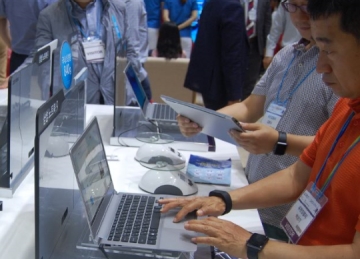
Global PC Shipments Decline for 8 Consecutive Quarters: 'Dark Age Continues in PC Market'
According to provisional results announced by Gartner, global PC shipments in the third quarter of 2016 declined 5.7% year-over-year to 68.9 million units. This marks eight consecutive quarters of decline, which Gartner states is the longest sustained downturn in PC industry history. PC manufacturers are facing significant challenges, particularly including weakened demand for back-to-school personal computers in emerging markets and continued weakness in consumer market demand.
2016.10.14by 김수지 기자
Nvidia invests $5 billion in Intel
NVIDIA and Intel, leaders in global AI computing technology, are now forging ahead in providing cutting-edge solutions through NVLink-based architecture integration. NVIDIA and Intel have officially announced a strategic partnership and stated that they will jointly develop customized data center and personal computing products to accelerate diverse applications and workloads ranging from hyperscale to enterprise and consumer markets, thereby laying the foundation for the next generation computing era.
2025.09.22by 배종인 기자
.jpg)
Applied Materials Launches Environmental Protection Campaign to Mark World Cleanup Day
Applied Materials Korea (CEO Park Kwang-seon) is carrying out environmental cleanup activities with employees and their families around the Dongtan Sinricheon area on the occasion of World Cleanup Day, evolving into a company that engages with the local community beyond technological innovation.
2025.09.22by 명세환 기자











