



Total global device shipments this year are expected to reach 2.3 billion units, similar to last year.
 Published2017.01.16 06:03
The introduction of new devices will increase sales of existing devices.
Gartner Inc., an IT consulting firm, forecasted that the total shipments of all devices (PCs, tablets, ultramobiles, and mobile phones) worldwide in 2017 will reach 2.3 billion units, similar to the previous year.
In 2016, an estimated 7 billion mobile phones, tablets, and PCs were used worldwide. Gartner forecasts that shipments of traditional devices will remain flat until 2018, while shipments of ultramobiles and mobile phones will see a slight increase.
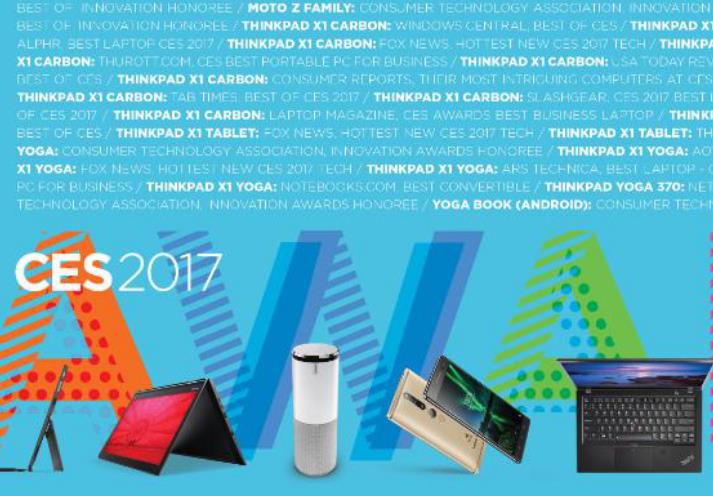
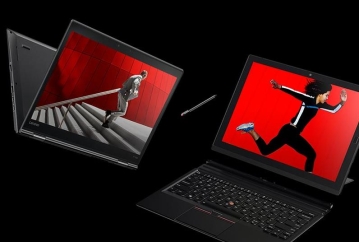
▲Lenovo unveiled groundbreaking new mobile and PC products at CES 2017.
“The global device market is currently stagnant,” said Ranjit Atwal, research director at Gartner. “Mobile phone shipments are growing only in emerging markets in the Asia-Pacific region, and we believe the decline in the PC market will soon bottom out.”
Researcher Ranjit Atwal noted, "In addition to declining shipments of existing devices, average selling prices are also entering a plateau. This is due to a saturated market and a slowing pace of innovation. Consumers are increasingly seeing fewer incentives to purchase new devices or upgrade existing ones." They are pursuing increasingly unique user experiences in emerging devices such as head-mounted displays (HMDs), virtual personal assistants (VPAs), and wearables,” he said.
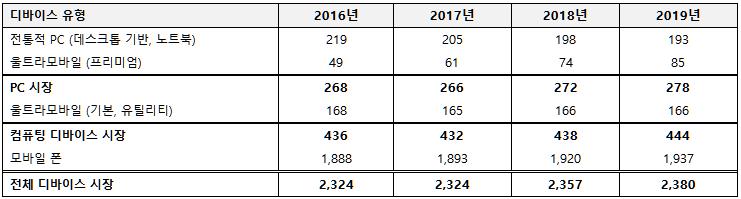
▲ Table 1. Global shipments by device type, 2016–2019 (unit: millions of units) Source: Gartner (January 2017)
Note: The Ultramobile (Premium) category includes devices such as Microsoft Windows 10 Intel x86 products and the Apple MacBook Air. The Ultramobile (Basic, Utility) category includes devices such as the Apple iPad, iPad Mini, Samsung Galaxy Tab S2, Amazon Fire HD, Lenovo Yoga Tab 3, and Acer Iconia One.
The PC market, currently in a slump, is expected to return to growth in 2018, benefiting from the replacement cycle. While traditional PC sales continue to decline, premium ultramobile devices with attractive price points and features are expected to spur purchases. Similarly, the mobile market is expected to benefit from the replacement cycle. However, replacement demand will differ between mature and emerging markets. Ranjit Atwal, Research Director, stated, "Unlike mature markets, emerging markets, where smartphones remain the primary computing device, will see more regular replacements."
For device manufacturers, there is a growing push to enter the rapidly growing new device product line. “This requires a shift from a hardware-centric approach to a richer, value-added, services-based approach,” said Ranjit Atwal, a researcher. “As a services-based approach becomes increasingly important, hardware providers that lack the expertise to directly deliver services will ultimately have to collaborate with service providers.”
Comments
Related news
Smartphone Market in 2017: “China is slowing down and India is rising”
At a system semiconductor forum hosted by the Korea Semiconductor Industry Association, Park Won-jae, an analyst at Daewoo Securities, stated, "The growth slowdown in the U.S. and Western European markets that led smartphone growth is beginning in earnest, and growth in the Chinese market, which was the main driver of smartphone market expansion, is also starting to decelerate," adding, "Future growth is expected to be driven primarily by India." As such, the 2017 smartphone market is projected to be characterized by sales volume of 1.53 billion units and keywords of full maturity and intensified competition. In 2016, handset estimated shipments declined to 1.95 billion units, while smartphone shipments are expected to reach 1.46 billion units in 2016, following 1.3 billion units in 2014 and 1.44 billion units in 2015.
2016.11.21by 신윤오 기자
The global cognitive and artificial intelligence systems market is set to grow at an average annual rate of 55.1% until 2020.
According to a recent research report from IDC (www.idc.com), the global Cognitive/AI systems market is projected to experience rapid growth with a compound annual growth rate of 55.1% over the five-year period from 2016 to 2020. With widespread adoption across various industries, the market size is expected to grow from $8 billion in 2016 to $47 billion in 2020.
2016.11.29by 신윤오 기자
The PC market will be dominated by gaming systems that combine AR and VR.
Lenovo (www.lenovo.co.kr) has announced five major trends in the PC market to watch in 2017. Kang Yong-nam, CEO of Lenovo Korea, stated, "While the growth trajectory of the PC market may continue to change, it is clear that potential for profit growth and remarkable innovation still exists. The innovation that realizes this potential and possibility stems from creative ideas and the perseverance to continuously advance them," and presented the following five key outlooks for the PC industry in 2017.
2017.01.09by 김수지 기자

ESP32 Development Environment Selection and GPS Application Implementation
The ESP32 is a microcontroller that integrates Wi-Fi, Bluetooth, 12-bit ADC, capacitive touch, PWM, DAC, and UART in a single SoC. However, the abundance of features does not by itself solve the designer's problems. The real challenges lie in selecting the appropriate development environment, determining which pins can be used and which must be avoided, and converting raw data from modules into usable information. This document addresses ESP32 peripheral constraints (ADC2 and Wi-Fi coexistence limitation, UART1 occupancy, ADC non-linear regions), the trade-offs between Arduino IDE and ESP-IDF, and the process from connecting NEO-6M/NEO-M8N GPS modules to UART2, parsing NMEA sentences, and visualizing routes in Google Earth, all organized based on documented references.
2026.10.12by 편집부

MIPI CSI-2, DSI-2, C-PHY, D-PHY Test Solution Technical White Paper
The MIPI interface adopts a burst mode that transitions between low-power (LP) and high-speed (HS) states for low-power consumption, and in return, strict timing rules are imposed on state transitions. Additionally, the high-speed section operates as a packet-based protocol with headers, ECC, and CRC, so verification engineers must handle waveforms and protocols simultaneously. Traditional configurations combining general-purpose oscilloscopes and AWGs reveal limitations in setup complexity, measurement uncertainty, and lack of reproducibility when faced with these requirements. This white paper, based on webinar materials, organizes the structure of this problem and describes how the SV5C-DPTXCPTX generator for receiver testing and SV5C-DPRXCPRX analyzer for transmitter testing integrate state transition testing, stressed eye testing, and protocol analysis into a single bench, along with their application boundaries.
2026.10.12by 편집부











