



ARM Launches Automotive Safety Hypervisor for Cortex-R52
 Published2017.01.26 14:03
ARM announced that it is developing a software hypervisor for the ARM Cortex-R52 processor.
The Cortex-R52 transforms a single chip into multiple virtual machines, capable of executing different software tasks simultaneously. This approach addresses the increasing software complexity in devices such as autonomous vehicles and industrial control systems, isolating critical safety functions from systems requiring less stringent control requirements. It also manages complexity and reduces costs by consolidating applications onto fewer electronic control units (ECUs).

“Mass-scale autonomous vehicles will be designed with dramatically improved ECU compute capabilities and the ability to safely manage more complex software stacks,” said Richard York, vice president of embedded marketing at ARM. “The Cortex-R52 is purpose-built for this, featuring hypervisor-based software isolation that protects critical safety features while ensuring lightning-fast task execution. This will enable the development of high-performance autonomous vehicles that drivers can trust.”
The Cortex-R52 adds hardware support for virtualization to the Cortex-R family of processors while maintaining all the features required for hard real-time systems. The ability to maintain deterministic execution within the hypervisor provides an ideal solution to the challenges posed by concurrent real-time systems within diverse robotic applications.
OpenSynergy's software architecture is designed for microcontrollers, such as domain controllers. This hypervisor technology enables multiple real-time operating systems and AUTOSAR systems at different ASIL levels to run in parallel on the Cortex-R52.
Comments
Related news
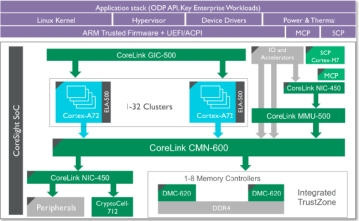
ARM Announces New Bus Interconnect and Memory Controller Technology
ARM has announced new bus interconnect and memory controller technologies that can meet requirements for scalability, performance, and efficiency across diverse fields including 5G, data center infrastructure, high-performance computing (HPC), automotive, and industrial systems. The newly announced ARM® CoreLink® CMN-600 Coherent Mesh Network interconnect and CoreLink DMC-620 DDR controller enable the development of the latest ARM-based SoCs that deliver unparalleled data processing capabilities and the shortest latency in the market.
2016.09.30by 신윤오 기자
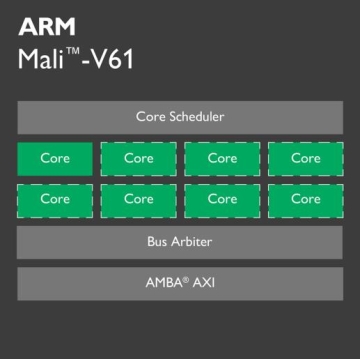
ARM Announces New Processor for Enhanced Mobile VR and 4K Streaming
ARM announced two new processors designed to meet the demands of Gen Z and mainstream users seeking more immersive and interactive visual content experiences on mobile devices. ARM unveiled the Mali-V61 VPU (Video Processing Unit), which delivers breakthrough real-time 4K120 video performance with superior efficiency and scalability, and the Mali-G51 GPU (Graphic Processing Unit), which offers the best performance per unit area and energy efficiency among GPUs released to date.
2016.11.08by 신윤오 기자
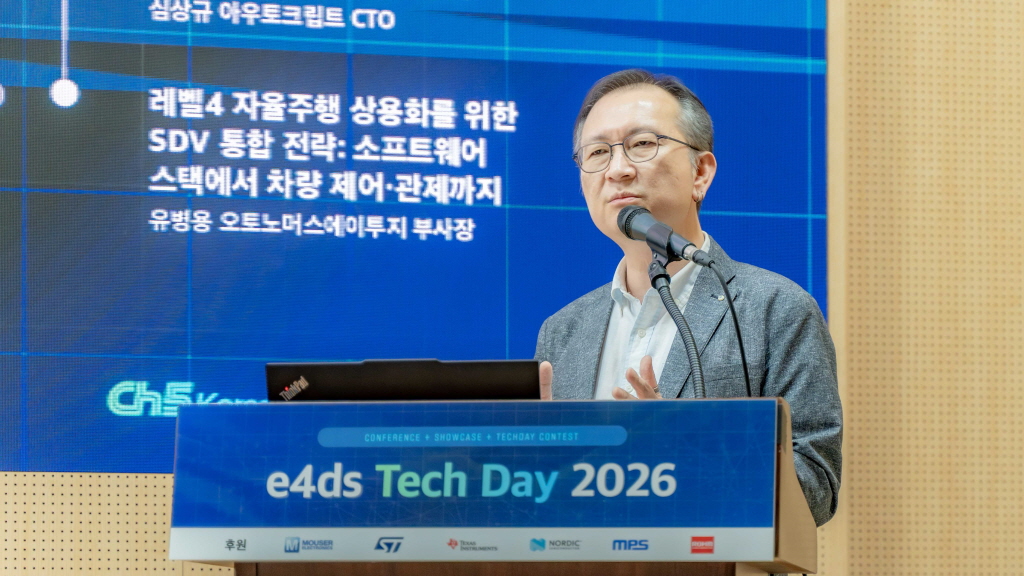
[e4ds Tech Day 2026 ⑨] Sim Sang-gyu, Autocrypt CTO: "In the Physical AI Era, Automotive Security Must Extend Beyond the Vehicle"
At e4ds Tech Day 2026, Sim Sang-gyu, CTO of Autocrypt, explained automotive cybersecurity strategies in the era of Physical AI and SDV (Software-Defined Vehicle). Automobiles are evolving as part of an ecosystem connected to AI, cloud, chargers, IoT, and robots, and he emphasized that the scope of security must expand beyond the vehicle interior to the entire connected environment. In particular, AI model tampering, adversarial attacks, OTA updates, and EV charger hacking were identified as major threats. He explained that response measures require zero trust, AI model integrity protection, intrusion detection, Security by Design and Default, and full lifecycle security management, and that proactive security system establishment beyond regulatory compliance is critical for securing future mobility competitiveness.
2026.10.12by 배종인 기자

Practical HIL Construction Strategy for Automotive and Off-Highway Controller Validation
As vehicle E/E architecture transitions to zonal structures and shifts to software-defined vehicles (SDV), the number of controllers (ECUs) requiring validation and software complexity are surging dramatically. Meanwhile, real vehicle testing cannot provide repeated verification under identical conditions and entails lead time and safety concerns. This white paper explains the principles of HIL (Hardware-in-the-Loop) validation and the structure of the NI platform composed of PXI, SLSC, and VeriStand, and through two actual implementation cases—Camera Record & Replay HIL for In-Cabin Monitoring Controller (ICMU) and Forklift Controller (VCU) HILS—describes how controller-level regression testing becomes possible. Additionally, it explicitly states application boundaries and limitations, such as lack of A2B support.
2026.10.12by 편집부
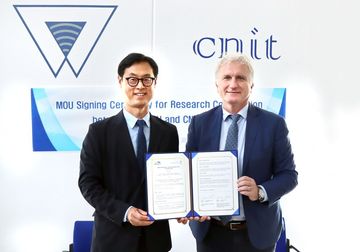
Korea Automotive Research Institute Signs MOU with Italy National Institute for Wireless Communications
The Korea Automotive Research Institute will sign an MOU with Italy's National Institute for Wireless Communications and launch joint research on next-generation mobility technologies based on 6G, V2X, and connected vehicles. The two organizations will conduct research to apply advanced wireless communication technologies to vehicles and discover international joint projects to advance next-generation connected vehicle technology development.
2026.10.12by 배종인 기자











