


Sogang University's wearable "Angelex" has advanced to the finals of the World Robot Design Competition.
 Published2017.02.16 17:12
Healthcare service functions are also possible
The wearable robot 'Angelex' developed by Professor Kyung-chul Gong's team from the Department of Mechanical Engineering at Sogang University using Dassault Systèmes' SolidWorks program has advanced to the finals of the robot design competition 'UAE Robotics for Good'. Angelex was selected as one of nine finalists out of over a thousand participating robots.
Angelex, a wearable robot for the elderly who experience inconvenience in daily life due to incomplete paralysis and muscle weakness, can walk without a special cane, and its functions have been improved, such as the use of zero-resistance drive technology that prevents the wearer from feeling the weight and resistance of the robot, and the use of IoT technology to provide pedestrian health management services.
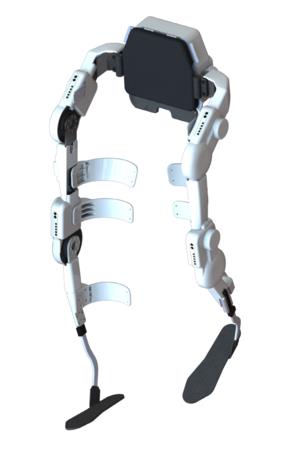
▲ 'Angelex', a wearable robot developed using Dassault Systèmes' SolidWorks program.
With the robotics market attracting significant attention, the achievements of Professor Gong Kyung-chul's team are expected to serve as a major opportunity to showcase Korea's robotics technology on the global stage.
The robotics market, valued at $71 billion as of 2015, is growing at an annual rate of over 17%, and leading countries in the robotics industry are already moving quickly to ease regulations and provide government support. Indeed, Japan announced its robotics market strategy in January of last year and announced plans to deploy 9.4 million wearable robots by 2025 to assist the elderly.
Comments
Related news
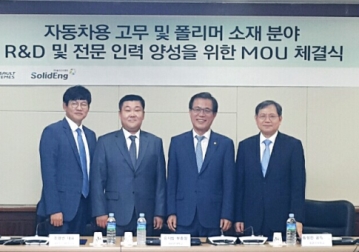
Dassault Systèmes conducts industry-academia joint research on automotive component and material technology development
Dassault Systèmes Korea (CEO Cho Young-bin) held an MOU (Memorandum of Understanding) signing ceremony today at Sungkyunkwan University's Second Engineering Building (President Chung Kyou-sang) and Solid Engineering Co., Ltd. (CEO Kim Hyung-gu) for research and technology development in automotive rubber and polymer materials, as well as specialized workforce development. In accordance with this agreement, Dassault Systèmes Korea plans to significantly strengthen mutual cooperation with Sungkyunkwan University and Solid Engineering for the advancement of the rubber and polymer industry, and to lead in research and technology development. Additionally, the company plans to provide substantial and continuous support for cultivating experts for long-term industry development.
2016.07.28by 홍보라 기자
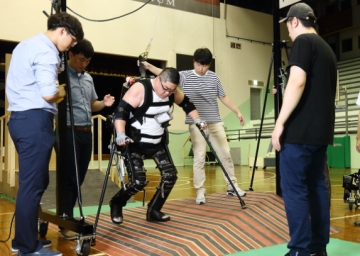
Dassault Systèmes Partners with Sogang University to Develop Wearable Robots
Dassault Systèmes (www.3ds.com) has signed an MOU (Memorandum of Understanding) with the Department of Mechanical Engineering at Sogang University to promote the development of wearable robots. The MOU signing ceremony, held at Sogang University, was attended by Ken Clayton, Global Executive Vice President of SOLIDWORKS, Professor Lee Chul-soo, Chair of the Department of Mechanical Engineering at Sogang University, and Director Kim Seok-chan of CubicTek (www.cubictek.co.kr), a SOLIDWORKS partner company, among other relevant parties, who pledged continued cooperation for the development of wearable robots in Korea.
2016.09.12by 홍보라 기자
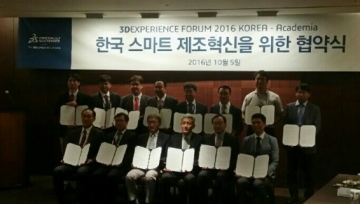
Dassault Systèmes partners with domestic companies and universities to expand smart manufacturing
Dassault Systèmes Korea, the Korea Smart Manufacturing Industry Association, and 11 major domestic universities signed an "Agreement for Korean Smart Manufacturing Innovation" at the Shilla Hotel in Jung-gu, Seoul on the 5th. Through this agreement, Dassault Systèmes plans to take the lead in cultivating talent aligned with the direction of manufacturing innovation needed by educational institutions and companies in Korea during the era of the Fourth Industrial Revolution, and in developing various industry-academia technology cooperation models.
2016.10.11by 김수지 기자
ESP32 Development Environment Selection and GPS Application Implementation
The ESP32 is a microcontroller that integrates Wi-Fi, Bluetooth, 12-bit ADC, capacitive touch, PWM, DAC, and UART in a single SoC. However, the abundance of features does not by itself solve the designer's problems. The real challenges lie in selecting the appropriate development environment, determining which pins can be used and which must be avoided, and converting raw data from modules into usable information. This document addresses ESP32 peripheral constraints (ADC2 and Wi-Fi coexistence limitation, UART1 occupancy, ADC non-linear regions), the trade-offs between Arduino IDE and ESP-IDF, and the process from connecting NEO-6M/NEO-M8N GPS modules to UART2, parsing NMEA sentences, and visualizing routes in Google Earth, all organized based on documented references.
2026.10.12by 편집부
MIPI CSI-2, DSI-2, C-PHY, D-PHY Test Solution Technical White Paper
The MIPI interface adopts a burst mode that transitions between low-power (LP) and high-speed (HS) states for low-power consumption, and in return, strict timing rules are imposed on state transitions. Additionally, the high-speed section operates as a packet-based protocol with headers, ECC, and CRC, so verification engineers must handle waveforms and protocols simultaneously. Traditional configurations combining general-purpose oscilloscopes and AWGs reveal limitations in setup complexity, measurement uncertainty, and lack of reproducibility when faced with these requirements. This white paper, based on webinar materials, organizes the structure of this problem and describes how the SV5C-DPTXCPTX generator for receiver testing and SV5C-DPRXCPRX analyzer for transmitter testing integrate state transition testing, stressed eye testing, and protocol analysis into a single bench, along with their application boundaries.
2026.10.12by 편집부











