


LGU+ Holds Business Briefing Ahead of NB-IoT Commercialization
 Published2017.02.22 12:15
Plan to commercialize equipment and technology developed in-house at the Open Lab
LG Uplus held a business briefing at its Yongsan headquarters on the 21st ahead of the commercialization of NB-IoT (NarrowBand-Internet of Things).
This briefing session was held with the purpose of enhancing partners' understanding of the business and establishing the relevant ecosystem and market at an early stage by providing a venue to share business promotion strategies and partner support plans.
The event was attended by key LG Uplus executives involved in NB-IoT, including Executive Vice President Ahn Seong-jun, Head of the IoT Division, and Senior Vice President Kwon Jun-hyeok, Head of Industrial and Public IoT, as well as Huawei’s Vice President of Solution Sales Korea, Yefangcheng, who decided to provide 100,000 chipsets and modules to partner companies free of charge. Presentations followed, focusing on network interconnection technical support plans, business direction and service models, and case studies of overseas commercial operators.
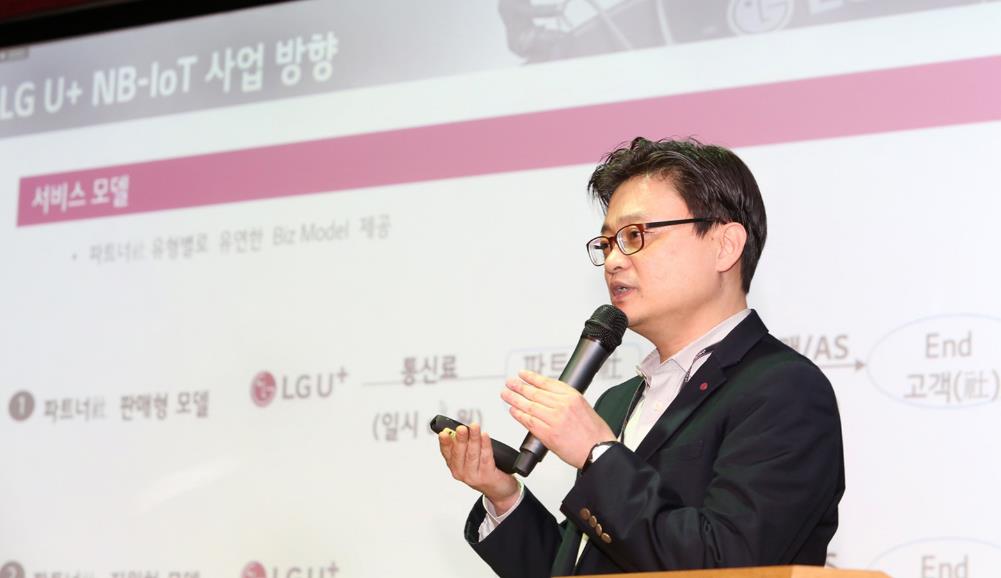
▲ An LG Uplus employee explaining business strategy to partner company officials.
At the briefing, Ahn Seong-jun, Executive Vice President and Head of the IoT Division at LG Uplus, stated, “Base stations in the Seoul and metropolitan areas are currently ready to provide NB-IoT services once government administrative procedures are completed,” adding, “We will take the lead in creating a new ecosystem by securing seamless IoT coverage nationwide in the future.”
Huawei, a global network equipment company, has been supplying LTE wireless base station equipment to LG Uplus since 2013 and has also actively supported the development of technologies such as '4*4 MIMO' and '256 QAM'. In addition, an Open Lab was opened at the LG Uplus Sangam headquarters at the end of last year, and a cooperative relationship has been maintained for several years.
LG Uplus plans to hold a series of events, starting with a business briefing, followed by business contests and hackathons, to accelerate the early adoption of NB-IoT in Korea. Huawei stated that it will sequentially supply NB-IoT chipsets and modules to partner companies starting in April, when the commercialization of dedicated networks in Korea is expected, and will actively support the commercialization of ideas generated through open labs and contests.
NB-IoT is suitable for communicating with objects over long distances of more than 10km with low power consumption, so LG Uplus plans to utilize this technology to first promote pilot projects for city gas meter reading and water metering, and later provide services such as cargo tracking and logistics management.
The NB-IoT Open Lab plans to provide total care services, including support for testing personnel and sales channels from the planning stage, to enable partner companies—such as terminal, service solution, and system integrator firms—to verify their self-developed equipment and technologies through network interoperability testing and to commercialize them. A dedicated website will also be launched next month to allow partners to use the Open Lab more systematically and conveniently.
Comments
Related news
LG Uplus: "We will secure global competitiveness through NB-IoT commercialization"
"Home IoT is targeting one million subscribers next year, and we plan to complete the nationwide NB-IoT (NarrowBand-Internet of Things) network by the end of next year to further accelerate our IoT business." An Sung-joon, Executive Vice President of LG Uplus' IoT Business Division, took the stage as a keynote speaker at the '2016 Global Mobile Broadband (MBB) Forum' held in Tokyo, Japan on the 24th and presented 'The IoT World LG Uplus Envisions,' announcing the company's future strategy to secure global competitiveness through the commercialization of NB-IoT.
2016.11.24by 신윤오 기자
Telit Focuses on NB-IoT Meter Reading Services and Automotive Market
Telit, a specialist in IoT (Internet of Things) modules and platform services, has presented a strategy to strengthen its presence in the IoT market. Kim Hee-chul, General Manager of Telit's Korea Sales Division, stated, "Recently, mobile carriers are building nationwide NB-IoT networks and preparing for commercialization, so Telit is also developing NB-IoT modules based on various chipset solutions," and added, "Accordingly, we will pursue a win-win strategy that drives business growth by targeting gas, water, and electricity meter reading services and vehicle management fields, which are suitable for long-distance object communication with low power consumption." Telit has presented its domestic market investment strategy, which includes launching LTE Cat 1 SKT modules, developing modules in preparation for NB-IoT (narrowband IoT) commercialization, and strengthening automotive business models.
2017.02.06by 서아람 기자
KT and ETRI succeed in developing NB-IoT terminal technology
KT announced that it has successfully developed 'NB-IoT' terminal technology that can provide Internet of Things services over wide areas with low power consumption through technical collaboration between ETRI (Electronics and Telecommunications Research Institute) and small and medium-sized enterprises. KT provided an open IoT service platform and terminal verification environment, while ETRI was responsible for NB-IoT system design.
2017.02.16by 김지혜 기자
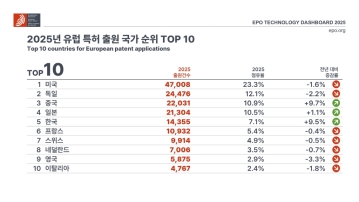
European Patent Applications Surpass 200,000 for the First Time… South Korea Maintains 5th Place, Led by Batteries and Telecommunications
According to the European Patent Office (EPO)'s 'Technology Dashboard 2025', European patent applications last year reached 201,974, surpassing 200,000 for the first time. Korean companies and inventors filed 14,355 applications, representing a 9.5% increase from the previous year and maintaining 5th place by country. Battery, digital communication, and semiconductor technologies led the growth, with Samsung ranking as the top EPO applicant for the second consecutive year and LG reaching 3rd place. The presence of major domestic cities such as Seoul, Suwon, and Yongin was also confirmed. It was also revealed that Korea's European patent strategy is expanding beyond individual technologies to span the entire industry.
2026.03.24by 명세환 기자

SK Telecom First Applies AI-Based Network Operations at Gwanghwamun K-Pop Concert
SK Telecom announced that it applied an AI-based network operation system for the first time at a large-scale K-pop concert held in the Gwanghwamun area of Seoul on March 21st, managing communication quality throughout the event. Mobile data usage during the three hours before and after the concert reached 12.15TB, approximately doubling compared to the same time slot the previous weekend. SK Telecom monitored traffic using the AI system 'A-One' in five-minute and 50-meter units to respond to potential overload situations, while also operating temporary communication facilities and on-site personnel in parallel. This case is interpreted as confirmation of the practical applicability of AI-based autonomous network operation in an environment where demand from dense events and foreign users increases simultaneously.
2026.03.23by 명세환 기자











