



To succeed in starting a business, target local government programs with substantial support.
 Published2017.03.06 19:00
As finding employment becomes more difficult and unemployment rises, interest in starting a business is expanding. According to the Small and Medium Business Administration, those in their 40s and 50s accounted for the largest share of newly established corporations this year, at 63.3%. Furthermore, the number of corporations founded by women is increasing more than that of men. We have now entered an era where people of all ages and genders are considering starting a business.
The 'Korea Startup & Innovation Festival,' held on the 28th of last month and hosted by the Ministry of Science, ICT and Future Planning and the Small and Medium Business Administration, perfectly reflected the recent enthusiasm for startups.
Various programs were held at this event, including a venture investment presentation (IR), a venture investment convention (investment consultation), a corporate poster session, an exhibition of university-based startup support programs and success stories, a crowdfunding competition, a university startup team competition and an integrated briefing session for major startup competitions, and a conference.
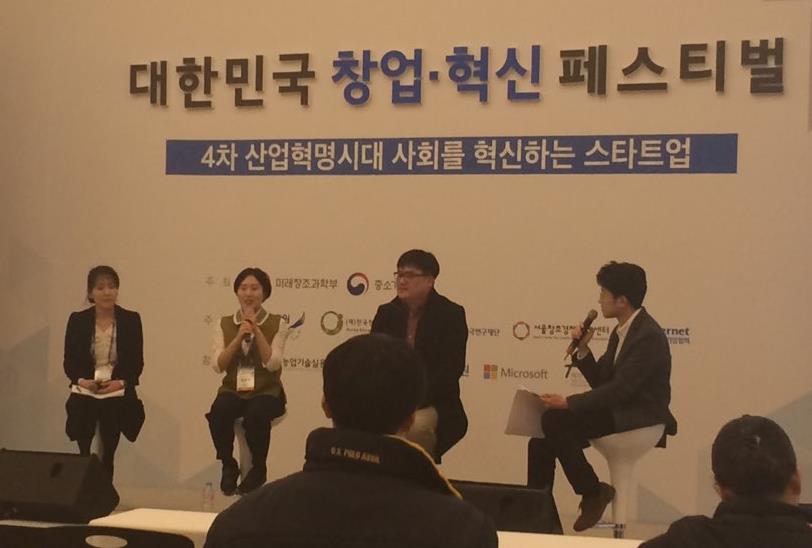
The Venture Investment Convention was organized to provide investment and networking opportunities by matching venture capital (VC) firms, which are struggling to find investment targets, with promising small and medium-sized enterprises and venture companies. To expand the venture boom, the government plans to hold venture investment conventions every quarter this year, twice in the metropolitan area and twice in the provinces.
250 startups recruited through regional SME offices and Creative Economy Innovation Centers met with approximately 150 venture capital analysts at about 50 consultation booths to introduce their products and services and receive one-on-one mentoring on preparations for securing investment. In addition, a poster session held within the consultation hall featured exhibitions showcasing the startups' products and strengths, as well as Q&A sessions.
The exhibition also featured startup displays based on science and technology developed through university research. Fifteen exhibition booths, including Nano Future Life, Windamp, Ebenezer K, Green Mobility, and Goodbros, showcased products and services from domestic startups with outstanding technological achievements.
In the international conference room, updates on the integrated progress, improvements, and schedules for various startup events, such as contests and competitions that had previously been held sporadically, were provided. Detailed event schedules were announced to ensure that contests and startup competitions hosted by both the government and the private sector are held weekly during the first half of the year.
Strengths are O2O, e-commerce, and content... Must challenge fields with clear markets.
Kim Jong-yoon, Vice President of Yanolja, and Kim Tae-ho, CEO of Poolus, who participated in the subsequent conference on the startup innovation ecosystem of the 4th Industrial Revolution era, gave presentations on how they are preparing for the 4th Industrial Revolution era. In Part 2, the startup growth stories of Baemin Fresh CEO Jo Seong-woo, Spoka CEO Choi Jae-seung, and Red Tie CEO Jeong Seung-hwan continued, detailing how they turned their ideas into businesses.
In the final third part, a talk was held on 'Development Directions for Promising Early-Stage Startups and Innovation in Korea's Startup Ecosystem,' featuring CEO Kim Kuk-hyun of Editoi, CEO Moon Jun-seok of InSquare, CEO Kang Mi-sook of Ebenezer K, and Kim Sun-woo, Director of the Innovation Enterprise Research Center at the Science and Technology Policy Institute.
"Since 2015, as the startup ecosystem has become popularized, anyone can now become an investor through crowdfunding," said Center Director Kim. "Korea's strengths are O2O (Online to Offline), e-commerce, and content," he added, advising entrepreneurs to take on challenges in fields with clear markets.
CEO Moon, who shared his experience of founding a business in Gwangju and introduced the pros and cons of starting a startup in a provincial area, encouraged entrepreneurship in the provinces, stating, “Competition for support is less fierce than in the capital area. If you visit a regional development agency first, it is easy to access and they provide active assistance. You can aim for a blue ocean with items based in the region.” He added, “The downside is that it is difficult to recruit new employees due to a shortage of skilled personnel. However, they do provide training support.”
We must enter an era of true job creation where starting a business is as enjoyable as a hobby.
CEO Kang advised, “It is helpful to have your idea validated for market viability in programs with judges, and to prepare by listing the advice and questions you hear from VCs or experts.” He added, “There are also many programs supported by local governments in the metropolitan area.” "There are many places that provide office space, so it is good to save on fixed costs," he added.
Finally, the panelists expressed their hope that the structure would become more accessible to startups by reducing the co-payment for government support programs, and their expectation for a true era of creative work where starting a business is treated like a hobby rather than work by guaranteeing a basic income.
Kim Sun-woo, Director of the Innovation Enterprise Research Center at the Science and Technology Policy Institute, stated, “We must prepare by thinking that the future is the era of job creation,” and emphasized to those preparing to start a business, “To prepare for the times, you must be able to handle diverse situations rather than specializing in just one field, and you must become technology-friendly.”
Comments
Related news

[Discussion Broadcast] "Small and Medium Enterprises Are the Driving Force of the Fourth Industrial Revolution Transformation; Must Possess Digital Capabilities and Leadership Capabilities"
The business environment has begun to change with the development of new digital technologies such as social networks, mobile, big data, and AI. Now, a company's capabilities are often measured by its ability to utilize digital technology. Loa Consulting defines Digital Transformation as "the collective term for the phenomenon of transitioning from traditional business methods of existing manufacturing enterprises to ecosystem-centered platform business models capable of acquiring new value," and it has been presented as a solution to the Fourth Industrial Revolution era. The Korea Information Industry Association held its 2017 IT Policy Forum on the 24th at the COEX Conference Room under the theme "Fourth Industrial Revolution, Digital Transformation is the Answer." We are broadcasting a live discussion held under the theme "Capabilities of Domestic Companies and National Policy Direction in the Era of Digital Transformation."
2017.01.31by 김지혜 기자
What are the government's proactive startup policies?
The Ministry of Science, ICT and Future Planning (hereinafter referred to as the Ministry) held a government business report meeting on future growth engine sectors on January 6th and announced the '2017 Ministry Work Implementation Plan.' To strengthen the startup ecosystem, the Ministry plans to establish 'customized specialized projects' that reflect regional demand and promote technology transfer from regional universities and government-funded research institutes. Additionally, the Ministry announced plans to diversify investment methods, provide close support to promising and venture companies, promote public technology-based businesses, and operate an 'Overseas Investor Support Center' to expand overseas contact points.
2017.02.21by 김지혜 기자
Nvidia invests $5 billion in Intel
NVIDIA and Intel, leaders in global AI computing technology, are now forging ahead in providing cutting-edge solutions through NVLink-based architecture integration. NVIDIA and Intel have officially announced a strategic partnership and stated that they will jointly develop customized data center and personal computing products to accelerate diverse applications and workloads ranging from hyperscale to enterprise and consumer markets, thereby laying the foundation for the next generation computing era.
2025.09.22by 배종인 기자
.jpg)
Applied Materials Launches Environmental Protection Campaign to Mark World Cleanup Day
Applied Materials Korea (CEO Park Kwang-seon) is carrying out environmental cleanup activities with employees and their families around the Dongtan Sinricheon area on the occasion of World Cleanup Day, evolving into a company that engages with the local community beyond technological innovation.
2025.09.22by 명세환 기자
.jpg)
The combination of electrical and electronic technologies like AI, semiconductors, and electric vehicles with renewable energy will determine industrial competitiveness.
Professor Lim Chun-taek from Gwangju Institute of Science and Technology (GIST) stated in his keynote speech at the '2025 e4ds Tech Day' on the 9th, "Global energy investment is already shifting from fossil fuels to renewable energy, and the trend of electrification combined with electrical and electronic technologies is changing the industrial landscape."
2025.09.12by 배종인 기자











