


Will Biometrics Become the Killer Application for Healthcare Wearable Devices?
 Published2017.03.20 12:41
MIT Technology Review, a technology magazine published by the Massachusetts Institute of Technology (MIT), announced 10 innovative technologies to watch in 2017. One of them is facial recognition payment technology (Paying with Your Face).
MIT Technology Review reported that China is a leader in facial recognition technology, which is attracting attention as a next-generation biometric technology. China stated that it can already use facial recognition to distinguish people entering buildings, track criminals, and even make payments.
The development of facial recognition technology in China is driven by government surveillance. Face++, a Chinese startup, distinguishes differences in captured faces using 83 dots. This technology is being applied across banking, retail, and transportation services. The mobile payment app Alipay allows users to authenticate via face to send or transfer money. Furthermore, Didi Chuxing, a ride-sharing company often referred to as China's Uber, utilizes Face++'s software to enable passengers to verify if a driver is legitimate. During the authentication process, users must move their faces to prevent photo-based deception.
In Korea as well, following the application of fingerprint recognition to smartphones, the introduction of iris recognition in the Galaxy Note 7 became a hot topic for a time. As the adoption of biometrics in real life accelerates, in which fields is it currently being applied?
Biometrics refers to a technology that identifies or authenticates individuals by extracting physical characteristics such as fingerprints, irises, retinas, veins, and faces, as well as behavioral characteristics such as voice, handwriting, gait, and body shape, using automated devices. Identification involves finding one person out of many, while authentication involves verifying whether something is correct based on existing information; thus, the two are distinguished.
Dr. Lee stated, “Since wearables are worn at all times, a vast amount of biometric information can be obtained.” He added, “I believe we should move forward in a direction that encompasses all technologies for authenticating signals, rather than using that vast amount of information solely for authentication purposes.”
Wearables that assist patients' rehabilitation and share biometric information
In the healthcare sector, biometric authentication, which was previously used only for employee authentication, is moving in the direction of being used to authenticate patients. To do so, collecting diverse medical information and continuously gathering and maintaining data for each patient presents the issue of authentication regarding whether the patient is the same person. There are also privacy issues.
Now, biometrics is moving beyond simply identifying a person using biometric information in mobile healthcare and medical monitoring to utilizing that person's medical information. In other words, biometrics, wearables, and healthcare are combining.
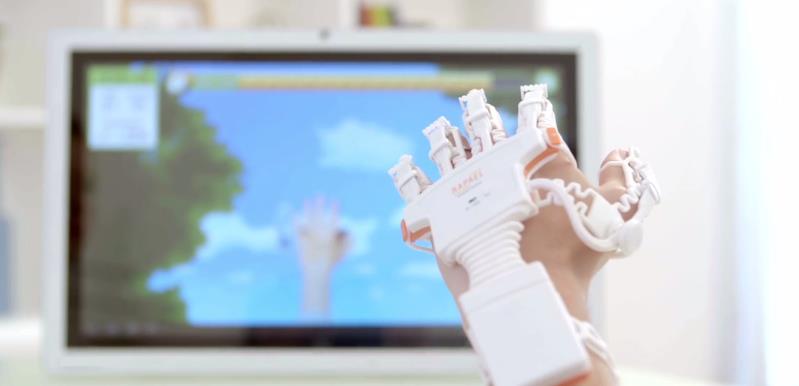
Neofect's 'Raphael' is a case in point. The Raphael Smart Glove assists in the rehabilitation of patients suffering from paralysis caused by stroke. It is a technology based on 'brain plasticity,' which allows other brain cells to take over the function of parts of the brain even if they have died, through rehabilitation therapy. Patients wear the Raphael Smart Glove and connect to an app via Bluetooth to train by repeatedly performing movements similar to real-life actions through games. A cloud service is currently under development to enable patients, medical staff, and caregivers to share the patient's training data.
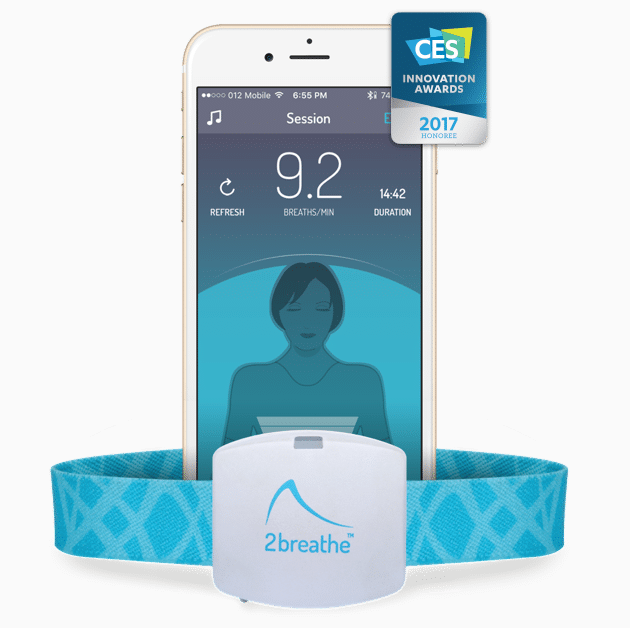
At CES 2017 held at the beginning of the year, products that store biometric information using wearable devices and apply it to healthcare also attracted attention.
Rotex has unveiled a biometric therapeutic electronic tattoo. The electronic tattoo is a biometric sensor as thin and light as a hair that can be attached to a user's skin to analyze body temperature, respiration, and more. Proteus's Proteus Discover is an ingestible sensor that enables the monitoring of health patterns and drug treatment effectiveness for patients with hypertension or diabetes. 2breathe by 2breathe Technologies measures respiration when worn around the waist while sleeping to guide users toward breathing optimal for sleep. It is a device designed to reduce blood pressure and stress, helping users maintain regular sleep patterns. MOTIV showcased a ring-shaped device, moving away from the traditional bracelet form factor. By reducing the device's size to improve comfort, it added convenience through waterproofing and extended battery life.
Dr. Lee of Neofect expressed his expectations, stating, “There are no accuracy standards for medical device certification, and in Korea, medical information cannot be released from hospitals. Therefore, we are currently collecting basic patient data, but in the future, we will be able to predict diseases through lifestyle habits obtained via wearable devices.”
Comments
Related news
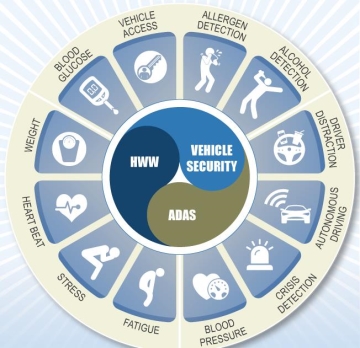
One in three new cars will be equipped with bio-wearable technology.
Frost & Sullivan has released the "Biometrics in the Global Automotive Industry, 2016-2025" analytical report. Advances in biometric technology will significantly transform the driving experience, health wellness and wellbeing (HWW), and automotive security. One in three new vehicles will be equipped with functionalities such as fingerprint recognition, iris recognition, voice recognition, gesture recognition, heart rate monitoring, EEG monitoring, stress detection, fatigue monitoring, eyelid monitoring, facial monitoring, and pulse detection.
2017.01.02by 신윤오 기자
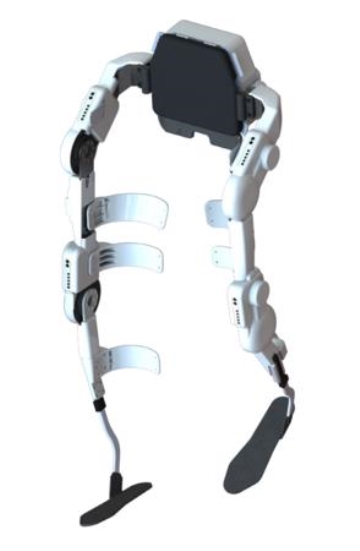
Sogang University's wearable "Angelex" has advanced to the finals of the World Robot Design Competition.
A wearable robot named 'AngelEx' developed by Professor Kong Kyung-chul's team at the Department of Mechanical Engineering at Sogang University using Dassault Systèmes' SolidWorks program has advanced to the finals of 'UAE Robotics for Good,' a robot design competition. AngelEx was selected as one of 9 finalists among approximately 1,000 participating robots. AngelEx is a wearable robot designed for elderly people and those with reduced mobility experiencing inconvenience in daily life due to incomplete paralysis and muscle weakness. It enables walking without the need for a specialized cane and features enhanced functionality through non-resistive actuator technology—which ensures the wearer does not feel the robot's weight and resistance—and integrated IoT technology for pedestrian health status management services.
2017.02.16by 서아람 기자
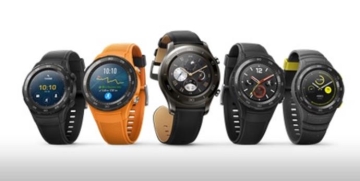
Huawei Unveils Smart Fitness Watch Redefining Wearables at MWC 2017
Huawei Consumer Business Group has defined a new category of wearable technology with the HUAWEI WATCH2 on the 26th (local time) at Mobile World Congress 2017, which is being held in Barcelona. Leveraging Huawei's latest research findings and development as a technology innovation company, the watch implements a stylish and classic wristwatch that integrates smartphone connectivity, smart living applications of a premium smartwatch, and detailed motion coaching and tracking of a leading sports tracking device.
2017.02.28by 신윤오 기자
ESP32 Development Environment Selection and GPS Application Implementation
The ESP32 is a microcontroller that integrates Wi-Fi, Bluetooth, 12-bit ADC, capacitive touch, PWM, DAC, and UART in a single SoC. However, the abundance of features does not by itself solve the designer's problems. The real challenges lie in selecting the appropriate development environment, determining which pins can be used and which must be avoided, and converting raw data from modules into usable information. This document addresses ESP32 peripheral constraints (ADC2 and Wi-Fi coexistence limitation, UART1 occupancy, ADC non-linear regions), the trade-offs between Arduino IDE and ESP-IDF, and the process from connecting NEO-6M/NEO-M8N GPS modules to UART2, parsing NMEA sentences, and visualizing routes in Google Earth, all organized based on documented references.
2026.10.12by 편집부

MIPI CSI-2, DSI-2, C-PHY, D-PHY Test Solution Technical White Paper
The MIPI interface adopts a burst mode that transitions between low-power (LP) and high-speed (HS) states for low-power consumption, and in return, strict timing rules are imposed on state transitions. Additionally, the high-speed section operates as a packet-based protocol with headers, ECC, and CRC, so verification engineers must handle waveforms and protocols simultaneously. Traditional configurations combining general-purpose oscilloscopes and AWGs reveal limitations in setup complexity, measurement uncertainty, and lack of reproducibility when faced with these requirements. This white paper, based on webinar materials, organizes the structure of this problem and describes how the SV5C-DPTXCPTX generator for receiver testing and SV5C-DPRXCPRX analyzer for transmitter testing integrate state transition testing, stressed eye testing, and protocol analysis into a single bench, along with their application boundaries.
2026.10.12by 편집부











