


NI Successfully Demonstrates Real-Time OTA Prototype for 28GHz Verizon 5G
 Published2017.04.06 09:36
Application of real-time code modifiable at base stations and user equipment
National Instruments (NI) publicly demonstrated a real-time Over-the-Air (OTA) prototype in the 28GHz band based on Verizon's 5G specifications at the IEEE Wireless Communications and Networking Conference (WCNC) held in San Francisco, USA.
This system utilizes hybrid beamforming and independent subframes to use OFDM with eight component carriers in a 2x2 downlink MU-MIMO setup, achieving a throughput of up to 5 Gb per second and scalable to over 20 Gb per second with eight MIMO streams.
The developers developed this prototype using NI's mmWave transceiver system, a new version of the RF mmWave head operating at 28 GHz, and a phased array antenna developed by Anokiwave and Ball Aerospace.
28GHz is a major frequency band designated by Verizon and its partners for distribution in the United States. This prototype system was written entirely in LabVIEW system design software, and modifiable real-time code was applied to both the base station and user equipment (UE or CPE).
James Kimery, Director of RF Research and SDR Marketing at NI, said, “This prototype demonstrates the powerful performance of the NI platform. With this platform combining hardware and software, researchers can now rapidly prototype new wireless standards and obtain results faster. Additionally, by prototyping and testing based on Verizon 5G specifications, they can immediately deploy 5G NR (New Radio) as soon as the standard is established.”
Comments
Related news

NI and the University of Texas at Austin Partner on Autonomous Driving Research and Testing
National Instruments (hereinafter NI) has announced a partnership with the Situation-Aware Vehicular Engineering Systems (hereinafter SAVES) initiative at the University of Texas at Austin. NI will supply an mmWave real-time testbed to accelerate research in vehicle automation and autonomous driving. This testbed is expected to play an important role in advancing autonomous vehicles by focusing on very low latency, novel radar waveforms, and data analysis.
2017.03.24by 김지혜 기자

KT Successfully Makes Hologram 5G Call Between Gwanghwamun and New Jersey
KT announced on the 3rd the results of 5G cooperation with US telecommunications company Verizon and stated that the two companies would continue cooperation in 5G services. At the meeting, the two companies successfully demonstrated hologram video calls between Gwanghwamun and New Jersey through global interoperability of 5G networks, showcasing the achievements of 5G cooperation and presenting a new paradigm for 5G business models both internally and externally. This was accomplished through continuous joint cooperation between KT and Verizon in the 5G sector since last year. The two companies have been jointly establishing 5G radio access technology standards that define interoperability between terminals and base stations, including frequency and transmission methods, since February of last year. They plan to complete the hardware standards specification shortly and will discuss specifications in the software field.
2017.04.04by 김자영 기자
SKT, Finding 5G Direction with Partners
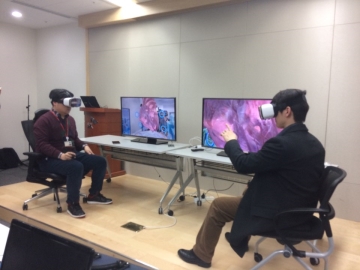
SK Telecom announced that it has publicly released Korea's first 5G RFI (Request For Information) to formally discuss 5G services and core technologies with domestic and international partners and jointly explore the evolution direction. Based on the RFI released this time, SK Telecom plans to coordinate 5G commercialization plans and opinions with partners and jointly discuss core technologies necessary for commercialization. It aims to present a 5G blueprint together with domestic and international partners and build an ecosystem.
2017.04.05by 김지혜 기자
European Patent Applications Surpass 200,000 for the First Time… South Korea Maintains 5th Place, Led by Batteries and Telecommunications
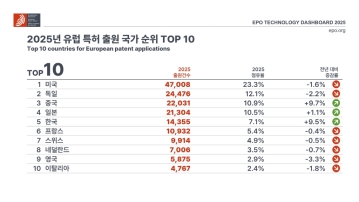
According to the European Patent Office (EPO)'s 'Technology Dashboard 2025', European patent applications last year reached 201,974, surpassing 200,000 for the first time. Korean companies and inventors filed 14,355 applications, representing a 9.5% increase from the previous year and maintaining 5th place by country. Battery, digital communication, and semiconductor technologies led the growth, with Samsung ranking as the top EPO applicant for the second consecutive year and LG reaching 3rd place. The presence of major domestic cities such as Seoul, Suwon, and Yongin was also confirmed. It was also revealed that Korea's European patent strategy is expanding beyond individual technologies to span the entire industry.
2026.03.24by 명세환 기자

SK Telecom First Applies AI-Based Network Operations at Gwanghwamun K-Pop Concert
SK Telecom announced that it applied an AI-based network operation system for the first time at a large-scale K-pop concert held in the Gwanghwamun area of Seoul on March 21st, managing communication quality throughout the event. Mobile data usage during the three hours before and after the concert reached 12.15TB, approximately doubling compared to the same time slot the previous weekend. SK Telecom monitored traffic using the AI system 'A-One' in five-minute and 50-meter units to respond to potential overload situations, while also operating temporary communication facilities and on-site personnel in parallel. This case is interpreted as confirmation of the practical applicability of AI-based autonomous network operation in an environment where demand from dense events and foreign users increases simultaneously.
2026.03.23by 명세환 기자











