


[Planning-Autonomous Vehicles①] Domestic Technology 'Cannot Stand Alone' - Strategic Collaboration Ecosystem Must Be Established
 Published2017.04.10 14:10
Aggressive M&A among semiconductor-related companies to secure platform dominance continues
If there is a technology that best fits the phrase 'dreams have become reality,' it would be autonomous vehicles. You call for a car and it comes on its own, driving itself to the destination. Autonomous vehicles recognize and avoid obstacles during driving while providing various conveniences and information to the owner. While full commercialization of completely autonomous vehicles will take some time, so-called 'semi-autonomous' vehicle technology is becoming increasingly sophisticated. Automobiles with autonomous driving functions have now come deep into our daily lives to the extent that their advertisements are easily seen. This publication will serialize autonomous vehicle planning over 11 installments. Starting with autonomous vehicle industry trends, we will cover semiconductor components, communications, precision mapping, software platforms, artificial intelligence, security, K-City services, and more. We appreciate your generous support. <Editor's Note>
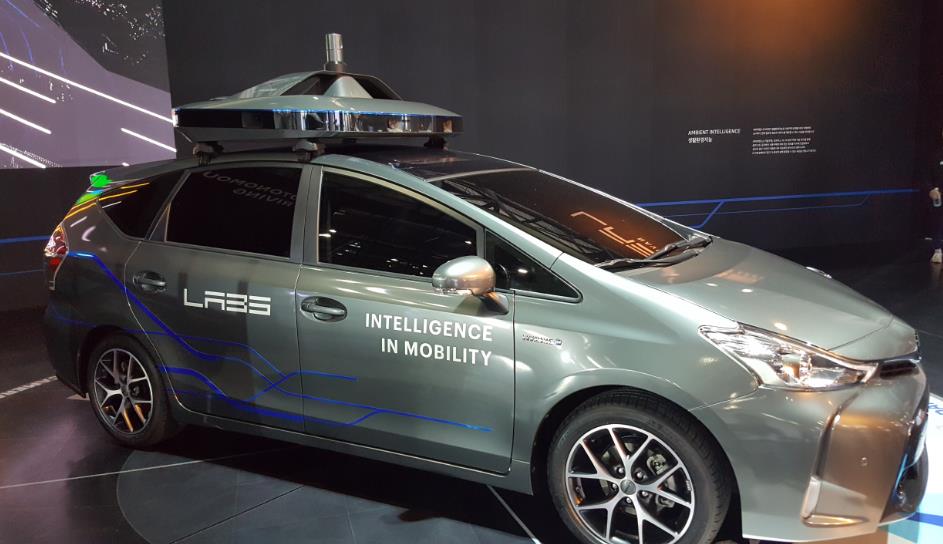
The most striking aspect of the 2017 Seoul Motor Show that concluded last week was the first-time participation of NAVER, a leading domestic IT company. While IT companies developing automobiles is no longer an unfamiliar sight, the appearance of a leading domestic IT company at Korea's representative auto show holds significant symbolic meaning for the automotive sector.
NAVER became the first domestic IT company to receive temporary road-driving approval from the Ministry of Land, Infrastructure and Transport for autonomous vehicles. Presenting a Level 3 autonomous vehicle, NAVER is developing autonomous vehicles as part of environmental implementation with 'living environment intelligence' as its technological direction. Prior to this, Hyundai Motor presented a Level 4 vehicle where the system can safely operate without driver intervention. Hyundai achieved autonomous driving by adding only minimal sensors such as radar and LiDAR to sensors already applied in mass-production vehicles.
The Society of Automotive Engineers (SAE) classifies autonomous driving technology into 6 levels, from 0 to 5. Up to Level 2, such technologies as automatic braking and lane-keeping have been commercialized, but they represent an incomplete autonomous driving stage. From Level 3 onward, vehicles can partially conduct autonomous driving.
Semiconductor companies conducting aggressive M&A to secure platform dominance
Autonomous vehicles must recognize their surrounding environment, plan driving routes, and follow planned paths. This requires various technologies including sensing technology, domain control units (DCU), digital maps, precision GPS, automatic braking, steering systems, and more.
To understand trends in core technologies related to autonomous vehicles, one must examine the movements of semiconductor-related companies. This is because there have been aggressive M&A activities by semiconductor-related companies to secure platform markets. This in turn demonstrates that the proportion of automotive in the global semiconductor market is continuously growing. Looking at major semiconductor companies last year, the top 5 were IT companies focused on communications, mobile devices, PCs, and others. As the automotive semiconductor market is expected to grow continuously at approximately 10% annually, M&A of companies possessing core technologies related to autonomous vehicles is occurring actively.
In the case of radar semiconductors, currently 1-3 units are installed per vehicle, but with autonomous vehicles, 6 or more units per vehicle are expected to be installed. This is expected to increase semiconductor demand. Automotive radar allocated frequencies are 24GHz (200MHz), 77GHz (1GHz), and 79GHz (4GHz). Since 24GHz has poor resolution, it cannot be used in applications requiring high performance. For autonomous vehicles, 77GHz and 79GHz are expected to be used.
Currently, only a few companies worldwide can manufacture 77GHz RF semiconductors: Infineon and NXP Semiconductors (which merged Freescale Semiconductors). Radar RF semiconductors contain ultra-high-frequency analog circuits. VCO and PLL circuit technology to generate and process 77 GHz is required.
In particular, 77 GHz long-range radar RF semiconductors use SiGe compound semiconductors, requiring different-level integration technology. TI (Texas Instruments) and ADI (Analog Devices) are developing based on CMOS. For late-entry companies to enter the radar RF semiconductor industry, acquiring leading companies is the most efficient approach. The case of NXP acquiring Freescale in 2015 and Qualcomm acquiring NXP in 2016, thereby becoming a leader in automotive semiconductors, is a typical example.
Similarly with camera semiconductors, for autonomous driving, a minimum of 5 or more units must be installed per vehicle to achieve 360-degree full coverage detection. Previously, the monitoring camera market was dominant, but currently the multi-functional recognition camera market is showing rapid growth.
Mobileye, an Israeli company, is a leading example of companies commercializing multi-functional camera recognition technology and software. Since Mobileye only designs, ST Microelectronics handles production and manufacturing, while TI mass-produces with Continental's software technology to this extent. The difficulty in recognition semiconductor technology is that cameras are sensitive to environmental conditions, requiring database verification of images by region, weather, illumination, and camera installation position. Nvidia is developing solutions using deep learning methods, but there is a large gap with Mobileye.
Intel acquiring Mobileye expected to focus on map update business
In March, Intel announced plans to acquire Mobileye to enter the automotive market. Additionally, Intel announced it would acquire a 15% stake in map company 'Here'. Maps, once created, require continuous maintenance. To maintain precision map levels, it is efficient to update in real-time using cameras. Since 70% of vehicles have Mobileye cameras installed, the map update business appears to be an area Intel will pursue in the future.
LiDAR is an essential sensor for implementing Level 3 and higher autonomous vehicles. Technically, there are mechanical scanning methods and solid-state scanning methods. Velodyne and IBEO are leading the market with mechanical scanning methods, but trends are expected to shift to solid-state scanning being developed by Quanergy and Infineon in the future.
The second area requiring attention is 5G communication technology and connected vehicles based on it. Currently, DSRC and 4G LTE are used for V2X dedicated communication, but the future will shift to 5G. 5G has fast data transmission rates, enabling transmission of video information inside vehicles and allowing smartphones to be used as terminals communicating with vehicles. Technology to update and download maps in real-time will be possible once 5G is commercialized.
Pay attention to competition for big data and artificial intelligence dominance among Tier 1 companies
Going forward, attention must be paid to competition for big data and artificial intelligence (AI) dominance among Tier 1 companies in the automotive industry. Big data from autonomous vehicles is primarily generated from radars, cameras, and LiDAR, transmitted to DCUs, and connected vehicles transmit location, map information, and information about other vehicles through communication modules to TCUs. DCUs are handled by ADAS companies, and TCUs by infotainment companies. Processing of collected big data is handled by AI, so competition to secure AI dominance within vehicles is expected. Samsung's acquisition of global automotive parts supplier Harman in March was also a strategic move to enter the connected car market.
Once 5G is introduced, not only in-vehicle processing but also the vehicles themselves can enable cloud computing from outside. It may be more efficient for vehicles to send big data to the cloud for processing rather than having in-vehicle terminals process it. With universal adoption of cloud computing expected to progress, IT companies like Google and NAVER are also entering this business. ADAS companies, infotainment companies, and IT companies will engage in fierce competition to secure data.
Maps are indispensable data in autonomous driving and connected vehicles. Infotainment companies possess navigation systems and thus secure maps, but ADAS companies need maps for localization. Map management itself is handled by TCUs, while IT companies manage server storage. Consequently, a certain level of sharing among companies is inevitable.
Efficient collaboration needed in maps, infotainment, and telematics
Finally, since maps, infotainment, and telematics are necessary to implement autonomous vehicles and connected vehicles, the systems are complex and domain knowledge is dispersed. For rapid and efficient collaboration, strategic partnerships led by OEMs are increasing. Unlike previous collaboration between OEMs and Tier 1 companies, collaboration with semiconductor companies, IT companies with information, and map companies is necessary.
Since our country faces difficulties entering the sensor market, we must establish partnerships with global semiconductor companies or acquire leading companies. Regarding maintenance of precision maps, participation in consortiums both domestically and internationally is necessary. To respond to the rapidly changing technological environment of autonomous vehicles and connected cars, a strategic collaboration ecosystem among OEMs, Tier 1&2, semiconductor companies, and ICT companies must be established.
Comments 11
11 Comments:
Related news

[Experience] Experience 5G at the Olympics in Pyeongchang
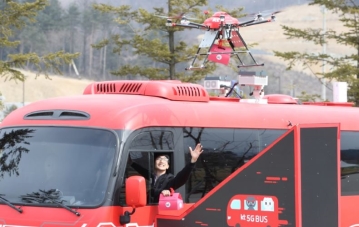
The PyeongChang Winter Olympics is now 332 days away. Following a vision announcement two years ago to showcase the world's first 5G trial service at the PyeongChang Olympics, KT held a press briefing on the 14th (Tuesday) at PyeongChang Alpensia Resort. The event began with a congratulatory video message from the organizing committee chairman and proceeded with demonstrations of autonomous driving 5G buses and drone delivery services, a 'VR Walkthrough' experience of the Olympic torch relay in virtual reality, and the public opening of the PyeongChang 5G Center showcasing four immersive services. The four immersive services are Sync View, Interactive Time Slice, 360° VR Live, and Omni Point View.
2017.03.16by 김자영 기자
[Decisive IT Scene] 5G Bus Receiving Packages via Autonomous Drone
KT (Chairman Hwang Chang-gyu, www.kt.com) provided an opportunity on the 14th to experience 5G-based convergence services to be unveiled at the 2018 PyeongChang Games at the Alpensia Resort in Pyeongchang, Gangwon Province. The company demonstrated a scenario in which a 5G bus driver with both hands free thanks to autonomous driving functionality receives packages delivered by an autonomous drone.
2017.03.14by 김자영 기자

Nvidia Showcases Latest Artificial Intelligence Technology at 'GTC 2017'
Nvidia announced that it will host the eighth GPU Technology Conference (GTC) in May. Particularly, on the third day of the event, Jensen Huang, Nvidia's founder and CEO, is expected to deliver a keynote speech attracting approximately 8,000 attendees. The GTC, held annually, has grown into the world's largest event attended by developers, data scientists, and senior executives in the fields of artificial intelligence (AI), virtual reality (VR), and autonomous vehicles.
2017.04.06by 김지혜 기자
Korean ITS Society Successfully Holds Future Technology Seminar on Autonomous Vehicles
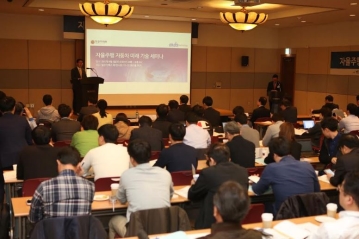
The Korean ITS Society announced that it successfully held a "Future Technology Seminar on Autonomous Vehicles" jointly with MDS Technology. Conditional autonomous vehicles are scheduled to be introduced in 2020, while fully autonomous vehicles are expected to be introduced around 2030. For successful and prompt commercialization of autonomous vehicles, technology development related to autonomous driving, expansion of supporting infrastructure, and institutional improvements are required.
2017.04.06by 김자영 기자

[e4ds Tech Day 2026 ⑨] Sim Sang-gyu, Autocrypt CTO: "In the Physical AI Era, Automotive Security Must Extend Beyond the Vehicle"
At e4ds Tech Day 2026, Sim Sang-gyu, CTO of Autocrypt, explained automotive cybersecurity strategies in the era of Physical AI and SDV (Software-Defined Vehicle). Automobiles are evolving as part of an ecosystem connected to AI, cloud, chargers, IoT, and robots, and he emphasized that the scope of security must expand beyond the vehicle interior to the entire connected environment. In particular, AI model tampering, adversarial attacks, OTA updates, and EV charger hacking were identified as major threats. He explained that response measures require zero trust, AI model integrity protection, intrusion detection, Security by Design and Default, and full lifecycle security management, and that proactive security system establishment beyond regulatory compliance is critical for securing future mobility competitiveness.
2026.10.12by 배종인 기자












좋은 전망입니다.
칩셋과 센서를 먹어야 앞서나가겠지요
멋진 전망이네요.
변화들이 눈에 쏙쏙 들어오니 재미있어요.
인텔? 엔비디아?
협력해야 상생의 길이 보일겁니다.
결국 인텔 아니면 엔비디아에 파트너 십 맺고 하라는 이야기?
멋진 전망이네요.
앞으로의 먹거리 사업, 기대되는군요
멋진데요. ^^
기대되는 사업 분야입니다