



[Interview] Domestic LiDAR Technology Capable of Multi-Channel, 360-Degree Scanning
 Published2017.04.12 18:08
Multi-channel 360-degree scanning lidar demos coming soon
In autonomous driving, sensors play a crucial role in recognizing the surroundings. Among these, LIDAR, often called the "eyes" of autonomous vehicles, can cover blind spots that radar cannot. However, to commercialize Level 3, which allows for partial driving, the challenge lies in lowering its price.
“The number of channels and scan speed are important for LiDAR used in autonomous vehicles because it must respond to accidents that can suddenly occur in vehicles traveling at high speeds,” explained Lee Han-young, a senior researcher at the Smart Sensor Research Center of the Korea Electronics Technology Institute (KETI).
Lidar is a sensor used for industrial precision positioning, defense equipment, and spacecraft, but it has the advantage of being able to obtain precise targeting and accurate distance values using lasers, so it is used not only in autonomous vehicles but also in 3D machine vision for robots and obstacle avoidance driving for drones.
Just as our eyes simultaneously perceive distance information about objects through light from various viewing angles, LIDAR uses laser scanning to achieve this function. To speed up scanning, multiple lasers are used, rather than a single one, and some can rotate 360 degrees depending on the scan range. They are classified into fixed, rotary, single-channel, and multi-channel (4 to 64 channels).
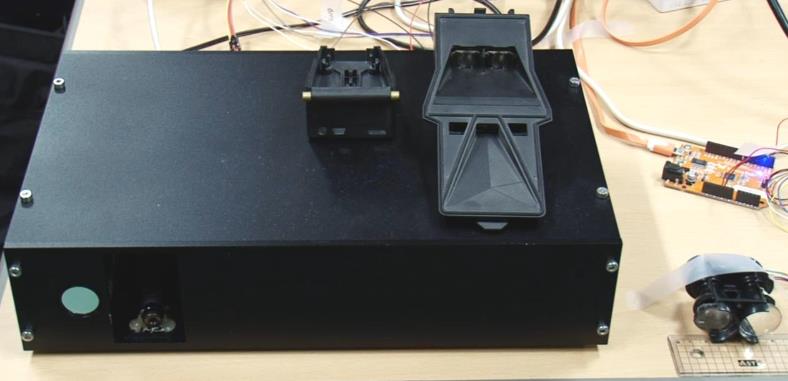
Last year, KETI developed a "scanning lidar optical engine platform" using purely domestic technology, installed it in an actual vehicle, and conducted road tests. The company already has experience transferring laser fence technology, and is currently conducting research on rangefinders with Hanwha Techwin.
The rangefinder is a single-channel lidar without the scanning module found in CCTV. Previously, CCTV cameras had low image resolution, allowing them to observe only close ranges, with autofocus limited to 10 meters. As image sensor resolution increased, accurate focus allowed for data acquisition of distant objects. However, the technology for focusing on distant objects was lacking. KETI is developing a miniaturized device capable of measuring from a distance of 100 meters and designed to fit inside a CCTV dome.
"Our ultimate goal with our final development is to extract object type, information, and distance from scanned data," the researcher said. "This requires expanding the scan range and angle, or developing a LiDAR with multiple channels." "A multi-channel, 360-degree scanning LiDAR is expected to be available for demonstration soon, and is attracting interest from several companies."
Even in Korea, high-end vehicles are being equipped with lidar. Hyundai's Genesis EQ900 features a product manufactured by Quanergy. This component contains eight lasers. The researcher said, “I understand that it is currently being applied to automobiles at around $300, and I believe that as time goes by, the price will come down and lidar will be installed in mid-size cars as well.”
Regarding the difficulties of technology development, this researcher expressed his feelings, saying, “Optical devices are widely used, and since lenses must be molded and injected, even extracting a single sample costs a lot of money.” He also said, “It is difficult to continuously level up the target to differentiate from competing technologies without any actual user requirements. In particular, it is difficult because the financial resources and research facilities are inferior to those of competitors.”
Accordingly, the online seminar (eeWebina) to be held on the 18th will cover the system configuration and standards of LiDAR, design conditions and core design technologies, as well as the single-channel LiDAR and 360-degree scanning LiDAR platform used in CCTVs currently being researched at KETI.
Comments
Related news
Axis Launches Modular Network Cameras with Affordable Performance
Axis Communications has launched two new products in its AXIS P12 series modular network camera product line: the 'AXIS P1254' and 'AXIS P1264'. The AXIS P1254 is a bullet-style network camera composed of the AXIS F1004 bullet sensor unit (lens and image sensor) and the AXIS P12 Mk II body (camera body). The AXIS P1264 is a discreet pinhole network camera composed of the AXIS F1004 pinhole sensor unit and the AXIS P12 Mk II body. Both products have been launched for indoor use.
2016.12.27by 홍보라 기자
ADI Launches 28nm CMOS LiDAR Technology Platform
Analog Devices has launched the Drive360™ 28nm CMOS RADAR technology platform, which is built on its ADAS (Advanced Driver Assistance System), MEMS, and RADAR technology portfolio. Analog Devices is the first to provide automotive RADAR technology based on the latest 28nm CMOS process. The Drive360™ RADAR platform delivers best-in-class RF performance for the latest safety and autonomous driving applications. This RF performance is superior to the current class-leading SiGe (silicon germanium) based platform, enabling vehicles to gain time to recognize and avoid small objects at greater distances.
2017.03.21by 김지혜 기자
[Planning-Autonomous Vehicles①] Domestic Technology 'Cannot Stand Alone' - Strategic Collaboration Ecosystem Must Be Established
The most striking aspect of the 2017 Seoul Motor Show that concluded last week was the first-time participation of NAVER, a leading domestic IT company. While IT companies developing automobiles is no longer an unfamiliar sight, the appearance of a leading domestic IT company at Korea's representative auto show holds significant symbolic meaning for the automotive sector. NAVER became the first domestic IT company to receive temporary road-driving approval from the Ministry of Land, Infrastructure and Transport for autonomous vehicles. Presenting a Level 3 autonomous vehicle, NAVER is developing autonomous vehicles as part of environmental implementation with 'living environment intelligence' as its technological direction. Prior to this, Hyundai Motor presented a Level 4 vehicle where the system can safely operate without driver intervention. Hyundai achieved autonomous driving by adding only minimal sensors such as radar and LiDAR to sensors already applied in mass-production vehicles.
2017.04.10by 김지혜 기자
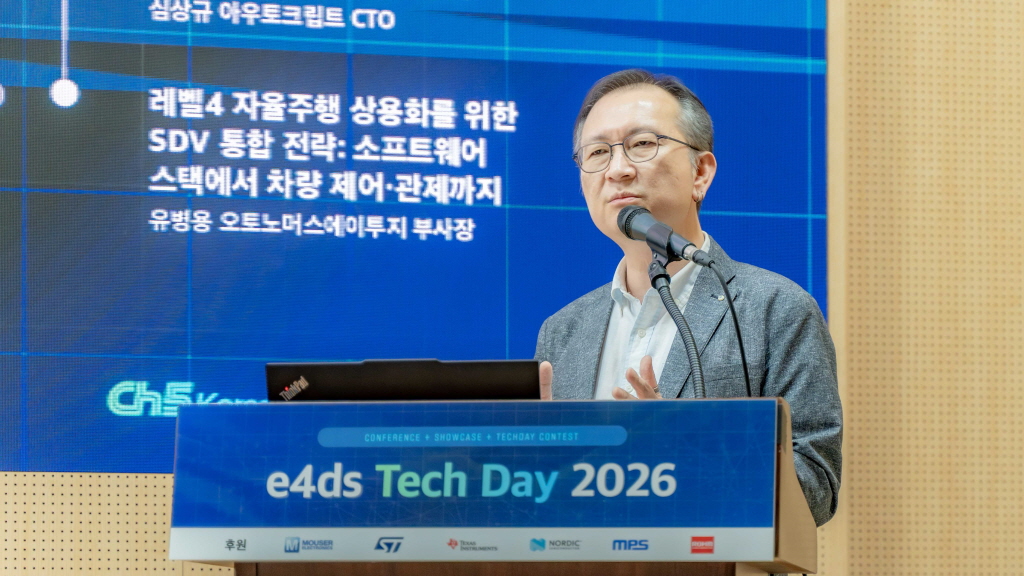
[e4ds Tech Day 2026 ⑨] Sim Sang-gyu, Autocrypt CTO: "In the Physical AI Era, Automotive Security Must Extend Beyond the Vehicle"
At e4ds Tech Day 2026, Sim Sang-gyu, CTO of Autocrypt, explained automotive cybersecurity strategies in the era of Physical AI and SDV (Software-Defined Vehicle). Automobiles are evolving as part of an ecosystem connected to AI, cloud, chargers, IoT, and robots, and he emphasized that the scope of security must expand beyond the vehicle interior to the entire connected environment. In particular, AI model tampering, adversarial attacks, OTA updates, and EV charger hacking were identified as major threats. He explained that response measures require zero trust, AI model integrity protection, intrusion detection, Security by Design and Default, and full lifecycle security management, and that proactive security system establishment beyond regulatory compliance is critical for securing future mobility competitiveness.
2026.10.12by 배종인 기자

Practical HIL Construction Strategy for Automotive and Off-Highway Controller Validation
As vehicle E/E architecture transitions to zonal structures and shifts to software-defined vehicles (SDV), the number of controllers (ECUs) requiring validation and software complexity are surging dramatically. Meanwhile, real vehicle testing cannot provide repeated verification under identical conditions and entails lead time and safety concerns. This white paper explains the principles of HIL (Hardware-in-the-Loop) validation and the structure of the NI platform composed of PXI, SLSC, and VeriStand, and through two actual implementation cases—Camera Record & Replay HIL for In-Cabin Monitoring Controller (ICMU) and Forklift Controller (VCU) HILS—describes how controller-level regression testing becomes possible. Additionally, it explicitly states application boundaries and limitations, such as lack of A2B support.
2026.10.12by 편집부











