



[Interview] Exploding Data Traffic: Why High-Speed Converters Are Needed in the 5G Era
 Published2017.04.21 10:57
ADC and DAC are important for fast digital signal conversion
KT is accelerating preparations to launch a 5G pilot service at the 2018 PyeongChang Winter Olympics and achieve early commercialization. On a national level, the 5G Strategy Promotion Committee, chaired by the Vice Minister of Science, ICT and Future Planning, is developing national 5G standards to submit to the ITU next February in order to secure a leading position in the 5G market. Fierce global competition over 5G standards is expected.
According to Cisco's VNI (Mobile Visual Networking Index) report, the number of mobile users worldwide is projected to reach 5.5 billion in 2021, and mobile data traffic is expected to increase sevenfold over the next five years. In Korea, the number of mobile users is expected to reach 45.4 million in 2021, representing approximately 88% of the population, and mobile data traffic is projected to increase fivefold compared to 2016.
In addition, it was predicted that globally, 5G would account for 1.5% of total mobile data traffic in 2021 and generate 4.7 times more traffic than 4G. In Korea, 5G is predicted to account for 6.9% of total mobile data traffic in 2021 and generate 4.8 times more connections than 4G.

Wireless backhaul base stations are required to meet the rapidly increasing demand for mobile data. This equipment serves to relay radio waves by bypassing them so that data can be received without interruption when the distance from the 5G base station increases or when radio waves are blocked by obstacles such as buildings, causing the service quality to deteriorate.
Currently, three major media—copper, optical fiber, and microwave—are used for backhaul, and microwave is expected to account for at least 50% of mobile network backhaul transmission. While traditional applications and telecommunications markets have relatively small channel bandwidths, E-Band (71–76 GHz, 81–86 GHz) P2P microwave systems offer wide channel bandwidths and allocated bands with channel spacing of up to 2 GHz. E-Band is a rapidly emerging band being adopted by wireless operators due to the increasing demand for high-speed wireless voice and data transmission.
The roles of ADCs and DACs are crucial for rapidly converting digital signals. DACs with a sampling rate of gigabit per second can support both narrowband and wideband applications. Analog Devices (ADI) offers a variety of SERDES IF class DACs that support a data rate of 1 gigabit per second, including the AD9136 and AD9135, which support up to 2 gigabit per second sampling rates.
The AD9135/AD9136 is a dual 11-bit/16-bit converter with a maximum speed of 2.8 GSPS, suitable for telecommunications systems requiring microwaves in point-to-point (P2P) wireless backhaul equipment. It supports E-Band frequencies and can generate multiple frequencies up to the Nyquist frequency.
"Converters with giga-sampling-per-second rates are used in telecommunications, industrial, and military fields. They are particularly suitable for the telecommunications sector," said Cha Seong-geun, Director of Analog Devices Korea. "They are widely used in backhaul systems overseas." "Our country will also need a backhaul system once 5G is commercialized," he said.
In addition, detailed information on ultra-wideband backhaul solutions using giga sampling rate ADCs and DACs, and ADI's giga sampling rate DAC products, will be available at the online seminar (eeWebinar) scheduled for the coming 25th.
Comments
Related news
ADI Launches SAR ADC with Built-in Picoampere Input Buffer
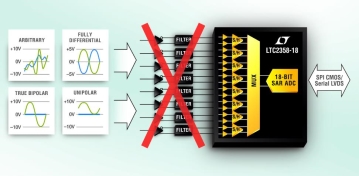
Analog Devices announced the launch of LTC2358-18, a new 18-bit 8-channel simultaneous sampling SAR (successive approximation register) ADC with an integrated picoampere (pA) input buffer. In particular, when board space is limited, the LTC2358-18 reduces space and cost by eliminating the front-end signal conditioning circuits commonly required to drive switched capacitor ADC inputs that require buffering. It can reduce 3 amplifiers, 6 resistors, and 2 capacitors per channel, thereby reducing a total of 88 components across 8 channels. This delivers significant reductions in BOM (bill of materials) cost as well as board area, while also providing more than 40% reduction in power consumption.
2017.04.18by 김지혜 기자

ADI Launches Accelerometer for Long-term Monitoring of High-Value Assets
Analog Devices has launched a next-generation accelerometer designed to enable long-term monitoring of the physical condition of high-value assets. The ADXL372 micropower high-g MEMS accelerometer, which achieves ultra-low power consumption, is a product focused on Internet of Things solutions where devices may experience shock or collision during storage, transport, or use, potentially adversely affecting functionality, safety, and reliability. The ADXL372 accelerometer, an ultra-low power MEMS sensor, can start operation immediately through its "instant on" feature and capture the complete waveform, thereby significantly reducing standby power consumption. While waiting to detect impact, only a current below 2 microamperes is required, so when the sensor is used in a motion detection activation system, it can operate for several years on a single small battery.
2017.04.19by 김지혜 기자
ADI Launches SEPIC Controller Supporting Wide Input Range
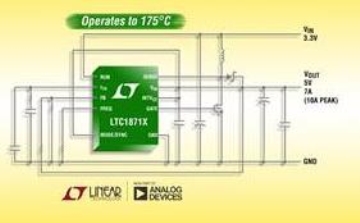
Analog Devices announced the launch of LTC1871X, a new current mode, boost, flyback, or SEPIC controller that supports a wide input range. This product is characterized by its ability to drive N-channel power MOSFETs and requires minimal external components. Designed with emphasis on low to medium power applications, this product utilizes the on-resistance of power MOSFETs, eliminating the need for a separate current sense resistor and maximizing efficiency. The LTC1871X is optimized for high-temperature environments up to 175°C.
2017.04.21by 김지혜 기자

Intel Unveils Next-Generation 'Core Ultra Series 3' and vPro Platform for Enterprise PCs
Intel has officially unveiled the "Intel Core Ultra Series 3" for next-generation enterprise PCs and the latest vPro platform, addressing a wide range of demands from enterprise notebooks to high-performance workstations.
2026.03.26by 배종인 기자

ROHM Launches ESD Protection Diode Compatible with High-Speed Interfaces of 10Gbps or Higher
Semiconductor specialist ROHM has developed the 'RESDxVx series' of ESD (electrostatic discharge) protection diodes capable of responding to next-generation high-speed data communication environments exceeding 10Gbps, simultaneously enhancing both signal quality maintenance required in high-speed interfaces and IC protection performance.
2026.03.26by 배종인 기자











