


Let's prepare for next-generation OLED lighting technology by fostering specialized talent.
 Published2017.04.27 17:23
Korea Photonics Industry Association supports OLED lighting cluster development project
How far has OLED lighting technology, referred to as the next generation of lighting, come? An event has been organized to examine everything from its basic concepts to its core technologies.
OLED lighting is considered an eco-friendly light source with a long lifespan, low power consumption, and low heat generation, and emits light in a flat manner similar to sunlight. It is also flexible and transparent, allowing for a wide range of applications in lighting design.
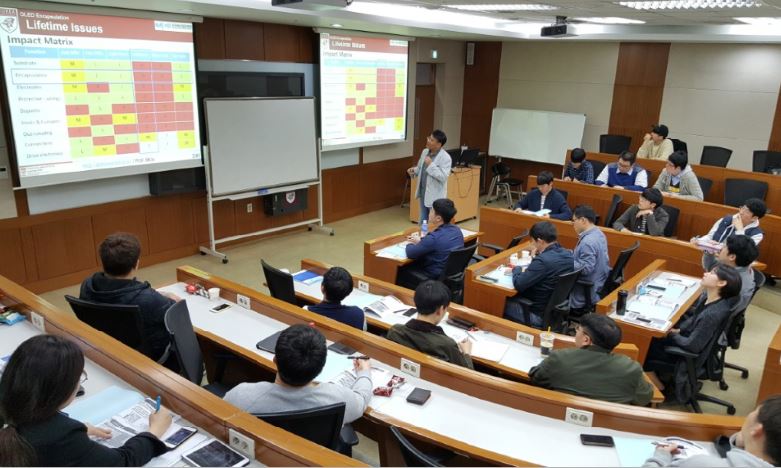
The Korea Association of Photonics Industry Development (KAPID) and the Display and Nanosystems Laboratory at Korea University held a seminar on OLED lighting theory education on the 27th at Room 127 of the Creative Building at Korea University.
This seminar was planned to foster specialized personnel in OLED lighting as part of the OLED lighting cluster development project conducted by the Korea Photonics Industry Association. This year marks the third round; the first and second rounds were held in regional areas, and Korea University was selected as the educational institution to facilitate participation from the metropolitan area.
In the morning of the event, the program began with a lecture by Professor Joo Byung-kwon of the Department of Electrical, Electronic and Radio Engineering at Korea University on "OLED Lighting Technology Trends and Encapsulation Technology," followed by a presentation on the light emission principles, structure, and equipment of OLED lighting (Jinho Kwak, Principal Researcher at Samsung Display OLED Business Division).
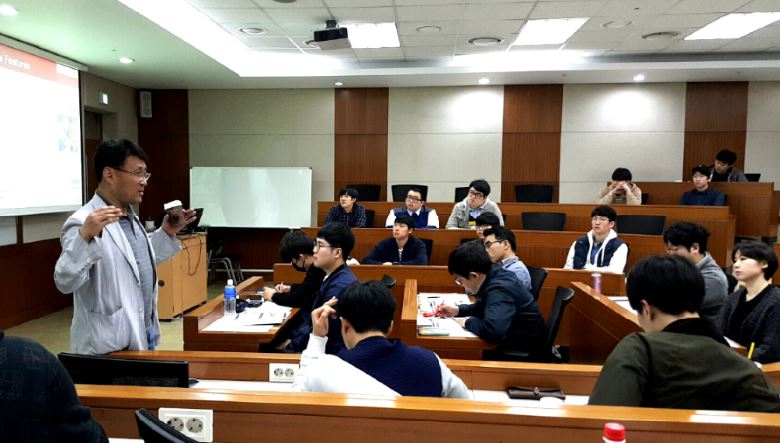
In the afternoon, presentations were given on topics including △ process technology for OLED lighting (Park Chul-hwi, Display & Nanosystems Laboratory, Korea University) △ OLED lifespan (Kim Sun-ju, Senior Researcher, OLED Business Division, Samsung Display) △ transparent electrode technology for OLED lighting (Jung Sun-kyu, Display & Nanosystems Laboratory, Korea University) △ light extraction technology for OLED panels for lighting (Shim Yong-seop, Display & Nanosystems Laboratory, Korea University).
Kim Ki-soo, Section Chief of the Policy Planning Department at the Korea Photonics Industry Association, stated, “The OLED Lighting Cluster Development Project is an initiative to build infrastructure that enables companies to commercialize technologies they develop in order to secure the competitiveness of the domestic industry,” adding, “We selected Korea University to systematically cultivate talent in OLED lighting technology starting from the basics.”
Comments
Related news

How will the next-generation iPhone differentiate itself with its flagship OLED and AR technologies?
On the 10th anniversary of iPhone's launch this year, what will the new iPhone look like? Apple's CEO Tim Cook emphasized through an article titled "iPhone 10 Years: The Revolution Continues" posted on the company's homepage that innovation is ongoing at Apple. Regarding Apple's future direction, KT Economic Management Research Institute (DigiEco) released a report titled "The Next-Generation iPhone in Three Types" (author: Kim Seung-yeol) on the 29th of last month. According to the report, Apple is known to be targeting market expansion through new iPhone form factors and features such as AR, facial recognition, and motion recognition capabilities.
2017.02.03by 서아람 기자

Samsung Electronics Sees Q1 Operating Earnings Jump Thanks to Strong Memory and Display Markets
Samsung Electronics announced first quarter 2017 consolidated results of 50.55 trillion won in revenue and 9.90 trillion won in operating profit. The first quarter performance was driven by strong component business results owing to robust memory and display prices and expanded premium product sales. Notably, operating profit increased by 3.2 trillion won compared to the same period last year, and the operating profit margin also rose from 13.4% to 19.6%. The component business saw significantly improved results due to ▲ strong memory prices ▲ expanded premium product sales such as high-capacity enterprise SSDs ▲ increased AP sales for flagship smartphones and diversified applications ▲ strong LCD pricing and expanded high-value-added product sales ▲ increased flexible OLED sales.
2017.04.27by 신윤오 기자
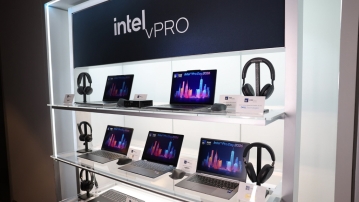
Intel Unveils Next-Generation 'Core Ultra Series 3' and vPro Platform for Enterprise PCs
Intel has officially unveiled the "Intel Core Ultra Series 3" for next-generation enterprise PCs and the latest vPro platform, addressing a wide range of demands from enterprise notebooks to high-performance workstations.
2026.03.26by 배종인 기자
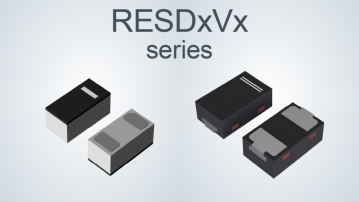
ROHM Launches ESD Protection Diode Compatible with High-Speed Interfaces of 10Gbps or Higher
Semiconductor specialist ROHM has developed the 'RESDxVx series' of ESD (electrostatic discharge) protection diodes capable of responding to next-generation high-speed data communication environments exceeding 10Gbps, simultaneously enhancing both signal quality maintenance required in high-speed interfaces and IC protection performance.
2026.03.26by 배종인 기자
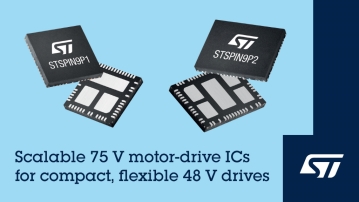
ST Launches 75V Drive IC Targeting 48V Industrial Motor Driving
ST Microelectronics has unveiled the 'STSPIN9P' series of 75V motor drive ICs tailored for 48V-class industrial drive system design. The new product family is characterized by half-bridge and full-bridge configurations that enable design scalability according to motor type and output conditions. Power supply circuits, protection functions, and current sensing circuits are integrated on-chip to simplify system configuration, and the devices are designed to support applications up to 500W maximum. The company plans to provide reference designs and demo boards to support development and evaluation in industrial automation, robotics, pumps, fans, lighting, and textile machinery.
2026.03.26by 배종인 기자











