


Development of touch-sensitive display technology
 Published2017.05.09 06:14
Signal detection, processing, and display functions integrated into a single device
Using displays by touching them has become natural. There is a growing need to develop technology that detects human body information on displays, to the extent that one can feel touch sensitivity varying depending on the device.
A research team led by Professor Park Chul-min of Yonsei University announced that it has developed a core technology for next-generation displays that instantly detects conductive human body information, such as fingerprints, and displays it on a screen.
This research, conducted under the Basic Research Support Program of the Ministry of Science, ICT and Future Planning, addresses the limitation of currently used Organic Light-Emitting Diode (OLED) displays being separate from sensors. The device developed in this study, which simultaneously performs the functions of a sensor and a display, is called an Organic Light-Emitting Board (OLEB).
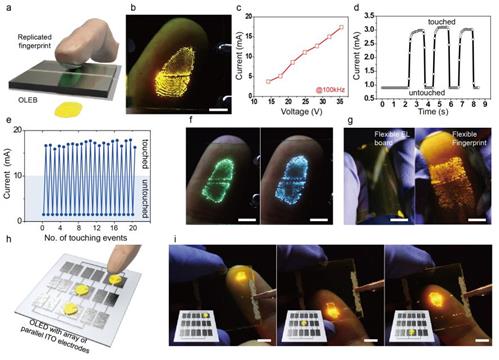
The organic light-emitting board reduces and simplifies the manufacturing process by integrating three components that perform signal detection, signal processing, and signal display functions. Since it is driven by an electric field generated by alternating current, it can utilize devices powered by the AC voltage used in general household appliances, enabling the development of highly efficient devices that reduce energy loss.
In addition, the electrical signal processing structure has been simplified, making it thinner (500 nm) and more flexible. It is also possible to write using a conductive pencil and display through self-luminescence. Conductive writing can be chemically erased.
Professor Park stated, “Unlike previous research, we have secured technological originality by developing it based on an alternating current electric field where detection and display are integrated,” adding, “It is expected to be applied to portable and automotive displays, smart windows for advertising, and more.”
Comments
Related news
ETRI to Use Graphene Instead of ITO in Displays
ETRI (Electronics and Telecommunications Research Institute) has successfully developed a display by creating electrodes using graphene, referred to as a dream material, instead of indium tin oxide (ITO), which has been widely used as electrodes for conventional OLED displays. The display substrate developed by the research team measures 370mm x 470mm, which is approximately the size of a 19-inch monitor. The graphene electrode thickness is 5 nanometers (nm) or less. ETRI anticipates that combining graphene with a flexible substrate will enable the implementation of thin and flexible displays. If realized, this could serve as a core technology applicable to the manufacturing of wearable devices that can be applied to clothing and skin.
2017.04.17by 김지혜 기자
A&K Display Expands Display Market with 'Estra'
A&K Display has launched the 'Istara' brand, which carries the meaning of 'star of TV,' to expand the domestic display market. UHD TV products will be exclusively launched through GS Home Shopping. The Istara product is based on LG IPS panels incorporating world-class technology and is priced at least 30% lower than products with equivalent specifications, which is expected to appeal to consumers who prioritize value for money.
2017.04.28by 김지혜 기자
Flexible OLEDs Must Improve Lifespan and Efficiency to Achieve Mass Adoption
Displays are now entering an era of 'flexibility.' As interest shifts toward flexible technology, plastic organic light-emitting diodes (POLED) are attracting attention. According to market research firm IHS Markit, OLED has caught up with liquid crystal displays (LCD), which dominate the smartphone display market, and demand for flexible OLED panels is increasing sharply, with predictions that they will surpass flat-panel OLED panels in the third quarter of this year. Compared to LED, OLED allows users to adjust color temperature, color, and brightness, and since it is an area light source that emits light from all surfaces, the area where heat is dissipated is wide, making it relatively free from heat concerns. Assuming operation in a typical environment, no heat sink is required, and since the film thickness is thin, transparency is possible. Because it can be made from plastic rather than glass, it is also possible to flex it. Aspects of OLED technology that have yet to be resolved are efficiency, lifespan, light extraction, and cost. OLED can theoretically achieve luminous efficiency of up to 190 lm/W, but currently it is around 70 lm/W, a level similar to LED. Lifespan can reach 10,000 hours, but to compete with LED, it needs to achieve 30,000 hours.
2017.05.08by 김지혜 기자
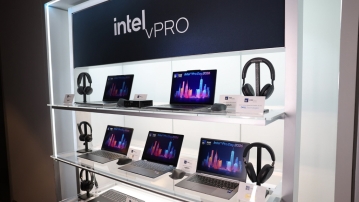
Intel Unveils Next-Generation 'Core Ultra Series 3' and vPro Platform for Enterprise PCs
Intel has officially unveiled the "Intel Core Ultra Series 3" for next-generation enterprise PCs and the latest vPro platform, addressing a wide range of demands from enterprise notebooks to high-performance workstations.
2026.03.26by 배종인 기자
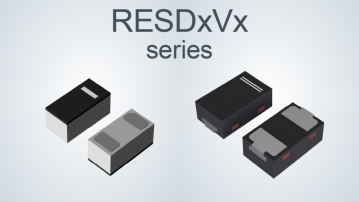
ROHM Launches ESD Protection Diode Compatible with High-Speed Interfaces of 10Gbps or Higher
Semiconductor specialist ROHM has developed the 'RESDxVx series' of ESD (electrostatic discharge) protection diodes capable of responding to next-generation high-speed data communication environments exceeding 10Gbps, simultaneously enhancing both signal quality maintenance required in high-speed interfaces and IC protection performance.
2026.03.26by 배종인 기자











