


NVIDIA Announces GPU to Lead High-Performance Computing
 Published2017.05.11 10:29
One Tesla V100 GPU replaces hundreds of CPUs
NVIDIA announced Volta™, the most powerful GPU computing architecture to lead the advancement of artificial intelligence and high-performance computing, during the keynote speech at the NVIDIA GPU Technology Conference (GTC).
During this keynote, the NVIDIA® Tesla® V100 Data Center GPU, the first Volta-based processor, was also announced. The Tesla V100 Data Center GPU supports the exceptional speed and scalability required for artificial intelligence inference and training, and accelerates high-performance computing and graphics workloads.
NVIDIA founder and CEO Jensen Huang stated, “Artificial intelligence will automate intelligence and bring about new social progress unprecedented since the Industrial Revolution.” He also said, “Deep learning, an innovative AI approach to building learnable computer software, requires infinite processing power. To meet this demand, thousands of NVIDIA engineers have dedicated themselves to developing Volta over the past three years.”
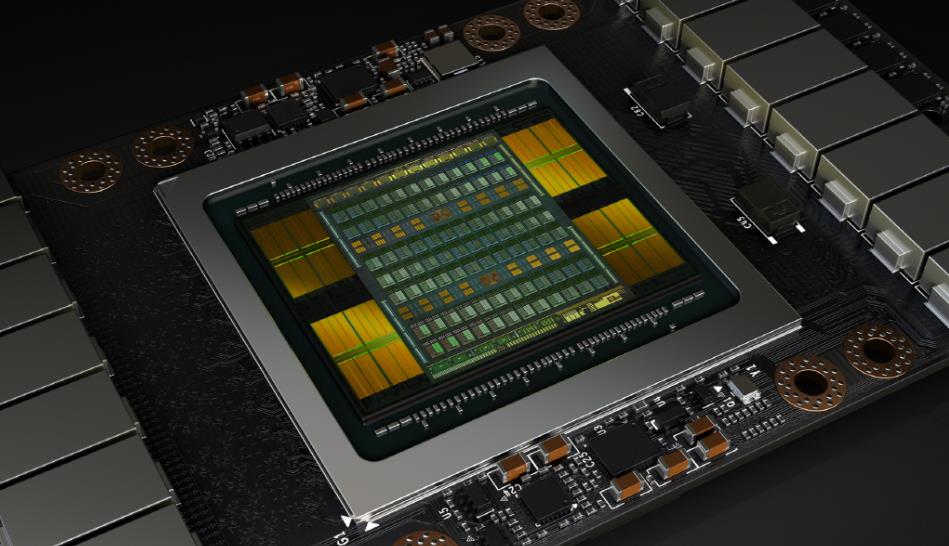
NVIDIA's 7th generation GPU architecture, Volta, is built with 21 billion transistors and enables deep learning with performance equivalent to 100 CPUs.
As networks become more advanced, data centers must provide exponentially improved processing power. Furthermore, they must possess efficient scalability to facilitate the rapid introduction of highly accurate AI-based services, such as natural language virtual assistants (VA) and personalized search and recommendation systems.
Volta is expected to set a new standard for high-performance computing by providing an outstanding platform for computational science and data science for new insights into high-performance computing systems. By combining CUDA® Cores and the new Volta Tensor Cores into a unified architecture, a single server equipped with a Tesla V100 GPU can replace hundreds of general-purpose CPUs required for existing high-performance computing.
Comments
Related news

NVIDIA Announces 'PilotNet,' AI That Learns Human Driving Styles
NVIDIA has released documentation on how its neural network, PilotNet, makes driving decisions within autonomous vehicles. Since the range of driving-related variables in real-world driving environments is nearly infinite, it is nearly impossible to program every variable individually to enable autonomous vehicles to drive themselves during autonomous vehicle development. However, by utilizing artificial intelligence to train vehicles on how to drive, it has become possible to identify which elements the vehicle focuses on during the learning process. NVIDIA developed PilotNet, a neural network-based system that learns vehicle driving by observing driver behavior. Furthermore, the company developed a tool that enables visualization of which elements the neural network system prioritizes when making driving decisions. Using this tool, NVIDIA built a system where vehicles learn autonomously and can verify how decisions are being made.
2017.05.10by 김자영 기자
NVIDIA Unveils Intelligent Video Analytics Platform to Implement AI Cities
NVIDIA unveiled the NVIDIA® Metropolis™ intelligent video analytics platform at the NVIDIA GPU Technology Conference (GTC), being held at the McEnery Convention Center in San Jose, California, starting from the 8th local time. The Metropolis platform introduced this time is a platform that supports the creation of safer and smarter city environments by applying deep learning to video streams in applications related to public safety, traffic management, and resource optimization. Currently, more than 50 NVIDIA AI city partner companies are providing various products and applications that leverage GPU-based deep learning, and are showcasing most of the related products and applications at NVIDIA GTC 2017. Deepu Talla, General Manager and Vice President of NVIDIA's Tegra business unit, said, "Deep learning realizes powerful intelligent video analytics that transforms anonymized video into valuable real-time insights, thereby enhancing safety and improving lives. Through the NVIDIA Metropolis platform, customers can apply artificial intelligence to all video streams and create even smarter city environments."
2017.05.10by 김지혜 기자
NVIDIA VRWorks, a software developer kit for applications
NVIDIA announced at the NVIDIA GPU Technology Conference held at the McEnery Convention Center in San Jose, California on the 8th that the NVIDIA VRWorks Software Developer Kit (SDK) has been utilized in new applications from Autodesk, ESI Group, and OPTIS. Enterprise VR is transforming various business areas ranging from engineering and design to manufacturing, operations, and sales. Through VRWorks, which consists of application programming interfaces, libraries, and engines, developers can more easily create VR experiences. Application-specialized development companies are incorporating core VRWorks features to support general enterprises looking to integrate VR into their businesses. VRWorks technologies such as VR SLI, single-pass stereo, and lens matched shading enhance the performance, efficiency, and image quality of VR rendering, while VRWorks 360 video and audio and physics support realistic sound, touch, and physical simulation in VR environments. Additionally, VRWorks includes Quadro platform-exclusive features such as warp and blend, synchronization, GPU affinity, and GPU direct for video.
2017.05.10by 김자영 기자
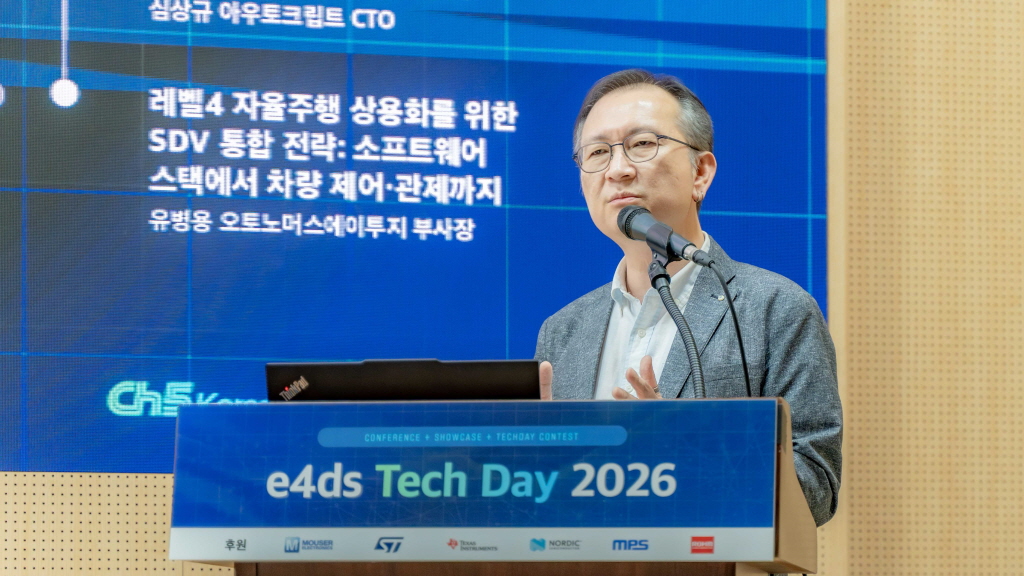
[e4ds Tech Day 2026 ⑨] Sim Sang-gyu, Autocrypt CTO: "In the Physical AI Era, Automotive Security Must Extend Beyond the Vehicle"
At e4ds Tech Day 2026, Sim Sang-gyu, CTO of Autocrypt, explained automotive cybersecurity strategies in the era of Physical AI and SDV (Software-Defined Vehicle). Automobiles are evolving as part of an ecosystem connected to AI, cloud, chargers, IoT, and robots, and he emphasized that the scope of security must expand beyond the vehicle interior to the entire connected environment. In particular, AI model tampering, adversarial attacks, OTA updates, and EV charger hacking were identified as major threats. He explained that response measures require zero trust, AI model integrity protection, intrusion detection, Security by Design and Default, and full lifecycle security management, and that proactive security system establishment beyond regulatory compliance is critical for securing future mobility competitiveness.
2026.10.12by 배종인 기자
NVIDIA to Invest $1 Billion in U.S. Science Over Next Five Years
NVIDIA has announced plans to invest $1 billion over the next five years to strengthen U.S. scientific and technological competitiveness. The company will enhance cutting-edge artificial intelligence research and development capabilities in key areas including quantum computing, healthcare, and energy security, while expanding support for higher education research institutions and cloud service providers. NVIDIA is participating as a major industry partner in the White House Office of Science and Technology Policy's Genesis Mission, and is promoting supercomputer construction in collaboration with national laboratories including Argonne and Los Alamos.
2026.10.12by 배종인 기자











