



SKT. 'Data obtained from offshore base stations transmitted via underwater communication'
 Published2017.05.31 10:41
Demonstration of LTE photo and text transmission over a distance of 800m at a depth of 25m, approximately 10km west of Incheon South Port
Transmission of sea temperature, currents, and salinity measured by sensors… Establishment of submarine defense systems, early warning, red tide monitoring, etc.
Earth's last communication dead zone, the 'ocean'. Underwater communication technology for building the world's first 'underwater communication base station' has been unveiled.
In Korea, a country surrounded by sea on three sides, the necessity of underwater communication technology is being increasingly emphasized not only for defense purposes such as submarine detection but also for monitoring radiation and shellfish toxins to ensure food safety, as well as red tides, and for early warning systems for tsunamis and underwater earthquakes; consequently, competition among nations worldwide is intensifying.
SK Telecom and Hoseo University announced on the 31st that they have successfully tested underwater communication technology using the LTE method in an environment 10km west of Incheon South Port, at a depth of approximately 25m, with a transmission and reception distance of approximately 800m. This is part of the 'base station-based underwater communication technology' project that has been underway since 2015, with SK Telecom and 13 other research institutions participating until 2021. On this day, Hoseo University and SK Telecom successfully measured about 10 types of underwater information, including water temperature, salinity, and current speed, and continuously transmitted and received text and photo data at 20-second intervals by utilizing a method that superimposed LTE (OFDM modulation) frequencies onto sound waves (3–70KHz). During the technology demonstration, the research team showcased real-time photo transmission of text and photo data, proving that information collected through various sensors in the underwater network can be aggregated at an underwater base station and reliably transmitted to land via a marine buoy. The waters off Incheon in the West Sea are particularly unsuitable for underwater communication due to severe turbidity and shallow depths; therefore, this demonstration is evaluated as having shown the stable performance of the underwater communication network despite these adverse conditions.
Professor Koh Hak-rim of Hoseo University stated, “Korea is the first country to demonstrate an underwater communication method involving the construction of an underwater base station. Through this demonstration, various data accumulated at the underwater base station was successfully transmitted to a marine buoy via underwater communication, and the underwater It was assessed that "we have moved beyond the core research phase for establishing a base station testbed."
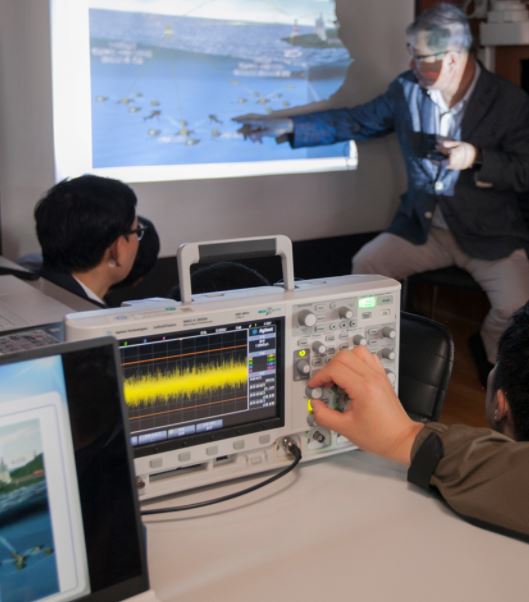
In the background, Professor Koh Hak-rim of Hoseo University is explaining the overview of the underwater communication network project to officials.
◇ Pave the way for underwater communication 'highways' to retrieve information from the ocean floor
An underwater base station-based communication network is largely composed of underwater sensors, underwater base stations, and maritime communication buoys. Information collected by sensors is transmitted to maritime communication buoys via base stations, and this data is then sent to the surface via communication networks such as satellite or LTE. Data is transmitted using sound waves underwater and radio waves in the air.
Underwater base stations are likened to 'underwater communication highways'. By installing an underwater base station and communicating with sensors that collect underwater information within a diameter of 20 to 30 km, there is an advantage of minimizing interference and managing with low power.
Compared to 1:1 communication using existing sound waves, it overcomes the highly variable underwater communication environment and enables low-power, systematic operation, allowing for real-time and long-term underwater observation.
Another major advantage is that it can be built and operated at a much lower cost compared to underwater wired communication networks.
By utilizing underwater communication technology, it can be used for defense purposes to detect and identify submarines and the like using underwater noise sensors around base stations; additionally, in the event of a maritime vessel accident, an underwater base station can be installed at the accident site to facilitate communication with divers or underwater robots.
Furthermore, securing big data such as ocean currents, water temperature, salinity, tide speed, and pH around base stations is expected to serve as a groundbreaking opportunity for water resource protection and marine environmental research. Accordingly, underwater communication technology is considered a key element for the underwater expansion of the Fourth Industrial Revolution.
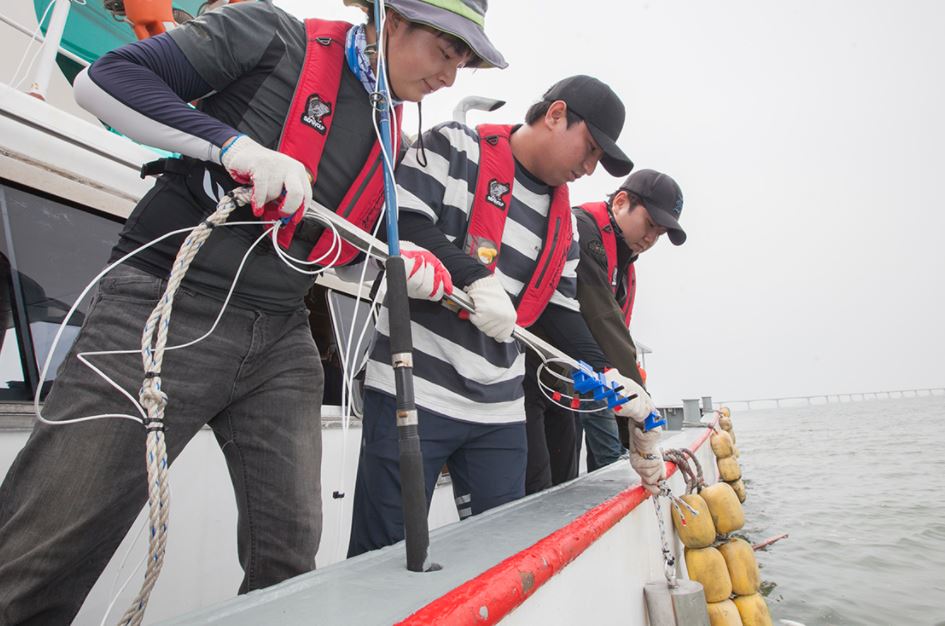
A joint research team lowering a hydrophone (acoustic receiver) device, which plays the role of receiving data in underwater communication, into the sea.
◇ First Unveiling of Cell Planning Technology for Underwater Base Station Installation in the West Sea
Hoseo University and SK Telecom plan to begin construction of a testbed on the west coast around October of this year for research on base station-based underwater communication networks, and have set a roadmap to finally complete the testbed in 2020–2021.
Both sides plan to complete actual sea area measurements by July and demonstration tests in September, with the goal of establishing a communication network (backbone network) between the base station and the offshore buoy of the underwater experimental network this coming October. In addition, we plan to complete the development of a communication system between underwater base stations and underwater sensors next year.
SK Telecom also disclosed the current status of its research on submarine network design technology for the construction of underwater base stations, based on actual underwater measurement data currently being collected.
Underwater communication network design technology determines the location and coverage of seabed base stations and is the core of the submarine communication network business. While research on radio wave prediction models has been systematically conducted on land for a long time, it can be said that the underwater environment is still in its early stages.
Park Jin-hyo, Head of the Network Technology Institute at SK Telecom, explained, “SK Telecom is currently the only company in Korea to possess independent and interoperability design capabilities for disaster networks (PS-LTE), railway networks (LTE-R), maritime networks (LTE-M), and underwater networks (DUMCN).” He added, “We plan to design underwater communication networks by fully leveraging our experience in optimizing sensing-based IoT network designs.”
◇ Global Underwater Communication Network Research Competition Heats Up
Overseas, countries such as the United States, Europe, and China are researching state-led wired and wireless underwater communication network technologies for marine environment observation, coastal surveillance, and underwater mobile communication. Since Korea is the first to establish a base station-based experimental network, it is currently receiving extraordinary attention from abroad.
The EU utilizes a hybrid wired and wireless approach, integrates the operation of underwater and terrestrial networks, and is carrying out the SUNRISE project to support the underwater Internet of Things.
Canada has established and is operating 'Ocean Networks Canada,' a real-time remote observation system that collects data from wired network-based sensors at observation stations around the world. In particular, 'Oceans Networks Canada' is a non-profit organization that started at the University of Victoria in Canada and manages and analyzes numerous underwater networks, collecting more than 200 Gb of underwater data every day.
Since the 1990s, developed countries such as the United States and Europe have secured underwater communication technology and established and utilized marine wireless networks, applying them to monitoring changes in the marine environment and defense sectors.
Recently, as global interest in the Internet of Things and big data intensifies, big data generated in the ocean is also becoming a key point of national competitiveness.
Comments
Related news

SK Telecom Recognized for Next-Generation Network Technology Competitiveness
SK Telecom (CEO and President Park Jung-ho) announced that it received a total of 3 awards at 2 global telecommunications and IT industry awards held in London, UK on the 23rd (local time). The company received Infrastructure Innovation Awards at the 'GTB Awards' for its 'world's first 5G handover technology' and 'LTE base station interference reduction and power saving technology', respectively.
2017.05.24by 신윤오 기자
KT to Provide 5G Media Services at the Youth World Cup
KT announced on the 24th that it successfully provided media services based on a 5G trial network at the Korea-Argentina match on the 23rd, following the Korea-Guinea match on the 20th at the U-20 World Cup Korea 2017. KT is participating as an official IT sponsor at this U-20 World Cup. Among the six stadiums hosting 52 preliminary and main tournament matches, KT has established a 5G trial network at Jeonju World Cup Stadium and Suwon World Cup Stadium, where Korea's preliminary matches and final will be held. Based on this infrastructure, KT provided fast and immersive media services by connecting dedicated cameras and 5G base stations installed at the stadiums with 5G core equipment in Umyeon-dong, Seocho-gu, Seoul, and a CDN center in Bundang-gu, Seongnam. The 360-degree VR applied stitching technology to seamlessly join high-definition footage captured by multiple VR-dedicated cameras installed behind the goal line to be viewable in a 360-degree direction, along with technology to transmit the stitched footage in real-time over an ultra-high-speed network. This can be experienced firsthand at the CD Zone (Commercial Display Zone) set up outdoors at Jeonju and Suwon World Cup Stadiums. For those unable to visit the stadium, downloading the 'FIFA U-20 WC 2017 VR Player' app allows viewing of 360-degree footage on a personal mobile phone. The app can be downloaded from Google Play Store and is also linked via banners on olleh tv mobile and the three terrestrial broadcasting networks' apps. Interactive Time Slice is a media service that allows users to select a desired point in time or player and rotate still images from various angles. It features smooth viewpoint transitions through Flying View and the ability to select a desired player to view that player's footage in detail through Free-Focus, offering various ways to experience the dynamic nature of the match. Interactive Time Slice can be experienced at the CD Zone outdoors at the stadiums and has also been provided to broadcasters for TV coverage. Additionally, KT will display a 5G bus at the CD Zone operating outdoors at Jeonju and Suwon World Cup Stadiums during Korea's preliminary matches and final. The 5G bus offers content including three-dimensional augmented reality (AR) and virtual reality (VR), holograms, and autonomous driving demonstration videos. Meanwhile, wishing for Korea's team to perform well, KT will hold street cheering events following the Korea-Argentina match on the 23rd and again at the Korea-England match on the 26th. Participants in the street cheering event held at the north plaza of Gwanghwamun, Seoul on match day will be given cheering tools such as headbands and handkerchiefs. Also
2017.05.24by 김자영 기자
LG Uplus, "Will Increase Seoul's Power Self-Sufficiency Rate to 20% by 2020"
LG Uplus announced on the 31st (Wednesday) that it has signed a business agreement with A-NINE, a solar power generation measurement device developer for Seoul Citizens Sunlight Power Generation Cooperative, a mini solar project operator in Seoul, to develop mini solar power generation measurement technology utilizing NB-IoT (Narrowband Internet of Things). As the Seoul Citizens Sunlight Power Generation Cooperative has introduced for the first time a remote monitoring system utilizing NB-IoT in Seoul's balcony-type mini solar installation project, which has been independently developed and promoted by Seoul since 2014, the outlook is that NB-IoT technology will gain further momentum in its expansion. In accordance with this agreement, LG Uplus will equip household solar power generation measurement devices developed by A-NINE with NB-IoT communication modules and transmit solar power generation data collected from the devices remotely to the monitoring center established by the Seoul Citizens Sunlight Power Generation Cooperative through its dedicated NB-IoT network.
2017.05.31by 김자영 기자
.jpg)
SalePoint Signs Multi-Year Partnership Agreement with AWS… Promoting Identity Security that Integrates Even AI Agents
Sailpoint has entered into a multi-year strategic partnership agreement with AWS and is moving forward with establishing an integrated governance system that manages both human and non-human identities together. The plan is to consistently manage access permissions in an environment where AI agents are increasing as work execution entities, while applying the principle of least privilege and automated policy enforcement. The two companies plan to jointly expand capabilities to manage the identities of various entities, including AI agents, within a single layer in the AWS environment. This collaboration is interpreted as a move to design security and governance together in corporate environments where AI adoption is expanding.
2026.03.26by 배종인 기자
.png)
Databricks Unveils Open AI Security Monitoring 'Lakewatch'
Databricks entered the security market on March 24 by unveiling LakeWatch, an open-source agentic SIEM. The core functionality of this product is to integrate and analyze security, IT, and business data in a single environment to support AI-based threat detection and investigation. The company explained that it reduces the limitations of existing security operations centers, which have had to forgo some data due to high cost structures, and enables large-scale data analysis and automation based on open formats and ecosystems. LakeWatch is currently offered as a private preview, with Adobe and Dropbox mentioned as early customers. Databricks also announced an expanded partnership with Anthropic as well as the acquisition of Antimatter and SiftD.ai.
2026.03.26by 배종인 기자











