


ams Launches LED Smart Lighting Manager Using Closed-Loop Sensing
 Published2017.06.05 10:39
ams announced the introduction of the new AS7220 Smart Lighting Manager. This product enables the realization of next-generation high-quality LED-based lamps and lighting products by utilizing closed-loop sensing to maintain more precise correlated color temperature (CCT) and light intensity while lowering system BOM costs.
The AS7220 is a successor product that combines a precision permanent calibration color sensor with an intelligent Cognitive Lighting engine for maintaining an independent closed-loop for the output of a white LED array. Consequently, it can automatically regulate phenomena such as color shift or LED brightness degradation caused by deviations in the LED driver due to aging, changes in operating temperature, and lifespan.
In the commercial, industrial, and high-end residential premium lighting system markets, manufacturers have been forced to rely on very tight LED binning to achieve the required CCT. Based on advanced sensor-driven algorithms, the ams AS7200 Smart Lighting Manager enables more extensive CCT testing and flexible binning by manufacturers, ensuring that LEDs provide stable and high-quality lighting.

Tom Griffiths, Senior Marketing Manager at ams, said, “The LED lighting industry continues to face the challenge of providing precisely identical color and output not only at operating temperatures but also throughout the lifespan customers expect.” While white LEDs perform well initially, differences in color or brightness develop over time. Furthermore, LEDs are evolving so rapidly that selecting the same LED for lighting less than a year old is no longer a cost-effective choice, which can lead to greater variations between lights.
Tom Griffiths, Senior Marketing Manager, continued, “Lighting manufacturers can relieve the burden of related technology and supply constraints by adding closed-loop sensing to their product architecture. Furthermore, they can reduce Bill of Materials (BoM) costs, expand the range of choices while maintaining consistency in component selection, and deliver more precise lighting quality throughout the product lifecycle.”
Comments
Related news
ams announces new color sensor with easy design and competitive price
ams (Korean subsidiary representative Jong-deok Lee) announced the launch of an integrated color point sensor IC. The sensor (AS7261 JENCOLOR® XYZ) is designed as a platform for color sensing to facilitate design-in and streamline the production process for manufacturers of professional and general-purpose colorimeters and color analyzers.
2017.05.11by 신윤오 기자

ams Announces New Foundry Ecosystem
ams announced an expansion of its foundry ecosystem at CDNLive EMEA. Based on collaboration with Fraunhofer IIS and RoodMicrotec, these three partner companies now provide IC development, assembly, test, and quality assurance services to OEMs, system integrators (SIs), and innovative startup companies, opening up a more reliable and comprehensive approach path for ASIC solutions. ASIC design is carried out through the verified design experience and technology of Fraunhofer IIS, a long-term partner of ams, as well as application expertise. ams provides specialized analog and sensor wafer manufacturing technology supporting industrial, automotive, and medical applications. Assembly services, as well as test services including test software and hardware development, are provided by ams and RoodMicrotec, and RoodMicrotec additionally provides extensive product quality assurance and failure analysis services.
2017.05.19by 김지혜 기자

ams, Expanding Singapore Manufacturing Facility Due to Increased Sensor Demand
ams announced the establishment of a new manufacturing facility in Ang Mo Kio, Singapore, and expansion of its business. Through the new manufacturing facility scheduled to open in July this year, ams plans to respond to increasing demand for advanced sensor solutions used in cutting-edge mobile applications. Over a certain period, the company plans to invest hundreds of millions of dollars with a focus on differentiation in technology, equipment, and personnel locally. ams sensor solutions are at the center of numerous digital products and technologies that currently surround us, including smartphones and mobile devices, smart homes/buildings, industrial automation and connected cars, as well as many devices equipped with IoT capabilities. Leading global companies are using them to detect light, color, images and sound, enhance precision and stability, and measure minute changes in location, environment and medical factors.
2017.05.29by 김지혜 기자

Intel Unveils Next-Generation 'Core Ultra Series 3' and vPro Platform for Enterprise PCs
Intel has officially unveiled the "Intel Core Ultra Series 3" for next-generation enterprise PCs and the latest vPro platform, addressing a wide range of demands from enterprise notebooks to high-performance workstations.
2026.03.26by 배종인 기자
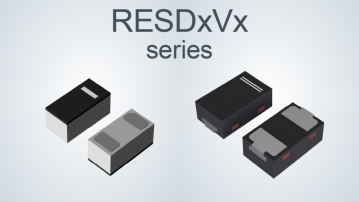
ROHM Launches ESD Protection Diode Compatible with High-Speed Interfaces of 10Gbps or Higher
Semiconductor specialist ROHM has developed the 'RESDxVx series' of ESD (electrostatic discharge) protection diodes capable of responding to next-generation high-speed data communication environments exceeding 10Gbps, simultaneously enhancing both signal quality maintenance required in high-speed interfaces and IC protection performance.
2026.03.26by 배종인 기자