



ADI Launches Non-Isolated Synchronous Step-Down Regulator Controller
 Published2017.06.09 14:24
Analog Devices announced the release of the LTC7801, a high-voltage non-isolated synchronous step-down switching regulator controller.
This product is available in a compact 24-pin package that drives the entire N-channel MOSFET power stage. With an input voltage range of 4V to 140V (150V abs max), it is designed to operate from high-input voltage sources or inputs with high-voltage surges, eliminating the need for external surge suppression devices. The LTC7801 is suitable for transportation, industrial control, robotics, and datacom applications because it continues to operate at a duty cycle of up to 100% even as the input voltage drops to 4V.
The output voltage can be set within the range of 0.8V to 60V with 96% efficiency at an output current of up to 20A. This device is ideal for always-on systems because it consumes only 40µA of power in sleep mode under output voltage regulation.
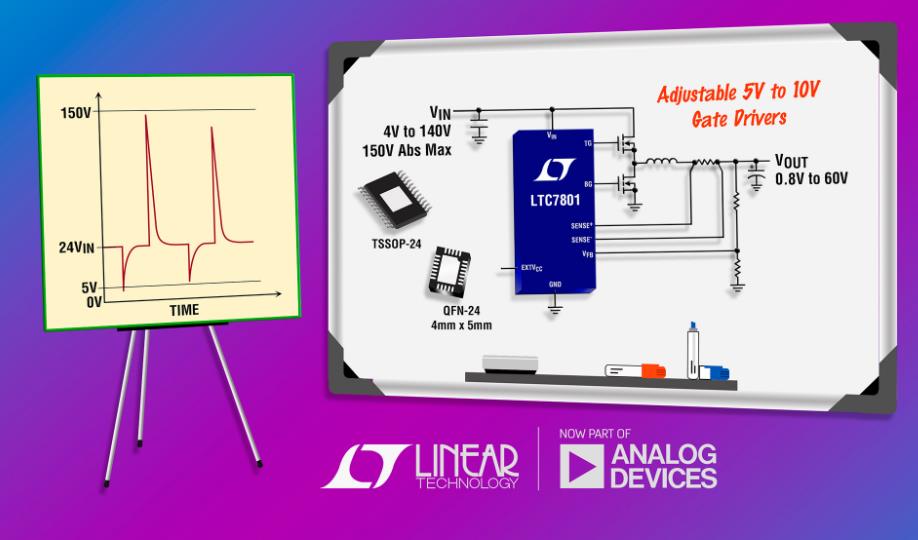
The internal charge pump enables a 100% duty cycle and continuous device operation even during dropout, making it useful when power needs to be supplied from the battery during discharge. The powerful 1Ω N-channel MOSFET gate driver of the LTC7801 can be adjusted in the 5V to 10V range to allow the use of logic or standard level MOSFETs for maximum efficiency.
The LTC7801 includes an NDRV pin to prevent significant on-chip power consumption in high input voltage applications, which drives the gate of an optional external N-channel MOSFET that functions as a low-dropout linear regulator to power the IC. The LTC7801 can also draw power from the output of a switching regulator or other available sources via the EXTVCC pin, allowing for reduced power consumption and increased efficiency.
Comments
Related news

ADI Announces Technology and Ecosystem for 5G Transition
Analog Devices (ADI) has announced its latest RadioVerse™ technology and design ecosystem. The RadioVerse™ product family provides new wireless transceiver hardware, software tools, and a stable design environment that contribute to reducing the size and power consumption of wireless devices required for next-generation networks. It enables rapid evaluation and development of 4G small cells and Pre-5G massive MIMO systems, which are essential for the transition to 5G. While increasing data transmission speed, it improves connectivity and data throughput in densely populated areas such as offices, stadiums, and public transportation where traffic is congested.
2017.06.07by 김지혜 기자
ADI Launches High-Speed High-Side MOSFET Capable of Operating Up to 150V
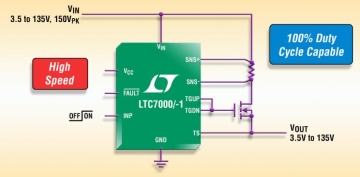
Analog Devices announced the launch of the LTC7000/-1, a high-speed high-side N-channel MOSFET driver capable of operating up to 150V supply voltage. The product's internal charge pump fully drives external N-channel MOSFET switches, enabling them to maintain an always-on state. The LTC7000/-1's powerful 1Ω gate driver can drive MOSFETs with large gate capacitance within short transition times, making it ideal for high-frequency switching and static switch applications. The LTC7000/-1 operates at bias voltages of 3.5V to 15V and input supply voltages of 3.5V to 135V, 150VPK. The product detects overcurrent conditions by monitoring voltage through an external sense resistor connected in series with the drain of the external MOSFET. The LTC7000/-1 receives ground-referenced low-voltage digital input signals and rapidly drives high-side N-channel power MOSFETs, with the MOSFET drain voltage permitted up to 150V relative to GND. With rise and fall times as fast as 13ns, switching losses can be reduced when driving 1,000pF loads.
2017.06.08by 김지혜 기자

Intel Unveils Next-Generation 'Core Ultra Series 3' and vPro Platform for Enterprise PCs
Intel has officially unveiled the "Intel Core Ultra Series 3" for next-generation enterprise PCs and the latest vPro platform, addressing a wide range of demands from enterprise notebooks to high-performance workstations.
2026.03.26by 배종인 기자

ROHM Launches ESD Protection Diode Compatible with High-Speed Interfaces of 10Gbps or Higher
Semiconductor specialist ROHM has developed the 'RESDxVx series' of ESD (electrostatic discharge) protection diodes capable of responding to next-generation high-speed data communication environments exceeding 10Gbps, simultaneously enhancing both signal quality maintenance required in high-speed interfaces and IC protection performance.
2026.03.26by 배종인 기자
ST Launches 75V Drive IC Targeting 48V Industrial Motor Driving
ST Microelectronics has unveiled the 'STSPIN9P' series of 75V motor drive ICs tailored for 48V-class industrial drive system design. The new product family is characterized by half-bridge and full-bridge configurations that enable design scalability according to motor type and output conditions. Power supply circuits, protection functions, and current sensing circuits are integrated on-chip to simplify system configuration, and the devices are designed to support applications up to 500W maximum. The company plans to provide reference designs and demo boards to support development and evaluation in industrial automation, robotics, pumps, fans, lighting, and textile machinery.
2026.03.26by 배종인 기자











