


AI chip that replicates the structure of the human brain is coming out
 Published2017.06.23 17:52
Artificial Intelligence Requires a Hardware-Based, Not Software-Based Approach
In the age of artificial intelligence, the key is the chip. There is no longer a place for software-based research.
At the 'AI New Industry Convergence Forum' hosted by the Korea Institute for Industrial Technology Promotion, Nepes Chairman Lee Byung-koo stated that artificial intelligence has become closely integrated into our lives and made the following remarks regarding methods for its popularization. Following this, Nepes Executive Director Ahn Jung-ho introduced the 'NM500,' an AI chip set to be released next month, noting that "there are many advantages to approaching AI from a hardware perspective."
Nepes, a semiconductor packaging company, designed a system semiconductor chip that implements artificial intelligence by signing a neuromorphic architecture licensing agreement with the U.S. semiconductor technology company General Vision (GV).
"Neuro" means nerve and "morphic" means shape; thus, neuromorphic is a chip that shapes nerves, or brain cells. The human brain is a hardware configuration in which individual neurons make judgments and are connected by synapses to process information simultaneously in parallel. The NM500 is a hardware method in which a single chip consists of 576 neurons, and after dividing the area to perform the desired training, the data is combined to derive a result.
Neuromorphic has eight characteristics, including the ability to simultaneously transmit input data to all neurons, constant response speed even as the number of neurons increases, exclusion of neurons showing low response from competition, automatic alignment of results based on the degree of neuron response, dynamic addition of new knowledge, spontaneous inhibition of incorrect learning, software implementations are not neuromorphic, and fast and free uploading and downloading.
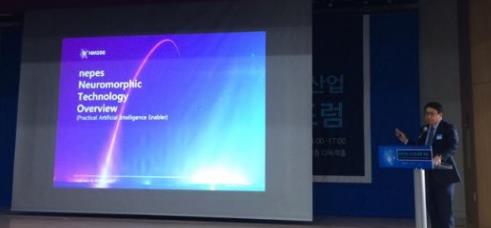
Executive Director Ahn stated, “The chip scheduled for release consists of 576 neurons. With 576 neurons, it is capable of powering most wearable devices. It operates on low energy of 0.3W, and the chip size is very small at 4.5mm,” adding, “The small size of the chip means that it can intelligentize electronic devices requiring intelligence and all hardware.”
The NM500 chip can utilize all data that a computer can accept, such as images, videos, text, and signals. Once the data is vectorized and stored in the chip, the chip itself determines the subsequent results. These results can then be used for verification, classification, motion tracking, and more.
Also, if more neurons are needed to analyze more data, it can be expanded by inserting other chips next to it or stacking them on top. The number of neurons can be expanded to over a million, and the response speed remains constant regardless of the number.
When combined with sensors, it is expected to be utilized in various applications, including not only electronic devices but also semiconductor inspection processes, X-ray image interpretation, automotive electronics, and home cognitive sensors.
We have also developed our own software, “Knowledge Builder,” which is a tool that trains intelligence according to field conditions and enables immediate use. The application boards scheduled for release are basically three types: Neuroshield, which allows for quick and easy experience with neurons; Neurobrick, which allows you to back up the number of neurons as much as you want; and Orange Brain Card, which has a built-in image sensor and is suitable for full-scale development.
Executive Director Ahn expressed his expectations, stating, “We plan to supply the NeuroShield product as open source. You are free to modify it to suit your needs and sell it. The reason for this openness is that we are currently lagging behind in the field of artificial intelligence software. However, since hardware is one of our strengths, we hope to become a global leader.”
Comments
Related news
[Reporter's Notebook] How Nvidia Became a Leading AI Company
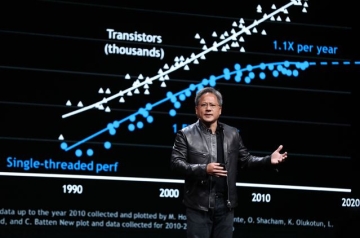
When was the possibility first discovered that GPUs, which initially emerged to simply assist CPUs in multimedia tasks such as gaming and video editing, could become a cornerstone in the field of artificial intelligence? Mark Hamilton, Vice President of Solution Architecture and Engineering at NVIDIA, says it was eleven years ago when CUDA, a parallel computing architecture that enhances computing performance based on GPU, was first shipped. Upon realizing that GPUs could not only run simple graphics codecs but could also execute general-purpose programs, he says NVIDIA first recognized the need to expand beyond being a graphics card manufacturer into the artificial intelligence field.
2017.05.30by 신윤오 기자
NVIDIA Announces AI Cloud Computing Collaboration Program with Server Manufacturer
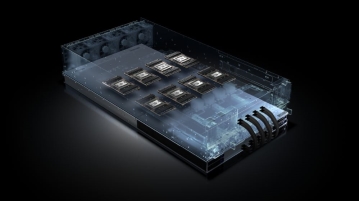
NVIDIA announced the NVIDIA HGX Partner Program, a partner program with global ODM vendors, at Computex, a technology exhibition held in Taiwan. Through this new partner program, designed to respond more rapidly to demand in artificial intelligence cloud computing, NVIDIA plans to conduct close collaboration with Foxconn, Inventec, Quanta, and Wistron. First, NVIDIA plans to pre-disclose the NVIDIA HGX reference architecture, NVIDIA GPU computing technology, and design guidelines to each ODM vendor. The HGX is the same datacenter design used in Microsoft's "Project Olympus," Facebook's "Big Basin" system, and NVIDIA's DGX-1 artificial intelligence supercomputer. As overall demand for artificial intelligence computing resources increased rapidly last year, the performance and market adoption of NVIDIA's GPU computing platform also increased sharply. Currently, all of the top 10 global hyperscale companies are utilizing NVIDIA GPU accelerators in their datacenters.
2017.05.31by 김자영 기자
ETRI to Develop Technology to Track Criminals Using CCTV AI
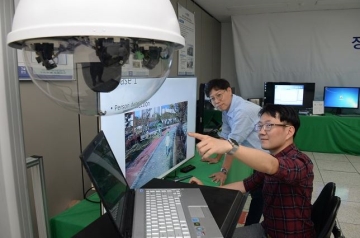
ETRI (Electronics and Telecommunications Research Institute) announced on the 1st that it will undertake development of a cloud-based intelligent video security incubation platform. This technology, by learning and providing intelligent public safety models optimized for diverse security environments based on a cloud platform, is expected to significantly contribute to strengthening market competitiveness through securing intelligent core technology for small and medium-sized video-related companies, as well as constructing next-generation advanced public safety platforms. Existing CCTV systems installed are widely utilized in crime resolution by providing decisive evidence; however, there are many situations where accurate identification by the naked eye is difficult. As a single operator monitors dozens of CCTV channel feeds over extended periods, there are cases where dangerous situations go undetected even when they occur. ETRI will develop next-generation advanced public safety technology by integrating artificial intelligence technology into security CCTV systems to automatically detect dangerous situations such as traffic accidents and crimes in real-time, alert police, and automatically identify and track suspects and vehicles related to incidents.
2017.06.01by 김자영 기자

Intel Unveils Next-Generation 'Core Ultra Series 3' and vPro Platform for Enterprise PCs
Intel has officially unveiled the "Intel Core Ultra Series 3" for next-generation enterprise PCs and the latest vPro platform, addressing a wide range of demands from enterprise notebooks to high-performance workstations.
2026.03.26by 배종인 기자

ROHM Launches ESD Protection Diode Compatible with High-Speed Interfaces of 10Gbps or Higher
Semiconductor specialist ROHM has developed the 'RESDxVx series' of ESD (electrostatic discharge) protection diodes capable of responding to next-generation high-speed data communication environments exceeding 10Gbps, simultaneously enhancing both signal quality maintenance required in high-speed interfaces and IC protection performance.
2026.03.26by 배종인 기자











