

Microchip Launches Controller with Full-Duplex Communication Support
 Published2017.06.26 14:03
Used by major OEMs in over 200 vehicle models
Microchip Technology Inc. announced the availability of its latest MOST150 Intelligent Network Interface Controller (INIC).
This product enables automotive manufacturers and Tier 1 suppliers to integrate MOST ® (Media Oriented Systems Transport) networks in both ring topologies and daisy-chain configurations over a coaxial physical layer supporting full-duplex communication.
Full-duplex daisy-chain networks allow two adjacent devices on a network to be connected with a single cable, reducing the number of cables and connectors required for reverse channels on each network.
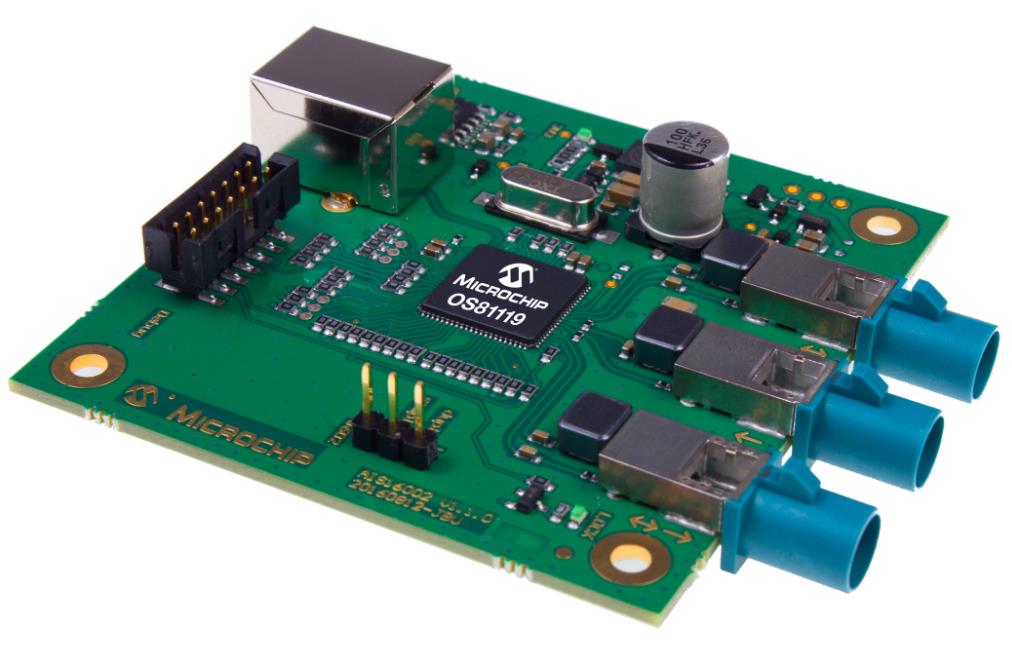
Microchip's OS81119 INIC can simplify the network architecture of automotive infotainment systems by using a coaxial physical layer (cPHY), an optical physical layer (oPHY), a daisy-chain topology, or creative hybrids of the two. Additionally, customers currently using MOST150 systems can quickly migrate to new topologies or add daisy-chained nodes with little or no hardware or software redesign.
“In an industry first, customers can now build a MOST150 network using a daisy-chain configuration,” said Dan Termer, vice president of Microchip’s Automotive Information Systems business unit. “MOST networks are a proven standard used by every major OEM in more than 200 vehicle models, and this new device is the culmination of continued innovation that makes MOST an even more cost-effective technology.”
Comments
Related news
Microchip Provides Wi-Fi SDK Supporting Apple HomeKit
Microchip Technology (Korean Representative Han Byung-don) announced that it provides a WiFi Software Development Kit (SDK) with complete certification supporting Apple HomeKit. MFi licensed vendors can design high-speed, low-power solutions through this SDK on the industry's first hardware-encryption-capable WiFi-based HomeKit development kit.
2017.05.19by 신윤오 기자

Microchip Simplifies Design and Implementation of Low-Power LCD Applications with 8-Bit MCUs
Microchip Technology announced the launch of a new family of low-power microcontrollers (MCU) with Core Independent Peripherals (CIP) for LCD driving and intelligent analog capabilities. The PIC16F19197 product family, consisting of nine products, includes a battery-friendly LCD drive charge pump, a 12-bit analog-to-digital converter (ADC2) with computation capability, a low-power comparator, and active clock tuning of a high-frequency oscillator. These products are 8-bit MCUs optimized for typical low-power battery-driven touch-enabled LCD applications.
2017.06.01by 김자영 기자
Microchip Launches 32-bit MCU Family with Power-Saving Features
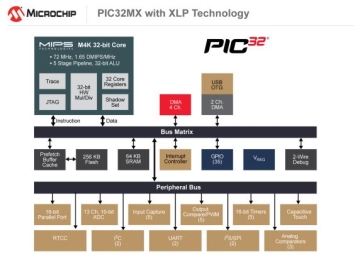
Microchip Technology has announced the latest PIC32 microcontroller family that integrates its XLP (eXtreme Low Power) technology into 32-bit products. The PIC32MX1/2 XLP provides an easy migration path for existing PIC32MX product customers to achieve high performance with significantly lower power consumption, enabling extended battery life while enhancing functionality in portable device applications. The PIC32MX1/2 XLP family reduces the need for code modifications for existing customers and delivers enhanced performance even with devices featuring fewer pins.
2017.06.20by 김자영 기자
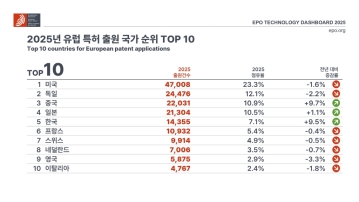
European Patent Applications Surpass 200,000 for the First Time… South Korea Maintains 5th Place, Led by Batteries and Telecommunications
According to the European Patent Office (EPO)'s 'Technology Dashboard 2025', European patent applications last year reached 201,974, surpassing 200,000 for the first time. Korean companies and inventors filed 14,355 applications, representing a 9.5% increase from the previous year and maintaining 5th place by country. Battery, digital communication, and semiconductor technologies led the growth, with Samsung ranking as the top EPO applicant for the second consecutive year and LG reaching 3rd place. The presence of major domestic cities such as Seoul, Suwon, and Yongin was also confirmed. It was also revealed that Korea's European patent strategy is expanding beyond individual technologies to span the entire industry.
2026.03.24by 명세환 기자

SK Telecom First Applies AI-Based Network Operations at Gwanghwamun K-Pop Concert
SK Telecom announced that it applied an AI-based network operation system for the first time at a large-scale K-pop concert held in the Gwanghwamun area of Seoul on March 21st, managing communication quality throughout the event. Mobile data usage during the three hours before and after the concert reached 12.15TB, approximately doubling compared to the same time slot the previous weekend. SK Telecom monitored traffic using the AI system 'A-One' in five-minute and 50-meter units to respond to potential overload situations, while also operating temporary communication facilities and on-site personnel in parallel. This case is interpreted as confirmation of the practical applicability of AI-based autonomous network operation in an environment where demand from dense events and foreign users increases simultaneously.
2026.03.23by 명세환 기자