


ADI Launches Switching Regulator with Reduced EMI/EMC Emissions
 Published2017.06.30 10:18
Analog Devices announced the release of the new LT8609S synchronous step-down switching regulator with 2A (3A peak) and 42V input.
This product adopts the proprietary Silent Switcher® 2 architecture, which is characterized by minimizing the hot loop area using two internal input capacitors and internal BST and INTVCC capacitors.
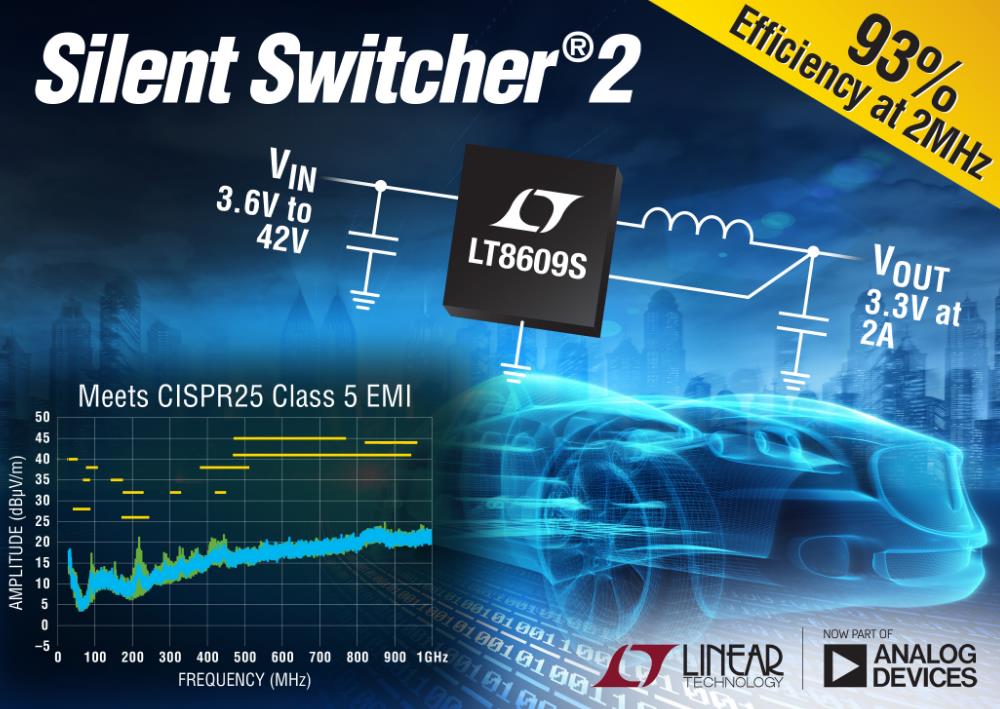
The LT8609S design significantly reduces EMI/EMC emissions by adopting a design in which stabilized switching edges and internal circuits are coupled to the ground plane, and copper patterns are used instead of bonding wires. Thanks to this improved EMI/EMC performance, it is less affected by board layout, which not only simplifies the design but also reduces risk when using 2-layer PC boards.
The LT8609S's unique design maintains an extremely low dropout voltage of 400mV (at 1.5A) under any conditions, enabling exceptional performance in situations such as automotive cold-crank. Furthermore, with a minimum on-time of just 45ns, it allows for switching from a 16V input to a 1.5V output at a fixed frequency of 2MHz, allowing designers to optimize efficiency and avoid noise-sensitive critical frequency bands.
Comments
Related news

ADI Responds Communication Base Station Requirements with 28-nanometer CMOS ADC
Analog Devices has newly launched the AD9208, a high-speed ADC product family. Designed for applications utilizing the gigahertz band, this new product was developed to meet the spectral efficiency requirements of 4G/5G multi-band wireless communication base stations. Using this new product can shorten the target execution time for manufacturing measurement instruments compliant with multiple standards, and can further enhance the detection range and sensitivity of defense electronic devices. Based on 28-nanometer CMOS technology, the AD9208 delivers industry-leading bandwidth and dynamic range to process the maximum number of signal bands. Additionally, while providing low-noise spectral density suitable for diversity ratio and I/O demodulation systems, power consumption is only half that of other solutions.
2017.06.22by 김지혜 기자
ADI Launches Transceiver with Enhanced ESD Protection
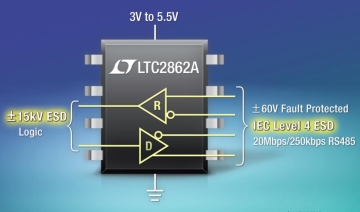
Analog Devices announced the release of LTC2862A, an upgraded version of the LTC2862 ±60V-tolerant RS485/RS422 transceiver. Half-duplex transceivers, which enable bidirectional communication but can only communicate in one direction at a time, have the advantage of eliminating field errors without costly external protection components by protecting actual RS485 systems from installation cross-wiring errors, ground voltage errors, or lightning-induced surge voltages that exceed the absolute maximum ratings of standard transceivers and cause overvoltage conditions. Both devices operate at 3V to 5.5V supply voltage and are compatible with the TIA/EIA-485-A standard. However, LTC2862A features superior ±40kV HBM and IEC Level 4 ESD ratings with higher specifications, and as a product that improves ESD protection and noise immunity of the previous version, it offers greater robustness and superior signal integrity.
2017.06.29by 김지혜 기자

ADI Introduces Low-Noise, Low-Power MEMS Accelerometer
Analog Devices has introduced two new accelerometers to be included in its widely used family of low-noise, low-drift, low-power 3-axis MEMS accelerometers. The ADXL356 and ADXL357 MEMS accelerometers deliver low noise performance at high frequencies, enabling high-resolution vibration measurement. This enables early detection of machinery faults in condition monitoring applications. While achieving this performance, the devices consume very low power, making them suitable for use in wireless sensor networks. The new MEMS accelerometers are designed to provide accurate and stable inclination measurement without saturating the sensor, even in environments with strong shock and vibration.
2017.06.29by 김지혜 기자

Intel Unveils Next-Generation 'Core Ultra Series 3' and vPro Platform for Enterprise PCs
Intel has officially unveiled the "Intel Core Ultra Series 3" for next-generation enterprise PCs and the latest vPro platform, addressing a wide range of demands from enterprise notebooks to high-performance workstations.
2026.03.26by 배종인 기자
ROHM Launches ESD Protection Diode Compatible with High-Speed Interfaces of 10Gbps or Higher
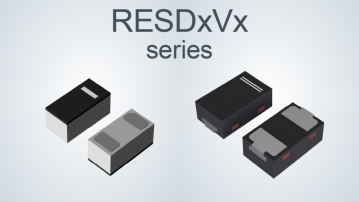
Semiconductor specialist ROHM has developed the 'RESDxVx series' of ESD (electrostatic discharge) protection diodes capable of responding to next-generation high-speed data communication environments exceeding 10Gbps, simultaneously enhancing both signal quality maintenance required in high-speed interfaces and IC protection performance.
2026.03.26by 배종인 기자