


It is time for the domestic software industry to foster practical talent.
 Published2017.07.06 17:22
IT Service Industry: Time to Find Fundamental Problems and Solutions
While talk of the Fourth Industrial Revolution continues, domestic software development is currently engaged in low-price competition. A venue was arranged to share opinions on the problems facing the domestic software industry and directions for its resurgence.
A seminar titled 'Domestic Business Application Trends and Activation Measures' hosted by Noonbisoft, a startup that creates business application platforms, was held at the Construction Mutual Aid Association on the 6th.
Professor Son Byeong-hee of Inha Technical College, who served as the moderator for the event, stated, “The core of the Fourth Industrial Revolution is software. While hardware is visible, allowing us to understand its direction of evolution and trends, software is invisible, making that impossible.” He added, “Software can expand infinitely because it incorporates human thought. Now is the time to find out how to respond to the current situation.”
Professor Kim Deok-hyeon of Sejong Cyber University, who delivered the keynote speech, stated, “I believe software capability should be defined as the capability of leading companies,” adding, “Our country focuses too much on the surface.” "We need to look into the cause of the phenomenon," he pointed out.
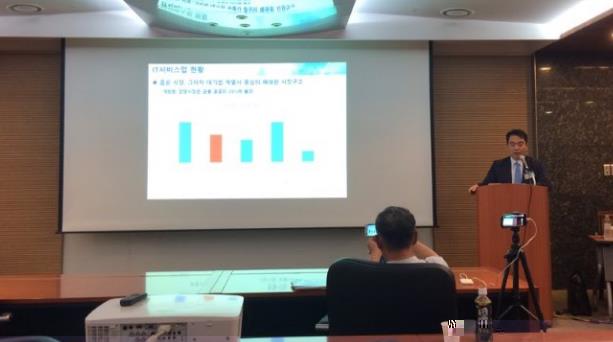
“A global software market share of around 1%, a lack of core/source technologies, low profitability of software companies, and reliance on overseas products and services—these are the phenomena occurring domestically,” he said, pointing out our capabilities, problems, and causes. “Upon analyzing the causes, they can be summarized into four categories: inconsistent government policies, a lack of rational thinking and execution capabilities, errors in recognizing the meaning and scope of IT and SW, and weak social/cultural capital.”
Yoo Ho-seok, a researcher at the Software Policy Research Institute who gave a presentation on "Directions and Conditions for the Re-launch of the Korean IT Service Industry," suggested the direction for the domestic market by citing the United States, a front-runner, and India, a latecomer, as examples.
Researcher Yoo stated, “We need to examine whether the same prescriptions have been in place for over a decade and if they are fundamental solutions,” explaining that the domestic market structure is centered on large corporations, involves wrongful practices by clients, and is stuck in a stalemate as ecosystem participants shift responsibility to one another due to government regulations. In addition, IT service companies determined that it is difficult to transition to a cloud-native model with high profitability and scalability.
He continued by saying, “Now that 20 years have passed since starting the software business, the IT service industry is at the stage of India’s staffing agency,” and suggested that a digital transition is the way to make a leap forward, citing the need for IT service capabilities to operate the real world beyond the virtual world by developing BPO and SaaS businesses based on customer process optimization capabilities.
"The Fourth Industrial Revolution will create a tremendous number of jobs in the software industry. However, without competence, one cannot enter the workforce even if the number of jobs increases. In practical work, the capabilities of the workforce are crucial," said Moon Yong-jun, a manager at SK C&C. "We must cultivate talent capable of applying their skills in the field, rather than relying on rote memorization. Now is the time for companies, not universities, to nurture talent."
This was followed by an introduction to the Pinion platform by CEO Chae Gap-byeong of Nunbisoft, global software company management strategies by Lee Seon, Director of the Macro Management Research Institute, a presentation by Professor Kang Jang-mook of Korea University on "Is the Software Policy Acceptable as It Is?", and a panel discussion.
Comments
Related news

[Planning-Autonomous Vehicles⑤] 'Running SW' Artificial Intelligence Cars, Software Dominates
Vehicles with electrified systems are commonly referred to as "running semiconductors." However, as the importance of software that drives these electronic devices grows, it may now be appropriate to call automobiles "running software." Whereas the previous trend was to install various functions for vehicle stability and convenience, with accompanying software (SW) to operate them, automobiles are increasingly becoming software-centric. Vehicle software can be divided into electronic component SW platforms and infotainment platforms. In the electronic component SW platform, AUTOSAR (automotive open system architecture), an open-standard automotive software, is at the center. AUTOSAR comprises 9 core partners with approximately 50 member companies, including BMW, Bosch, Continental, Daimler, Ford, GM, Peugeot Citroën, Toyota, and Volkswagen as core partners, consisting of 7 OEM companies and 2 Tier 1 suppliers. The purpose of AUTOSAR is to address the growing complexity of software as electronic devices increase, and to reduce costs by enhancing software reusability.
2017.05.22by 김지혜 기자
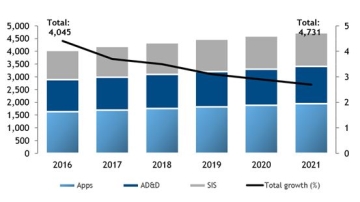
Software Thrives in Digital Transformation, Growing 3.7% This Year
Last year, the domestic software market grew 4.4% compared to 2015, and is projected to expand by approximately 3.7% this year. According to a recent report by IDC Korea (CEO Hong You-suk), titled "Korea Software Market Forecast Report 2017-2021," the domestic software market exceeded 4 trillion won for the first time, recording a market size of 4.045 trillion won (based on software licenses).
2017.06.13by 신윤오 기자
Korea's Largest Cloud Open Source Software Event Opens
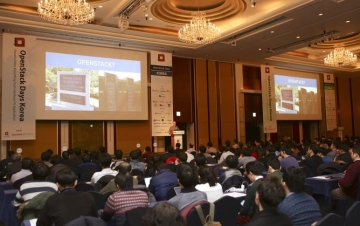
The OpenStack Foundation (www.openstack.org) announced that it will host "OpenStack Days Korea 2017" on July 13-14 at Lotte Hotel World Jamsil and COEX. The event, jointly hosted by the OpenStack Foundation and the OpenStack Korea Community, was first held in 2014 as part of efforts to promote OpenStack domestically and revitalize the related ecosystem. Each year, the event attracts 800 to 1,000 participants and has established itself as Korea's largest cloud open source software conference.
2017.06.27by 신윤오 기자
.jpg)
SalePoint Signs Multi-Year Partnership Agreement with AWS… Promoting Identity Security that Integrates Even AI Agents
Sailpoint has entered into a multi-year strategic partnership agreement with AWS and is moving forward with establishing an integrated governance system that manages both human and non-human identities together. The plan is to consistently manage access permissions in an environment where AI agents are increasing as work execution entities, while applying the principle of least privilege and automated policy enforcement. The two companies plan to jointly expand capabilities to manage the identities of various entities, including AI agents, within a single layer in the AWS environment. This collaboration is interpreted as a move to design security and governance together in corporate environments where AI adoption is expanding.
2026.03.26by 배종인 기자
.png)
Databricks Unveils Open AI Security Monitoring 'Lakewatch'
Databricks entered the security market on March 24 by unveiling LakeWatch, an open-source agentic SIEM. The core functionality of this product is to integrate and analyze security, IT, and business data in a single environment to support AI-based threat detection and investigation. The company explained that it reduces the limitations of existing security operations centers, which have had to forgo some data due to high cost structures, and enables large-scale data analysis and automation based on open formats and ecosystems. LakeWatch is currently offered as a private preview, with Adobe and Dropbox mentioned as early customers. Databricks also announced an expanded partnership with Anthropic as well as the acquisition of Antimatter and SiftD.ai.
2026.03.26by 배종인 기자











