


Real-time networking TSN, technology development is active as standardization gains momentum
 Published2017.07.10 16:22
International standardization movement is diligent
As 'real-time networking', which analyzes and processes data in real time and controls networking time, is gaining attention as a next-generation network, attention is also being focused on the progress of standardization.
While networks have evolved to be able to upload large amounts of data quickly, real-time networking is evolving into TSN (Time Sensitive Networking), which can transmit information in real time and even predict measurement information.
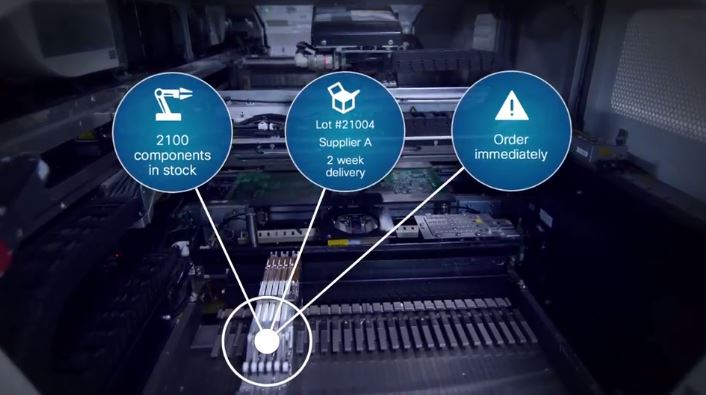
Cisco's Manufacturing Optimization Process (Photo Source: Cisco Homepage)
Research is in progress by establishing a working group and test bed related to TSN.
TSN is currently being standardized by two associations, the Internet Engineering Task Force (IETF) and the Institute of Electrical and Electronics Engineers (IEEE).
Since 2014, IETF has been forming a working group to extend time-controlled network technology to the L3 network layer using IP/MPLS-based DetNet (Deterministic Networking) technology, and is currently in the process of standardizing it.
Time-sensitive technologies are based on the Software Defined Networking (SDN) architecture. It uses an integrated control method. SDN sets the final transmitter and receiver within the domain, calculates a path that satisfies the maximum packet size, transmission rate, and delay of the DetNet flow based on the extended PCE (Path Computation Element), and then reserves time-sensitive stream resources to each node through the SDN controller. There are many things to consider when introducing time-sensitive technology to the entire L3 layer, so the scope of DetNet was limited to the enterprise network.
According to ETRI's report on trends in ultra-low latency infrastructure technology, the IETF is moving toward DLNEx (Latency Characteristic Exposure for 'Deterministic' Latency Network), which expands time-controlled network technology to the entire Internet.
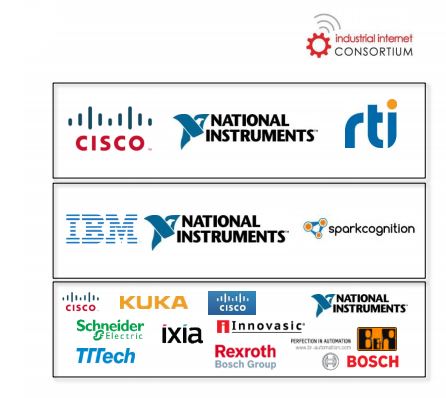
IIC Consortium (Photo courtesy: NI)
IEEE is working on standardizing TSN technology, which applies AVB (Audio Video Bridging), an audio and video transmission technology, to Ethernet.
It uses time-sensitive lossless protection techniques to deliver streams without loss and with low latency. It splits the stream and delivers it through multiple paths within the TSN domain, and merges the traffic received through multiple paths to provide high redundancy even in the event of a failure.
For the same priority, the ID and VLAN (Virtual Local Area Network) ID, destination address, maximum frame size and number of frames in the stream, priority, maximum delay value are transmitted, and a TSN is allocated between relay nodes after receiving a ready message.
Accordingly, TSN-related technology development is also actively taking place domestically and internationally. In Korea, the Electronics and Telecommunications Research Institute, Korea Aerospace University, etc. are developing AVB-related chipsets and systems, and ETRI is researching TSN technology as an infrastructure technology for unmanned vehicle business.
Internationally, Cisco, National Instruments, Intel, KUKA, Schneider Electronic, TTTech, and Bosch Group's Rexroth have formed the Industrial Internet Consortium (IIC) to build a TSN testbed and develop related products that support TSN 802.1.
If you don't use a 'common language' like TSN and OPC-UA protocols, you may be left behind in the relevant industries.
“There will come a time when it will be difficult to survive without using the OPC-UA protocol or TSN,” said Jongwoo Kim, manager of measurement embedded marketing at National Instruments (NI). At the NI Measurement Forum, Manager Kim emphasized interoperable control rather than one-sided monitoring, saying, “If you uploaded data, you should take it down.”
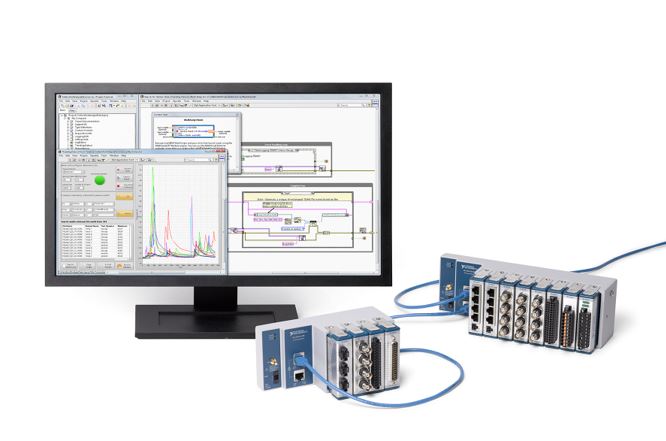
This year, Cisco and NI each released a network switch (IE4000Switch) and controller (cDAQ-9185 and cDAQ-9189) that implement TSN.
TSN is utilized not only as a network but also as a power switch. Manager Kim said, “TSN increases the efficiency of power distribution in smart grid projects. It has already been introduced in smart grid projects abroad, and there will be a move to introduce it in Korea as well.”
Comments
Related news
Schneider Hosts Smart Factory Process Automation Conference
Schneider Electric Korea announced that it successfully held the Smart Factory Process Automation Conference 2017 at MVL Hotel in Yeosu, Jeollanam-do on the 8th. The conference was held to officially announce the opening of Schneider Electric's Yeosu branch by inviting industry officials from the oil and gas, and petrochemical sectors in Yeosu, and to showcase Schneider's process automation solutions. The conference was well-attended with over 100 employees from major domestic and international companies including LG Chem, GS Caltex, Lotte Chemical, and POSCO ICT. The conference was attended by more than 20 employees of Schneider Electric Systems Korea, which oversees Schneider Electric's process automation business, including Executive Vice President Jeon Seok-bae. Starting with Executive Vice President Jeon Seok-bae's keynote speech, a total of six seminar sessions were conducted, with each session introducing Schneider Electric's next-generation process automation solutions. In addition, demonstrations of approximately 10 types of products were conducted, including the Foxboro Evo process automation system, Triconex, and Modicon PLC. Furthermore, customized process automation solution consulting tailored to business needs was provided to customers pursuing process efficiency and safety, which received great response. The Foxboro Evo process automation system showcased at the conference is characterized by excellent fault tolerance and highly available control functions. Through the non-stop component product line, it collects business-valuable data and shares it with field operators, and supports insightful decision-making based on the collected data.
2017.06.12by 김자영 기자
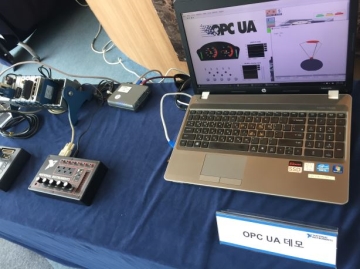
[Photo News] Introducing NI Smart Factory Solutions
National Instruments held a measurement and control symposium on Tuesday the 4th, introducing core technologies and solutions for implementing smart factories. A symposium on the same topic will also be held at BEXCO in Busan on Thursday the 6th.
2017.07.04by 김자영 기자
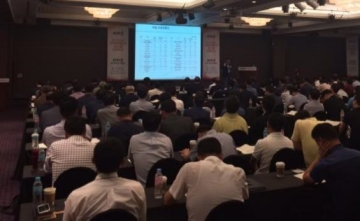
Smart factory is not an option but a necessity in the Fourth Industrial Revolution era
"The keyword of the Fourth Industrial Revolution is manufacturing." At the keynote address of the Korean manufacturing smart factory roadmap conference, Professor Park Hee-jae from Seoul National University stated, "Manufacturing consists of two aspects: the product that needs to be made and the process of making the product. Making these two aspects smart is the direction that manufacturing must take in response to the Fourth Industrial Revolution." The event was held on the 4th at Geomungo Hall at The K Hotel Yangjae, hosted by the Korea Management Certification Institute, with presentations centered on the core hardware and software strategies of smart factory. Smart factory is gaining attention as an essential condition not for choice but for survival in the Fourth Industrial Revolution era.
2017.07.04by 김지혜 기자
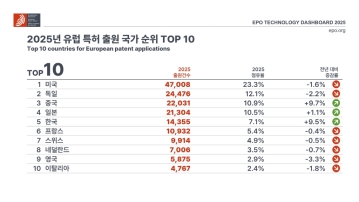
European Patent Applications Surpass 200,000 for the First Time… South Korea Maintains 5th Place, Led by Batteries and Telecommunications
According to the European Patent Office (EPO)'s 'Technology Dashboard 2025', European patent applications last year reached 201,974, surpassing 200,000 for the first time. Korean companies and inventors filed 14,355 applications, representing a 9.5% increase from the previous year and maintaining 5th place by country. Battery, digital communication, and semiconductor technologies led the growth, with Samsung ranking as the top EPO applicant for the second consecutive year and LG reaching 3rd place. The presence of major domestic cities such as Seoul, Suwon, and Yongin was also confirmed. It was also revealed that Korea's European patent strategy is expanding beyond individual technologies to span the entire industry.
2026.03.24by 명세환 기자
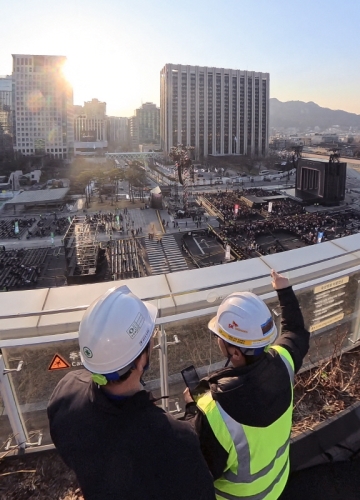
SK Telecom First Applies AI-Based Network Operations at Gwanghwamun K-Pop Concert
SK Telecom announced that it applied an AI-based network operation system for the first time at a large-scale K-pop concert held in the Gwanghwamun area of Seoul on March 21st, managing communication quality throughout the event. Mobile data usage during the three hours before and after the concert reached 12.15TB, approximately doubling compared to the same time slot the previous weekend. SK Telecom monitored traffic using the AI system 'A-One' in five-minute and 50-meter units to respond to potential overload situations, while also operating temporary communication facilities and on-site personnel in parallel. This case is interpreted as confirmation of the practical applicability of AI-based autonomous network operation in an environment where demand from dense events and foreign users increases simultaneously.
2026.03.23by 명세환 기자











