


ADI Releases Operational Amplifier with Low Noise Characteristics via Zero Drift Application
 Published2017.07.11 11:24
Analog Devices announced the release of the new LTC2063 zero-drift operational amplifier, which typically consumes 1.3μA (up to 2μA) at an input voltage of 1.8V.
This micropower amplifier is characterized by unparalleled precision. Thanks to its high-precision input characteristics, large feedback network resistors can be used, allowing for reduced power consumption while maintaining accuracy even in high-temperature environments.
Rail-to-rail input and output characteristics enable the use of a single power supply and support an enhanced dynamic range. The built-in EMI filter provides 114 dB of EMI rejection performance at 1.8 GHz. Due to the unique 1/f low noise characteristics of the zero-drift architecture applied to this product, the LTC2063 is highly suitable for the amplification and conditioning of low-frequency sensor signals in portable and wireless sensor network applications, as well as in high-temperature industrial and automotive systems.
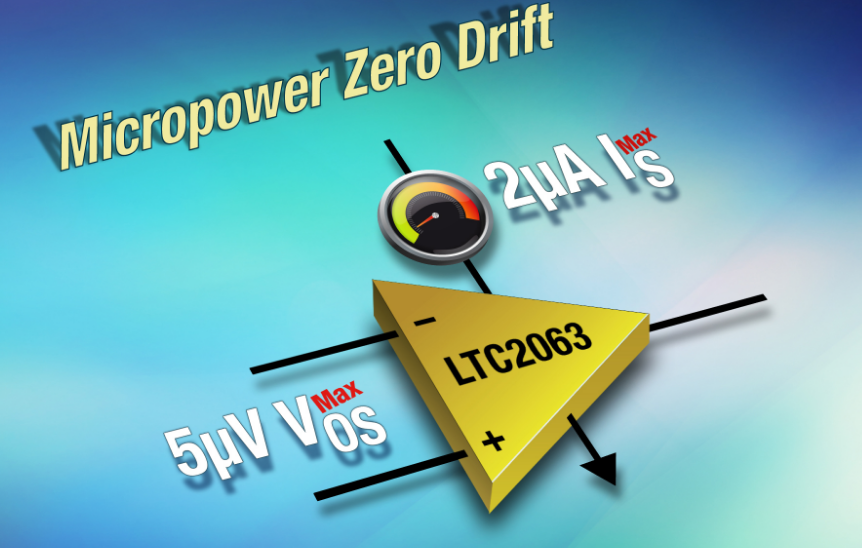
The LTC2063 is supplied in SOT-23 and SC70 packages. The SC70 version includes a shutdown mode that reduces current consumption to 90nA when the amplifier is not in use, making it suitable for sensor applications with ultra-low power duty cycles. For example, a low-duty-cycle high-precision oxygen detection circuit described in the datasheet consumes an average current of 200 nA or less.
Ross Yu, Marketing Manager at Dust Networks®, stated, “The LTC2063 is a precision measurement solution of a completely different dimension that can be deployed anywhere,” and added, “Its ultra-low power and high-precision characteristics are a perfect match for Dust Networks’ SmartMesh® wireless sensor networks. Thanks to this combination, the scope of application for precision measurement technology, which was previously difficult to use in practice, will expand further in the future.”
Comments
Related news
ADI Launches Switching Regulator with Reduced EMI/EMC Emissions
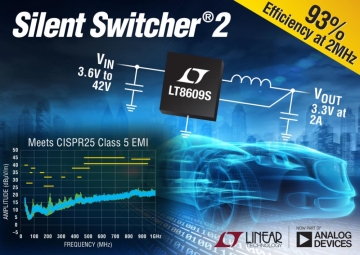
Analog Devices announced the launch of LT8609S, a new synchronous step-down switching regulator with 2A (3A peak) and 42V input capability. The product features the company's proprietary Silent Switcher® 2 architecture, characterized by minimization of hot loop area through the use of two internal input capacitors and internal BST and INTVCC capacitors. The LT8609S design adopts a topology where stabilized switching edges and internal circuits are coupled to the ground plane, and employs copper patterns instead of bond wires, thereby significantly reducing EMI/EMC emissions. Thanks to this enhanced EMI/EMC performance, the design is less susceptible to board layout variations, which simplifies design efforts and reduces risk even when using two-layer PCBs.
2017.06.30by 김지혜 기자
ADI Releases MOSFET Driver Capable of Operating at 150V Supply Voltage
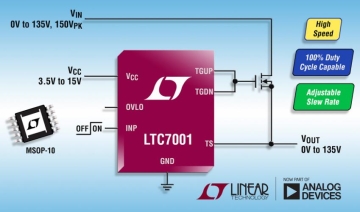
Analog Devices announced the release of the LTC7001, a fast high-side N-channel MOSFET driver capable of operating with supply voltages up to 150V. The product's internal charge pump fully drives an external N-channel MOSFET switch, enabling it to maintain an always-ON state. The LTC7001's powerful 1Ω gate driver can drive MOSFETs with large gate capacitance within very short transition times and a propagation delay of 35ns, making it ideal for high-frequency switching and static switch applications. The LTC7001 receives ground-referenced low-voltage digital input signals and rapidly drives high-side N-channel power MOSFETs, with the MOSFET drain voltage allowed to range from 0V to 135V (150V absolute maximum).
2017.07.07by 김지혜 기자

[Interview] "How to Select the Best ADC for Your Application"
Is an ADC a good product just because it has high resolution and fast sampling speed? And if the price is also cheap, can we call it the most ideal ADC? Park Sun-hwa, Manager of Field Application Engineering at Analog Devices (ADI), says "not necessarily." "Rather than pinpointing just one condition as ideal, the best ADC is the one that fits the application you're designing." For example, it works like this. Depending on what signal you detect—light, sound, video, etc.—the sensor differs, and according to the type of signal, the sensor stage used before the ADC also changes. What's important in a sensor is sensitivity and dynamic range. If the sound you're trying to detect is sometimes loud and sometimes quiet, the detection range must be wide.
2017.07.10by 김지혜 기자

Intel Unveils Next-Generation 'Core Ultra Series 3' and vPro Platform for Enterprise PCs
Intel has officially unveiled the "Intel Core Ultra Series 3" for next-generation enterprise PCs and the latest vPro platform, addressing a wide range of demands from enterprise notebooks to high-performance workstations.
2026.03.26by 배종인 기자

ROHM Launches ESD Protection Diode Compatible with High-Speed Interfaces of 10Gbps or Higher
Semiconductor specialist ROHM has developed the 'RESDxVx series' of ESD (electrostatic discharge) protection diodes capable of responding to next-generation high-speed data communication environments exceeding 10Gbps, simultaneously enhancing both signal quality maintenance required in high-speed interfaces and IC protection performance.
2026.03.26by 배종인 기자











