


[Exhibition Topic] Five unique ideas, from practical to life-oriented
 Published2017.07.17 06:58
Fresh research exhibits on smartphone-based home IoT, wireless charging batteries, etc.
The 48th Summer Conference of the Korean Institute of Electrical Engineers (KIEE, Chairman Park Jun-ho) was held at BEXCO. The society selected and exhibited basic research ideas for the electric power industry. The eyes of the college students introducing their ideas were serious in a place where college students from all over the country gathered. There, they selected five interesting ideas that they discovered.
1. Solar water purification boat that eliminates green algae - Seoul National University of Science and Technology
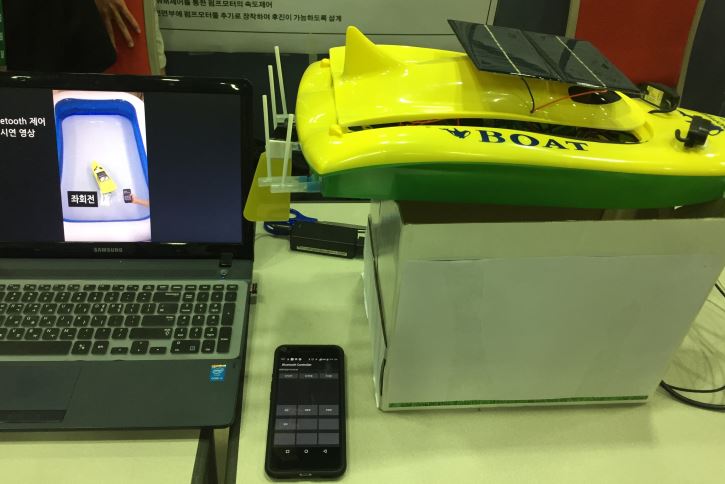
It is a solar boat that travels through still water. It supplies power through solar panels attached to the ceiling, but uses DC batteries on days with little sunlight. The Arduino inside the boat is connected to a smartphone via Bluetooth, allowing for remote control of direction changes and on/off. The infrared sensor detects obstacles and performs autonomous driving to avoid them. The participating student said, “In the future, we plan to control the speed of the pump motor with PWM (pulse width modulation) control, and add a pump motor to the front to enable reverse movement.”
2. Don’t buy new home IoT devices. Make use of your unused smartphone! - Kyungsung University
“Do you have a smartphone that you don’t use at home?” For home IoT, we utilized smartphones that are left at home. Instead of purchasing a ‘responsible’ device for each device, we devised a way to utilize existing devices. If you plug an unused smartphone into a home IoT device, it will be connected to sensors and Bluetooth throughout the house, allowing you to control gas valves, lights, and windows from a user smartphone app. You can also set up CCTV. By connecting to Wi-Fi, you can also implement a voice assistant like Google Assistant.
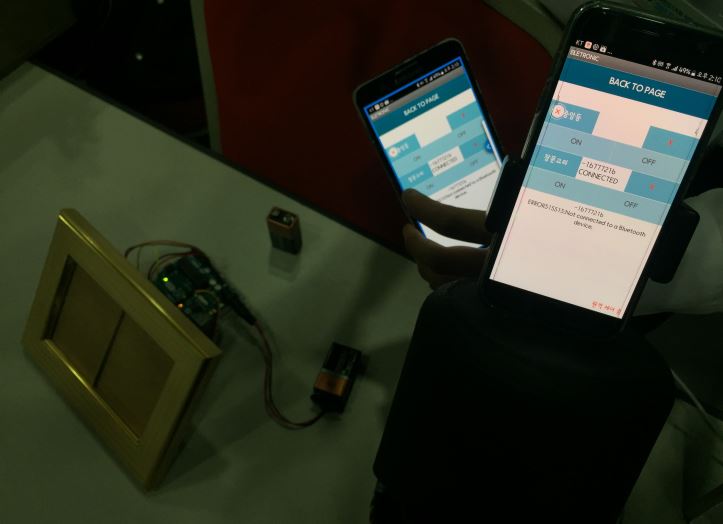
Demonstrating the window opening and closing control function using a smartphone
3. Wireless charging auxiliary battery that charges multiple smartphone devices at once - Hankyung University
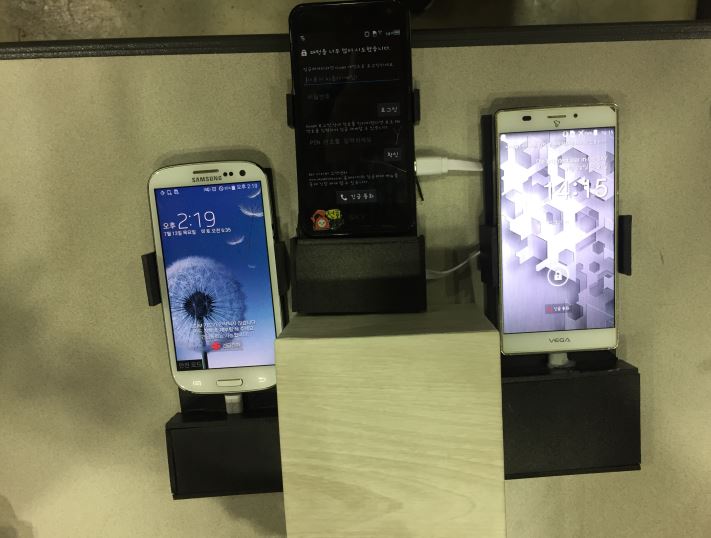
The charger is a 1:1 structure. The auxiliary battery that connects the cable and the mobile phone, or the wireless pad that charges by placing it on the pad wirelessly, can only charge one at a time. To eliminate this inconvenience, we designed a simultaneous(?) charger that can 'fill up to three smartphones with one auxiliary battery'.
The charging terminal can charge a mobile phone located up to 15 cm above and 6 cm to the side. The participating student said, “Currently, it is presented in the form of a terminal attached to a mobile phone, but if the receiver is built into the mobile phone manufacturing process, more convenient and stable wireless charging will be possible.”
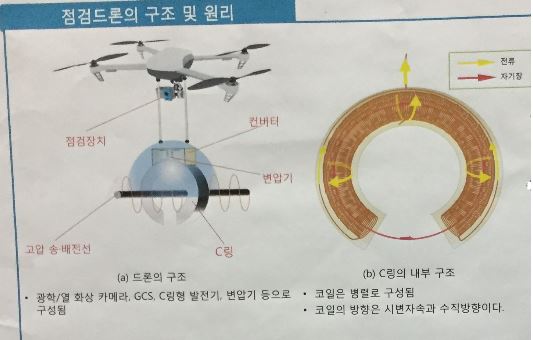
4. Wireless self-power supply of power facility inspection drone - Chungnam National University
Korea Electric Power Corporation is discussing inspections using drones, but the drone’s battery life of about 20 minutes is a limitation. Considering the power consumption of the travel section, the inspection time is actually only a few minutes.
Add optical/thermal imaging cameras, C-ring generators, and transformers to drones. The drones inspect high-voltage transmission and distribution lines and self-supply power with C-rings. Using thermal imaging cameras attached to drones, autonomous flight is also possible. “If drones can self-supply, their range of movement will expand, which will reduce the number of drones introduced. People can only detect and correct abnormal data, which will increase efficiency.”
5. LED streetlights, 'fine dust air purifiers' that can be used all day long, not just at night - Chungnam National University
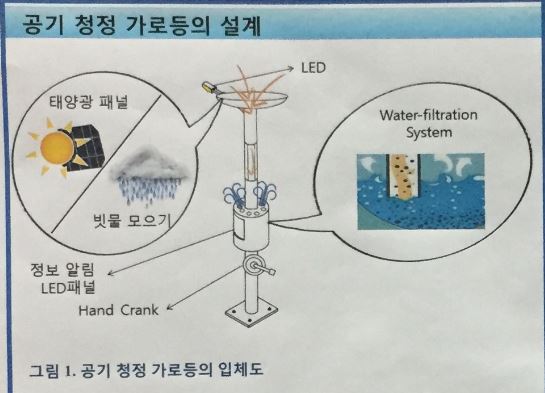
Ultrafine dust is polar. Ultrafine dust contains nitrate and sulfate components that dissolve when in contact with water. Rainwater collected by the rainwater collector is stored in the lower water tank, and only the necessary amount is drawn up to the main body in the middle. It is a structure that purifies fine dust by the absorption power of water.
“There is no need for a separate filter, so there is no need for maintenance personnel, and it can be used semi-permanently.” The material used to store water is made of a material that is not affected by environmental hormones or temperature, lowering the temperature in the summer and increasing humidity in the winter to create a comfortable environment.
Comments
Related news
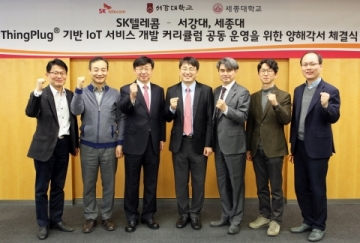
SK Telecom Provides IoT Product Development Environment for University Students via 'IoT Platform'
SK Telecom announced on the 18th that it has introduced 'ThingPlug(Thingplug)', an IoT platform that supports anyone to easily develop IoT (Internet of Things) services and apply them to real-life situations, into university regular curricula.
2016.03.18by 명세환 기자
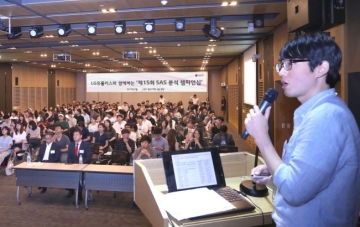
LG Uplus Hosts 'SAS Analytics Championship' to Seek Big Data Talent
LG Uplus is hosting the "15th SAS Analytics Championship" competition open to university students and graduate students nationwide as part of its initiative to recruit specialized talent in the big data industry. The competition is co-hosted with SAS Korea. The SAS Analytics Championship is a big data analytics competition that SAS Korea has conducted annually since 2002 to nurture next-generation "Data Scientists" in the big data era.
2017.07.04by 김자영 기자
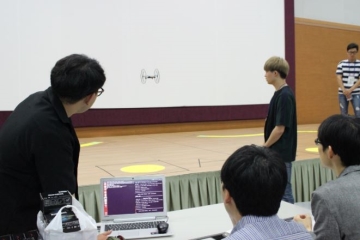
MathWorks: "Autonomous drone flight using MATLAB, practical training to be supported next year"
The 4th Mini Drone Autonomous Flight Competition for expanding the foundation of the drone industry was held on the 13th (Thursday) at BEXCO. Co-hosted by Meshworks, Kwangwoon University, and the Korean Institute of Electrical Engineers, the event was conducted in a two-division league format with participation from 5 undergraduate teams and 9 graduate teams from engineering disciplines. The competition looked distinctly different from existing drone competitions. For one, the drones were so small that they were barely visible on the screen, and there was no sign of the excitement found in drone soccer or racing. It was so quiet that one wondered if it had even started.
2017.07.14by 김자영 기자
Korea Instrument, KOLAS Accredited Calibration Agency First to Simultaneously Acquire ISO/IEC 27,001·27,701
Korea Instrument has become the first among KOLAS accredited calibration agencies to simultaneously acquire ISO/IEC 27,001 and ISO/IEC 27,701 certifications. Through its proprietary platforms CWIZ Enterprise and CWIZ Partners, the company has embedded information security and personal data protection requirements across all business processes including customer information, equipment data, and calibration reports, with plans to continuously advance its management system through regular audits and security inspections.
2026.10.12by 배종인 기자
TeamViewer One, IT Incident Automation Workflow and Resolution Center Enhanced
TeamViewer has added IT incident automation capabilities and an advanced Resolution Center to its integrated digital workplace management platform 'TeamViewer ONE'. Recurrent service disruptions, configuration errors, and capacity shortages are automatically handled according to preset policies, and device status verification through script deployment can be managed in a unified interface, significantly reducing repetitive tasks for IT teams.
2026.10.12by 배종인 기자











