


SKT to Commercialize 'Quantum Cryptography' That Cannot Be Broken Even by Supercomputers
 Published2017.07.24 07:00
Lowering prices and reducing size makes it possible to introduce all communication devices
There have been growing concerns that existing encryption systems will collapse once quantum computers capable of prime factorization are commercialized. On the 23rd, SK Telecom announced that it has developed a Quantum Random Number Generator (QRNG) and a quantum cryptographic communication security system as security solutions for quantum computers.
Conventional optical communication contains countless photons, making it impossible to detect even if some keys are intercepted or duplicated, thus posing a high threat of hacking. This is also why existing encryption systems are expected to collapse once quantum computers are developed. However, a quantum encryption key is a single photon.
When A transmits information to B, the information becomes meaningless except during transmission via the 'normal course.' If a hacker intervenes midway to measure the information and retransmit it to B, the hacker cannot obtain the information due to the uncertainty and non-replicability principles, and B detects the fact of eavesdropping as the error is amplified.
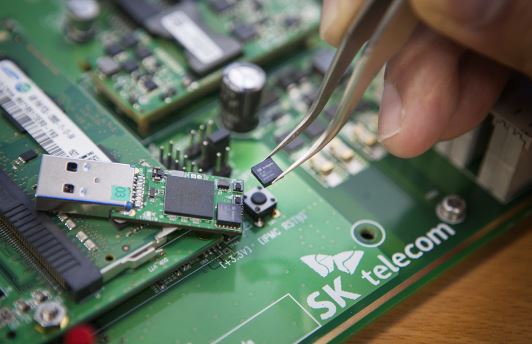
Despite these advantages, quantum random number generators could not be commercialized because they are at least the size of a palm and cost tens of millions of won. The quantum random number generator developed by SK Telecom is in the form of a 5x5mm chip, smaller than a fingernail, and costs tens of thousands of won.
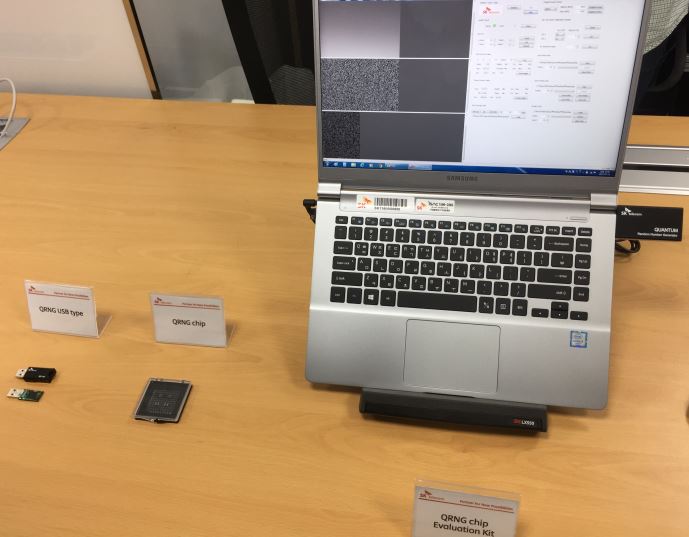
A demonstration showing the light sampling stages is being presented by connecting an evaluation kit to a laptop.
Starting from the top left, in the order of 10-bit, 2-bit, and 1-bit.
The second sampling step followed the U.S. standard (NIST SP 800-90 ADC).
"It is a security chip that can be introduced into all fields where communication is involved, such as digital certificates, Hardware Security Modules (HSMs) for connected cars, corporate servers, home IoT, and smart factories," said Kwak Seung-hwan, Head of SKT's Quantum Tech Lab. "We expect it to provide a high level of security for end-to-end communication."
SKT conducted technology tests at central stations in Seongnam, Suwon, Yongin, and Yangpyeong, and has been operating a security network utilizing quantum information and communication technology on the LTE network throughout Sejong City from June of last year until now. Lab Director Kwak Seung-hwan stated, "We plan to implement quantum technology by the third quarter of this year with the goal of applying it to all networks," and added, "We are also researching how to apply encryption to Li-Fi, a wireless communication technology that utilizes light."
Comments
Related news
SKT to establish IoT security guidelines
SK Telecom announced that following its appointment as the chair of the 'IoT Security Division,' it will take the lead in discovering security policies to activate the IoT industry. The 'IoT Security Division' is a consultation body comprising private companies such as SK Telecom and LG CNS, related startups, academia, and research institutions. In March, private companies and research institutions united to launch the 'Public-Private IoT Expansion Council' for systematic IoT industry development, and structured the council into four divisions: ▲Security ▲Convergence ▲Network·Service ▲Platform·Standardization. Among these, the 'IoT Security Division' took swift action to strengthen IoT ecosystem competitiveness by appointing a chair organization and embarking on substantive activities.
2017.06.05by 김지혜 기자
SKT Successfully Transmits and Receives Quantum Cryptographic Keys on Experimental Network 112km Round Trip Between Bundang and Suwon
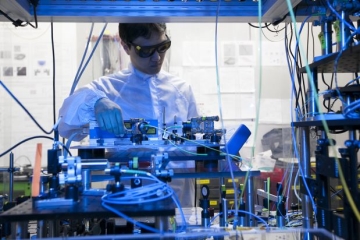
SK Telecom has developed a dedicated quantum key distribution repeater and announced that it successfully transmitted quantum cryptographic keys over a 112 km round-trip experimental network spanning from Bundang to Yongin and Suwon. By connecting multiple units of the newly developed quantum key distribution dedicated repeater, quantum cryptographic communication can be transmitted over hundreds to thousands of kilometers. Since quantum key distribution uses extremely weak signals at the single quantum level, quantum cryptographic key transmission was only possible up to approximately 80 km prior to the development of the dedicated repeater. Despite its excellent security performance, the 'distance limitation' has been a major obstacle to the commercialization of quantum key distribution. To overcome this, SK Telecom developed a dedicated quantum key distribution repeater (Trusted Repeater) and enabled transmission of quantum cryptographic keys beyond 80 km. For example, considering that the distance from Seoul to Busan is approximately 460 km, if five dedicated repeaters are installed, quantum cryptographic keys transmitted from Seoul can be received in Busan. SK Telecom plans to apply the dedicated repeater to its commercial network in part by the end of this year and gradually expand the coverage of quantum key distribution services.
2017.06.19by 김자영 기자
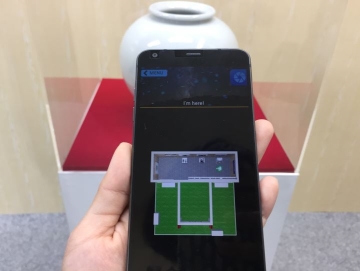
Commercialization of Li-fi with lighting equipped with dedicated modules
An app utilizing Li-Fi has been launched. Uyang D&U introduced a Li-Fi app called Lion, which displays relevant data when visitors stand in front of exhibits in museums. It leverages OCC (Optical Camera Communications) technology that receives data when LED light enters the screen. The company also collaborated with Purple Ocean, a game development specialist, to showcase an AR game called "Starlight Tree" that reflects LED. Similar to PokéStops and gyms in Pokémon Go, plants in the game grow rapidly wherever there is LED. Currently, data load speed varies depending on the smartphone's performance. In the on-site demonstration, it took approximately 3 seconds for the camera to recognize the light, load the data, and navigate to the page on the mobile device tested.
2017.07.03by 김자영 기자

[Planning - Autonomous Vehicles⑧] Cybersecurity is the key to preventing autonomous vehicles from becoming "running weapons."
Security technology is garnering attention for realizing autonomous driving technology at level 4 or higher, where vehicle control is transferred from the driver to the vehicle. This is because drivers must be assured that autonomous vehicles remain safe even when exposed to threat factors such as vehicle system errors or hacker intrusions. Automotive semiconductor companies such as Renesas, Infineon, NXP, and Maxim have been applying Hardware Security Modules (HSM). The HSM supports key management functions by centrally storing keys and transmitting them in encrypted form.
2017.07.17by 김자영 기자
.png)
Databricks Unveils Open AI Security Monitoring 'Lakewatch'
Databricks entered the security market on March 24 by unveiling LakeWatch, an open-source agentic SIEM. The core functionality of this product is to integrate and analyze security, IT, and business data in a single environment to support AI-based threat detection and investigation. The company explained that it reduces the limitations of existing security operations centers, which have had to forgo some data due to high cost structures, and enables large-scale data analysis and automation based on open formats and ecosystems. LakeWatch is currently offered as a private preview, with Adobe and Dropbox mentioned as early customers. Databricks also announced an expanded partnership with Anthropic as well as the acquisition of Antimatter and SiftD.ai.
2026.03.26by 배종인 기자











