



[Issue] How will the autonomous vehicle test site opening this October be operated?
 Published2017.07.25 09:26
After opening in the second half of 2019, we plan to continue research until fully autonomous driving.
In line with the government's plan to achieve Level 3 autonomous driving technology by 2020, the country's largest driving test site, 'K-CITY', will open for the first time in October.
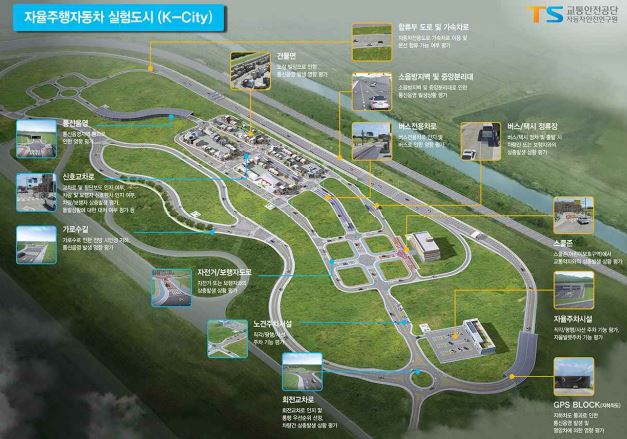
As of May of this year, there are a total of 19 autonomous vehicles that have been granted temporary operation permits nationwide. These autonomous vehicles are traveling across the country, but they are inaccessible to child protection zones and have limitations in testing on actual roads. Since numerous tests are required for safety, K-CITY in Hwaseong is a place where scenarios can be reenacted and tested repeatedly.
K-CITY benchmarked M-CITY, a 40,000-pyeong test bed in Michigan, USA. It will be operated by the Korea Automobile Testing & Research Institute (KATRI) with a communications network (5G, WAVE) and a precision road map built on 110,000 pyeong. In the second half of 2019, when it is scheduled to open, it plans to build a traffic environment of downtown, community, highway, suburban road, and autonomous parking facility so that it can test vehicle responses to various situations.
We met with Dr. Yongwon Yoon, an engineer at the Autonomous Driving Research Center of the Autonomous Driving Vehicle Center, an official of K-CITY, and asked him about it.
Q. I heard that K-CITY is like building a virtual city.
A. When I went to the M-CITY opening ceremony in July last year, it looked like a drama set, with houses, buildings, and even a school zone. K-CITY ultimately wants to build a virtual city by 2019. When a self-driving car stops at the starting point, if the control center gives a signal, the area moves according to the scenario. Whether it's a person, a traffic light, or a surrounding car. This is where they test whether the sensors in the car are working properly and whether there are any malfunctions.
Q. If it's a test, what part do you focus on the most?
A. The relevant technologies that need to be tested are still under discussion, but we plan to approach them in stages. The most basic example is AEB (Autonomous Emergency Braking), which stops when it sees a pedestrian. We are drawing up a roadmap centered around ADAS (Advanced Driver Assistance Systems), which encompasses this. In addition, we expect to run the NCAP (new car assessment program) in parallel.
Q. You must be watching the autonomous driving test process from up close. What is the technology level like?
A. For now, autonomous driving starts when you say “I will start” on the road and take your hand off. In normal driving, there are preparatory actions such as changing gears or starting the engine, but autonomous vehicles are not as comfortable to drive because the driver cannot predict them. This is because the research is focused on safety. Precise control that does not cause discomfort to people is something that other organizations should introduce.
Q. The government has set a goal of achieving Level 3 autonomous driving technology by 2020. Some forecasting agencies even predict that fully autonomous driving will be achieved by 2030.
A. The prediction agency paints a rosy future. However, from an engineer's perspective, it is 'not yet'. If autonomous driving level 3 is commercialized in 2020, there will be errors accordingly. On the other hand, companies that are quick to move beyond level 3 will prepare for levels 4 and 5. K-CITY plans to develop and utilize the space to study and test scenarios accordingly.
Comments
Related news
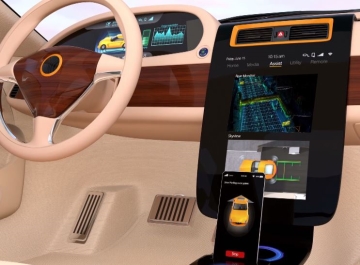
[Planning - Autonomous Vehicles⑥] Precision Road Maps, the Last Puzzle Piece for the Autonomous Vehicle Era
Germany's three premium automakers—BMW, Mercedes-Benz (Daimler), and Audi—joined forces to acquire a company called HERE. At the 2017 CES, Hyundai Motor showcased an autonomous vehicle and evaluated that "this" played the largest role in autonomous driving technology. There is also commentary that Tesla, which caused a fatality with an autonomous vehicle last year, could have prevented the accident if it had "this." What is the common point in the actions taken by these companies representing the current automotive industry? It is "maps." HERE is a representative digital map specialist company, the best technology that Hyundai Motor praised itself for is maps, and Tesla also pointed out the limitations of 3D maps. Recently, cutting-edge "sensor" technologies such as lidar and radar are rapidly advancing, so why is the necessity of "high-precision maps" for autonomous driving being raised? The industry refers to maps as "another sensor" that can serve as a lifeline when cameras, communications, and sensors all fail simultaneously.
2017.06.05by 김자영 기자
[Planning-Autonomous Vehicles ⑦] ISO 26262: Now a Necessity, Not an Option—Is Korea Ready?
"When autonomous vehicles become widespread, traffic accident rates can drop close to 0%." This is the assertion of Chen Liu, former Policy and Strategy Planning Director at the U.S. National Highway Traffic Safety Administration (NHTSA). According to U.S. traffic accident statistics, 94% of traffic accidents result from driver error. He viewed autonomous vehicles as a solution to accidents caused by human factors such as drunk driving, speeding, and drowsy driving. While there are positive assessments that autonomous vehicles reduce traffic accident risk, there are also negative perspectives. According to a survey by Sungkyunkwan University's SSK Risk Communication Research Group, when anxiety about autonomous vehicles was rated on a scale of 100, it scored 48.5 points—the closer to 0, the "very anxious." The factors causing anxiety ranked highest for malfunction concerns, followed by response to emergencies, external hacking, pedestrian accidents, personal information leaks, and rear-end collisions, with most concerns related to safety and security.
2017.06.26by 김지혜 기자

[Planning - Autonomous Vehicles⑧] Cybersecurity is the key to preventing autonomous vehicles from becoming "running weapons."
Security technology is garnering attention for realizing autonomous driving technology at level 4 or higher, where vehicle control is transferred from the driver to the vehicle. This is because drivers must be assured that autonomous vehicles remain safe even when exposed to threat factors such as vehicle system errors or hacker intrusions. Automotive semiconductor companies such as Renesas, Infineon, NXP, and Maxim have been applying Hardware Security Modules (HSM). The HSM supports key management functions by centrally storing keys and transmitting them in encrypted form.
2017.07.17by 김자영 기자
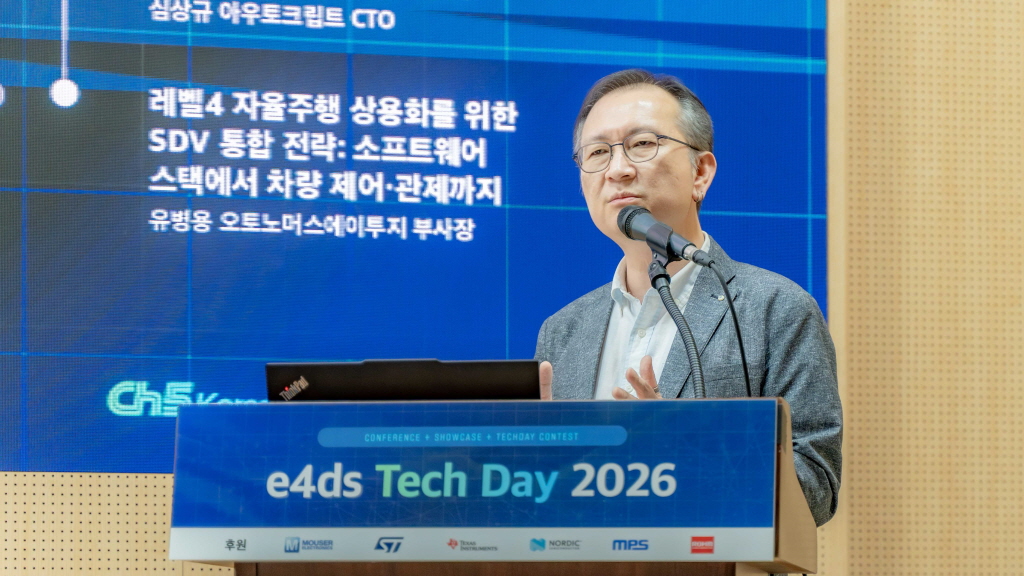
[e4ds Tech Day 2026 ⑨] Sim Sang-gyu, Autocrypt CTO: "In the Physical AI Era, Automotive Security Must Extend Beyond the Vehicle"
At e4ds Tech Day 2026, Sim Sang-gyu, CTO of Autocrypt, explained automotive cybersecurity strategies in the era of Physical AI and SDV (Software-Defined Vehicle). Automobiles are evolving as part of an ecosystem connected to AI, cloud, chargers, IoT, and robots, and he emphasized that the scope of security must expand beyond the vehicle interior to the entire connected environment. In particular, AI model tampering, adversarial attacks, OTA updates, and EV charger hacking were identified as major threats. He explained that response measures require zero trust, AI model integrity protection, intrusion detection, Security by Design and Default, and full lifecycle security management, and that proactive security system establishment beyond regulatory compliance is critical for securing future mobility competitiveness.
2026.10.12by 배종인 기자

Practical HIL Construction Strategy for Automotive and Off-Highway Controller Validation
As vehicle E/E architecture transitions to zonal structures and shifts to software-defined vehicles (SDV), the number of controllers (ECUs) requiring validation and software complexity are surging dramatically. Meanwhile, real vehicle testing cannot provide repeated verification under identical conditions and entails lead time and safety concerns. This white paper explains the principles of HIL (Hardware-in-the-Loop) validation and the structure of the NI platform composed of PXI, SLSC, and VeriStand, and through two actual implementation cases—Camera Record & Replay HIL for In-Cabin Monitoring Controller (ICMU) and Forklift Controller (VCU) HILS—describes how controller-level regression testing becomes possible. Additionally, it explicitly states application boundaries and limitations, such as lack of A2B support.
2026.10.12by 편집부











