


The Home IoT trend is blowing fiercely in China.
 Published2017.07.25 10:12
Korea International Trade Association Releases Report on 'Current Status and Implications of China's Smart Home Market'
A wave of IoT-equipped smart home products is sweeping through Chinese households. This is attributed to companies like Xiaomi and Haier luring Chinese consumers by flooding them with a wide variety of reasonably priced smart home products.
According to the report "Current Status and Implications of the Chinese Smart Home Market" released by the Shanghai branch of the Korea International Trade Association, China's smart home market reached 60.6 billion yuan (10.07 trillion won) in 2016, marking a significant 50.2% growth compared to the previous year. It is projected to show a growth rate exceeding 50% over the next five years.
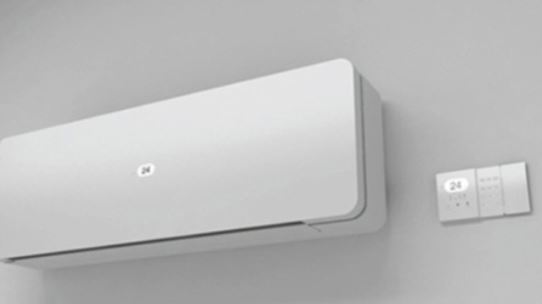
Xiaomi-Midea joint air conditioner (Source: Baidu website)
Not only traditional home appliance companies, but also IT firms such as Xiaomi, 360, and Tencent are entering the smart home market and investing massive amounts of capital in research and development and the development of advanced technologies. The Chinese government is also fostering the smart home sector as a key area through various policies.
While early smart homes began with simple appliance control and security systems, they are now expanding into service areas that include remote monitoring and control, telemedicine and home healthcare, and online education. Smart home products can generate profits through big data and related services even after the sale, and specific service models such as material delivery, remote healthcare, and long-term educational services are being presented.
Consequently, strategic alliances among traditional home appliance companies, internet firms, and media platform companies are becoming increasingly active. A prime example is Xiaomi, which is achieving significant success through partnerships with video platform iQiyi and joint product launches with home appliance manufacturer Philips.
According to the '2017 Trends in Chinese Household Internet Consumption' cited in the report, the main online consumers of smart homes are the post-80s and post-90s generations, who have a high adaptability to new products and have a habit of using mobile phones, accounting for about 80% of smart product buyers. It was found that smart home users are usually interested in travel, financial management, and shopping, and most are households with young children.
In addition, Chinese consumers showed high interest in small, cost-effective products and energy-saving products. It was found that the price ranges Chinese consumers are willing to spend on smart home products were significantly high, in the order of 5,000-9,999 yuan (24.0%), 1,000-4,999 yuan (20.9%), and 10,000-29,999 yuan (20.0%).
Park Sun-kyung, Deputy Director of the Korea International Trade Association’s Shanghai Branch, pointed out, “There is a high possibility that a loyal customer base will be formed as consumers’ initial smart home consumption experience, which began with purchasing individual items, expands to the entire product line of a specific brand.” She emphasized, “Korean companies also need to target the Chinese market with active O2O strategies, such as establishing large-scale offline experience centers and expanding online sales networks, tailored to the purchasing habits of key smart home consumer groups.”
Comments
Related news

KT Smart Home “Genie, call the elevator”
KT announced that it plans to build an apartment complex with a voice recognition artificial intelligence system to be installed at the 'Lotte Castle' complex scheduled to move into Yeongdo-gu, Busan in the second half of this year. The Lotte Castle complex will introduce a solution that controls the home network system within units and KT's home IoT service through voice via 'GiGA Genie,' KT's artificial intelligence TV service. Installation is planned for each unit during the move-in period, and home network services such as heating control, elevator call, and vehicle entry notification will be provided through GiGA Genie.
2017.03.24by 김자영 기자
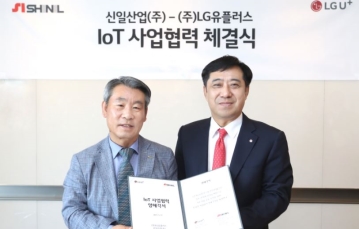
LG Uplus Controls Small Home Appliances via IoT
LG U+ announced on the 18th that it will apply IoT technology to all small home appliances manufactured by Shinil Industries, a comprehensive home appliance company. LG U+ and Shinil Industries signed a business agreement at LG U+ headquarters and decided to begin development by integrating LG U+ IoT technology into summer appliances such as fans, air circulators, and dehumidifiers manufactured by Shinil Industries, as well as winter appliances including heaters, electric heating pads, and hot air blowers, and environmental appliances such as water purifiers. All products from Shinil Industries will be interoperable with 'IoT@home,' LG U+'s home IoT platform app, and IoT products are scheduled to be launched starting with winter appliances by the end of this year. Once the IoT products are launched, users will be able to control small home appliances in their homes through smartphones. For example, in the case of a fan used during summer, users can adjust wind speed, wind direction, and timer through an app or simple voice commands without needing a separate remote control, even while lying down. Users can also pre-input operation schedules in the app before bedtime, such as controlling fan speed and direction on an hourly basis. Moreover, if a user leaves home with a fan turned on, IoT sensors such as opening detectors will sense the away status and send app push notifications to the user, enabling remote control of home appliances from anywhere at any time. In particular, LG U+ plans to pursue sleep sensors that automatically adjust temperature by recognizing the user's sleep state and promote sleep based on big data. An Sung-jun, Head of IoT Business at LG U+, stated, "Starting with our cooperation with Shinil Industries, we plan to rapidly expand IoT services by integrating them into small home appliance products" and "We will introduce services that innovate customer experience through various devices linked to our home IoT platform."
2017.05.18by 김자영 기자
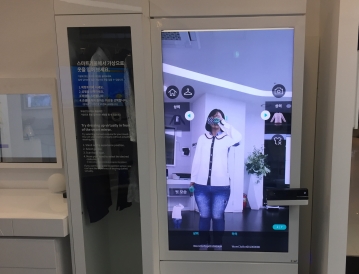
[Experience] I went to the Home IoT Experience Center and the experience was 'interesting', but the purchase was 'not sure'
"Now, here comes the technology." From facial recognition at the entrance door to the kitchen, living room, bathroom, and bedroom. The Internet of Things has arrived. On a rainy day, I visited The Smartium. Since opening its smart home and smart city exhibition in April, The Smartium typically receives around 30 visitors three times a day at 10 a.m., 12 p.m., and 2 p.m. On this day, due to the weather, there were no visitors at all. Nevertheless, 'I had to do the coverage.' After turning on all the devices that had been switched off to save electricity, I stood in front of a mirror beside the wardrobe. It's not an ordinary mirror, but a smart mirror where you can try on clothes virtually without actually wearing them. Unlike Amazon's Echo Look, which captures photos and videos to be viewed on a mobile phone, the smart mirror is literally a mirror. I first selected either female or male, then swiped through outfits—from outerwear to t-shirts, pants, and dresses—to try them on.
2017.06.12by 김자영 기자
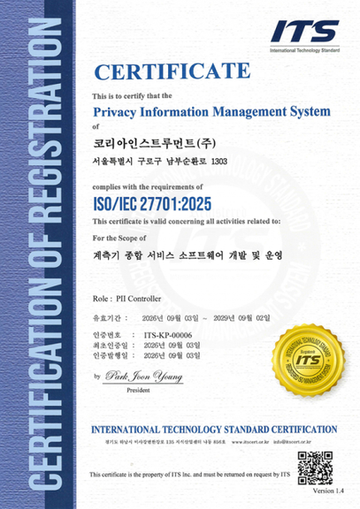
Korea Instrument, KOLAS Accredited Calibration Agency First to Simultaneously Acquire ISO/IEC 27,001·27,701
Korea Instrument has become the first among KOLAS accredited calibration agencies to simultaneously acquire ISO/IEC 27,001 and ISO/IEC 27,701 certifications. Through its proprietary platforms CWIZ Enterprise and CWIZ Partners, the company has embedded information security and personal data protection requirements across all business processes including customer information, equipment data, and calibration reports, with plans to continuously advance its management system through regular audits and security inspections.
2026.10.12by 배종인 기자

TeamViewer One, IT Incident Automation Workflow and Resolution Center Enhanced
TeamViewer has added IT incident automation capabilities and an advanced Resolution Center to its integrated digital workplace management platform 'TeamViewer ONE'. Recurrent service disruptions, configuration errors, and capacity shortages are automatically handled according to preset policies, and device status verification through script deployment can be managed in a unified interface, significantly reducing repetitive tasks for IT teams.
2026.10.12by 배종인 기자











