



ISO26262 2nd Edition Expands to Semiconductors, Difficulties in Responding to Domestic Standards
 Published2017.07.27 09:55
The semiconductor industry needs a common interpretation of functional safety.
An opportunity has been created to actively promote the ISO26262 2nd edition , which will be officially released in May next year, to domestic semiconductor companies. The second revision expands the scope of application to the semiconductor sector, requiring a response from the automotive industry.
On the 26th, the 'ISO26262 2nd Automotive Semiconductor Safety Design International Standard Guideline Semiconductor Semiconductor Safety Design ...
Jeong Dong-hee, President of the Korean Agency for Technology and Standards, stated, "Domestic standard proposals are significantly stagnant. Looking at the IEC and ISO, the number of domestic standard proposals has been declining since 2009." He also addressed the need for standards, saying, "In the era of the Fourth Industrial Revolution, we need to prioritize standards rather than follow suit."
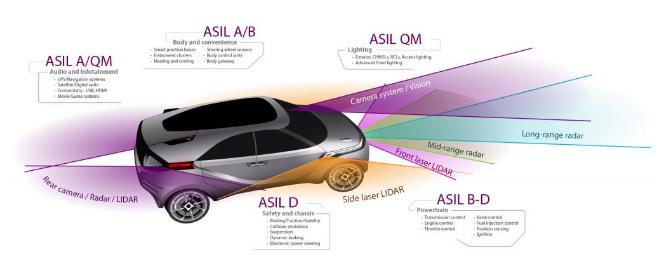
He said, “The National Institute of Standards and Technology will play a proactive role in promoting standards. He added, “We will create an environment where companies, academia, and others can strategically create standards,” and “We will supplement it with the Korean Industrial Standards (KS) standard in line with the publication of the second edition of ISO 26262, and we will continue to provide education to related companies.”
The second revision of ISO 26262 includes some revisions to existing Parts 1 through 10, while new Parts 11 and 12 are established. Part 11 covers automotive semiconductor guidelines, and Part 12 includes motorcycle guidelines.
In the automotive semiconductor sector, "safety analysis" guidance has been refined, providing failure modes and potential causes. The "emergency operational time interval" defines the time between a failure and the arrival of a safe state, during which safety must be ensured. It also provides guidance on IP design verification, basic failure rate estimation, and fault injection testing, and includes technically helpful content on fault control for digital and analog components.
Kim Dong-ho, a director at the Korea Agency for Technology and Standards, said, "To respond to the second edition of ISO 26262, experts are participating in international standardization meetings and sharing the results with the industry. We are promoting the revision of KS R ISO 26262 and disseminating it. We are also establishing a foundation for testing and evaluation."
“Part 11 is an unprecedented standard created to address the need for a commonly understood interpretation of functional safety in the semiconductor industry,” said Koh Byeong-gak, a senior researcher at the Korea Testing Laboratory (KTL). “It should be noted that this is not a requirement. “It is to provide information on how to apply it,” he explained.
Kwon Young-soo, head of the processor research group at the Electronics and Telecommunications Research Institute (ETRI), introduced Aldebaran, a self-developed processor for autonomous vehicles, and said, “The core of ISO26262 is detecting faults and analyzing the safety mechanisms created to detect them.” He added, “In order to move towards autonomous vehicles, functional safety that goes beyond fault detection is necessary.”
In the afternoon, representatives from Qualcomm, Infineon, Renesas, Texas Instruments, NXP, Mentor Siemens, Synopsys, Hyundai Motor Company, and SK Hynix appeared and discussed how the industry is responding to ISO26262.
Comments
Related news
Mentor Graphics' Design Verification Solutions Receive Automotive Functional Safety Certification
Mentor Graphics announced that three Questa products—its design verification solutions (Questa® Simulation, Questa® Verification Management, and Questa® Clock-Domain Crossing (CDC))—have obtained ISO 26262 certification, the international standard for automotive functional safety, from SGS-TÜV Saar, a standardization certification body. ISO 26262 is an international standard for automotive functional safety established in 2011 to prevent accidents caused by electrical/electronic failures. The Questa products that received this certification have been added as the latest offerings to the Mentor Safe functional safety verification program.
2017.03.16by 김지혜 기자
[Planning-Autonomous Vehicles ⑦] ISO 26262: Now a Necessity, Not an Option—Is Korea Ready?
"When autonomous vehicles become widespread, traffic accident rates can drop close to 0%." This is the assertion of Chen Liu, former Policy and Strategy Planning Director at the U.S. National Highway Traffic Safety Administration (NHTSA). According to U.S. traffic accident statistics, 94% of traffic accidents result from driver error. He viewed autonomous vehicles as a solution to accidents caused by human factors such as drunk driving, speeding, and drowsy driving. While there are positive assessments that autonomous vehicles reduce traffic accident risk, there are also negative perspectives. According to a survey by Sungkyunkwan University's SSK Risk Communication Research Group, when anxiety about autonomous vehicles was rated on a scale of 100, it scored 48.5 points—the closer to 0, the "very anxious." The factors causing anxiety ranked highest for malfunction concerns, followed by response to emergencies, external hacking, pedestrian accidents, personal information leaks, and rear-end collisions, with most concerns related to safety and security.
2017.06.26by 김지혜 기자

ams Launches Magnetic Position Sensor Compliant with ISO26262 Safety Standards
ams is launching a new family of magnetic position sensors that provide enhanced safety and diagnostic functions, enabling automotive OEMs to achieve the highest grade of ISO26262 ASIL system safety level compliance standards. The AS5270A/B devices are suitable for various automotive applications including brake and gas pedals, throttle valves and tumble flaps, steering wheel position, chassis suspension height, EGR (exhaust gas recirculation) valves, fuel level measurement systems, and 2/4 wheel drive switches. The AS5270A and AS5270B system-on-chip (SoC) devices function as 0 to 360° rotational magnetic position sensors, providing non-contact high-resolution, absolute angle measurement capabilities. The AS5270A/B were developed as SEooC (safety element out of context) devices as defined in the ISO26262 functional safety standards specification.
2017.07.05by 김지혜 기자

[e4ds Tech Day 2026 ⑨] Sim Sang-gyu, Autocrypt CTO: "In the Physical AI Era, Automotive Security Must Extend Beyond the Vehicle"
At e4ds Tech Day 2026, Sim Sang-gyu, CTO of Autocrypt, explained automotive cybersecurity strategies in the era of Physical AI and SDV (Software-Defined Vehicle). Automobiles are evolving as part of an ecosystem connected to AI, cloud, chargers, IoT, and robots, and he emphasized that the scope of security must expand beyond the vehicle interior to the entire connected environment. In particular, AI model tampering, adversarial attacks, OTA updates, and EV charger hacking were identified as major threats. He explained that response measures require zero trust, AI model integrity protection, intrusion detection, Security by Design and Default, and full lifecycle security management, and that proactive security system establishment beyond regulatory compliance is critical for securing future mobility competitiveness.
2026.10.12by 배종인 기자
Practical HIL Construction Strategy for Automotive and Off-Highway Controller Validation
As vehicle E/E architecture transitions to zonal structures and shifts to software-defined vehicles (SDV), the number of controllers (ECUs) requiring validation and software complexity are surging dramatically. Meanwhile, real vehicle testing cannot provide repeated verification under identical conditions and entails lead time and safety concerns. This white paper explains the principles of HIL (Hardware-in-the-Loop) validation and the structure of the NI platform composed of PXI, SLSC, and VeriStand, and through two actual implementation cases—Camera Record & Replay HIL for In-Cabin Monitoring Controller (ICMU) and Forklift Controller (VCU) HILS—describes how controller-level regression testing becomes possible. Additionally, it explicitly states application boundaries and limitations, such as lack of A2B support.
2026.10.12by 편집부











