



Expanding the introduction of private cloud in the education sector, including elementary, middle, and high schools and universities
 Published2017.08.02 09:58
The Ministry of Science and ICT announced that it will provide private cloud services to 9 universities and 125 elementary, middle, and high schools in Korea in order to expand the introduction of private cloud in the education sector.
The Ministry of Science and ICT has been receiving requests for private cloud usage from 430 universities across the country since May through the Korea Information Society Agency. As a result, a total of 31 universities applied, and 9 of them were selected for support.
The schools eligible for support for use of private cloud universities are Konkuk University, Kyunghee University, Kongju National University, Dongguk University, Dongseo University, Seoul National University, Pusan National University, Sejong University, and Handong Global University. The services provided are SaaS for cloud-based software education, course registration, writing editing guidance, email, online lecture evaluation, etc., and IaaS for cloud-based web services. Approximately 60,000 students and faculty members will use the services.
Through the 'Public Sector (University) Private Cloud Leading Utilization Project', we plan to discover best practices in private cloud utilization by universities by organizing and providing customized services for each university centered on areas with high actual demand, and share these with other universities to support further expansion of private cloud service use by universities in the future.
In addition, the Ministry of Science and ICT will expand the “Digital School Backpack” that began in 2015 targeting 23 elementary, middle, and high schools to 125 schools this year.
Digital School Backpack is a cloud service that provides SW education content, class/assignment management, communication/collaboration functions, etc., and it can reduce the burden of device/SW management on teachers who experience PC-centered SW education, and it can also provide students with the benefit of being able to continue their studies in a convenient online environment similar to class time, even after returning home.
Lee Sang-hak, Software Policy Officer at the Ministry of Science and ICT, said, “We will improve the educational environment and enhance the quality of education through various private cloud leading projects in the education sector, while supporting the introduction of private cloud services required by each field, thereby promoting private cloud in the public sector.” We expect that this will also help to activate its use,” he said.
Comments
Related news
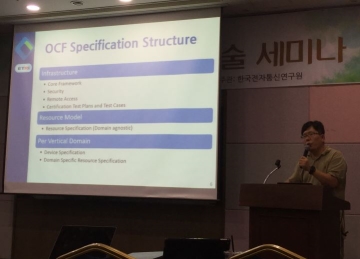
Easy and fast connectivity is key to IoT healthcare as well; how is standardization progressing?
A discussion on smart healthcare was held on the 18th at the Science and Technology Hall. At the event "Healthcare Internet of Things Technology for the Fourth Industrial Revolution," hosted by the Ministry of Food and Drug Safety and organized by the Electronics and Telecommunications Research Institute, participants discussed △cloud for healthcare IoT application development △healthcare IoT device development processes and Web RTC technology for remote healthcare services △OCF standards △healthcare patent trends and demonstration project status.
2017.07.18by 김자영 기자
Dassault Systèmes acquires stake in fast-growing cloud company Outscale.
Dassault Systèmes announced that it has acquired a majority stake in Outscale, a leading global enterprise-class cloud service provider based in France. Through this acquisition, Dassault Systèmes strengthens its position as one of the world's fastest-growing cloud companies while accelerating support for digital transformation initiatives across enterprises in various industrial sectors. Founded in France in 2010, Outscale is an enterprise-class Infrastructure as a Service (IaaS) cloud provider that has received industry-leading certifications including Cisco CMSP Advanced, 100% Intel Cloud Technology, and NetApp AltaVault. The company provides services through 10 data centers located across Europe, North America, and Asia.
2017.07.25by 김지혜 기자
NXP Establishes Partnership with AWS to Address IoT Security Issues
# Integration of Amazon Greengrass with NXP Gateway Platform NXP is entering into collaboration with Amazon Web Services (AWS) in the IoT sector. NXP has announced the integration of Amazon Greengrass with its Layerscape Intelligent Gateway platform. Amazon Greengrass is software that extends AWS cloud capabilities to local devices, enabling data collection and analysis closer to the point of information generation, and facilitating secure communication over local networks. This integration enables efficient security support for edge computing and Internet of Things (IoT) cloud interaction. This makes it possible to access world-class secure IoT anywhere—in homes, offices, and other business environments—while enhancing business agility. Going forward, the two companies plan to explore various collaboration opportunities ranging from product R&D, business development, to market expansion in the edge computing and cloud platform sectors, with the goal of securing IoT data through innovative collaboration. NXP's Intelligent Gateway Platform uses the company's core QorIQ Layerscape processor architecture. This processor family, in addition to advanced edge computing performance and security capabilities, seamlessly extends AWS cloud capabilities down to the device level, enabling real-time processing of information collected by internet users locally, as well as management, analysis, and permanent storage in the cloud. The Layerscape series processors are industry-leading ultra-compact, low-power products featuring high-performance 64-bit ARMv8 architecture. This product line includes single-core, dual-core, quad-core, and 8-core systems-on-chip (SoCs). Additionally, this processor family integrates powerful network, security, storage, and TSN hardware acceleration engines with programmable application interfaces. The Layerscape processor, which excels in high performance and low power consumption, has established itself as the preferred platform for SDN/NFV edge computing nodes as well as enterprise, industrial, and residential intelligent gateway devices. Qu Dajian, Marketing Director for Asia-Pacific Region, Digital Network Business Unit at NXP Semiconductors, stated, "NXP is committed to leading IoT industry advancement through innovation and collaboration. The integration of NXP Layerscape and AWS Greengrass not only effectively improves edge computing and cloud platform operations, but as IoT rapidly advances,
2017.07.31by 김지혜 기자
.jpg)
SalePoint Signs Multi-Year Partnership Agreement with AWS… Promoting Identity Security that Integrates Even AI Agents
Sailpoint has entered into a multi-year strategic partnership agreement with AWS and is moving forward with establishing an integrated governance system that manages both human and non-human identities together. The plan is to consistently manage access permissions in an environment where AI agents are increasing as work execution entities, while applying the principle of least privilege and automated policy enforcement. The two companies plan to jointly expand capabilities to manage the identities of various entities, including AI agents, within a single layer in the AWS environment. This collaboration is interpreted as a move to design security and governance together in corporate environments where AI adoption is expanding.
2026.03.26by 배종인 기자
.png)
Databricks Unveils Open AI Security Monitoring 'Lakewatch'
Databricks entered the security market on March 24 by unveiling LakeWatch, an open-source agentic SIEM. The core functionality of this product is to integrate and analyze security, IT, and business data in a single environment to support AI-based threat detection and investigation. The company explained that it reduces the limitations of existing security operations centers, which have had to forgo some data due to high cost structures, and enables large-scale data analysis and automation based on open formats and ecosystems. LakeWatch is currently offered as a private preview, with Adobe and Dropbox mentioned as early customers. Databricks also announced an expanded partnership with Anthropic as well as the acquisition of Antimatter and SiftD.ai.
2026.03.26by 배종인 기자











