


LG Uplus Develops Simulator to Predict 5G Base Station Coverage
 Published2017.08.10 17:07
Input over 60 items to calculate signal strength and data speed
LG Uplus announced on the 10th that it has jointly developed a '5G Millimeter Wave Simulator (mmWave Simulator)' capable of predicting 5G base station coverage with Hanyang University's 'HY-MC Research Center (Director Seung-won Choi)'.
The 5G simulator was developed to be able to calculate various information related to network design, such as signal strength by location, signal strength against noise, and data speed, by inputting about 60 essential items required for building a mobile communication network, such as frequency band and bandwidth, base station and terminal information, terrain, and building height and area.
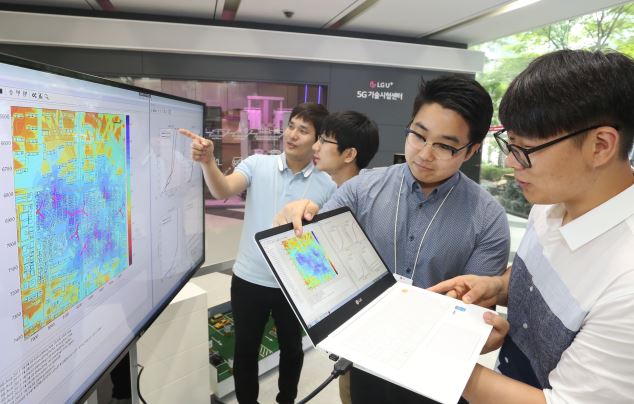
LG Uplus explained that as the 28GHz frequency, which has the characteristic of reflecting or absorbing radio waves from surrounding obstacles, is rapidly emerging for 5G services, it developed a 5G simulator together with Hanyang University to design an efficient network utilizing the characteristics of high frequencies for 5G.
Hanyang University’s HY-MC Research Center, which has an industry-academia partnership with LG Uplus, is an academic institution that actively participates in the establishment of international mobile communication standards and holds numerous patented technologies, and is actively carrying out 5G-related projects such as the ‘research on network virtualization base technologies for mobile communication systems after 4G.’
We plan to use the 5G simulator developed in collaboration with Hanyang University to build a test network until a commercial simulator is secured, and based on this development experience, we intend to produce a more advanced simulator in the future to build a commercial 5G network and provide high-quality 5G services.
It is expected that further advancement of the simulator will enable its use in predicting 5G communication vulnerable areas, improving quality through cause analysis, and predicting services that can be provided to customers.
"We have entered into industry-academia collaboration with university research institutes to foster future engineers who form the basis of market-leading innovation," said Kim Dae-hee, Senior Vice President of Network Strategy at LG Uplus. "We will continue to further solidify our cooperative relationship with universities in the future."
Comments
Related news
KT, Share Your Ideas for 5G Implementation!
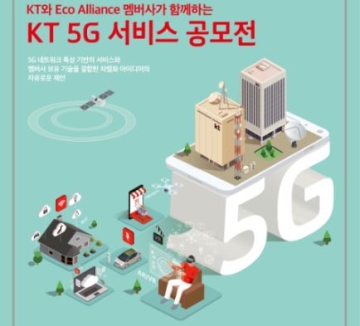
KT is soliciting ideas with a total prize pool of 30 million won to open the '5G era' together with small and medium-sized enterprises and venture companies. This contest is designed to discover services that provide high value to consumers by combining the characteristics of 5G networks—fast speed, seamless connectivity, and massive capacity—with technologies possessed by small and medium-sized enterprises and venture companies. Following the world's first 5G trial service in PyeongChang, Gangwon Province in 2018, KT is preparing related services along with network development for the world's first 5G commercialization in 2019. To this end, KT is strengthening collaboration not only with group companies and partners but also with small and medium-sized enterprises and venture companies equipped with technological capabilities.
2017.08.01by 김자영 기자
KT Holds 5G Strategy Meeting with Korean, Chinese, and Japanese Telecom Companies
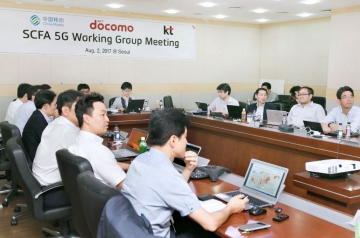
KT announced on the 3rd that it held an 'SCFA (Strategic Cooperation Framework Agreement) 5G Technology Strategy Meeting' with national telecommunications carriers from Korea, China, and Japan at the KT Research and Development Center in Umyeon-dong, Seoul, to prepare 5G services for the Olympics. SCFA is Asia's largest strategic consultation body among telecommunications operators established in 2011, with KT representing Northeast Asia, China's China Mobile Communication Corporation, and Japan's NTT DOCOMO participating to conduct active collaboration in next-generation network technology, services, and marketing sectors.
2017.08.03by 김자영 기자
SK Telecom to Localize 5G Equipment
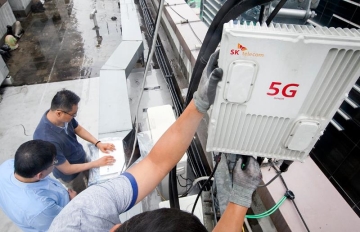
SK Telecom announced that it has jointly developed a "wireless 5G relay" repeater with domestic telecommunications equipment manufacturer KMW and applied it to the "5G test network" located in Gangnam-gu, Seoul for the first time in Korea. The "5G relay" amplifies 5G wireless signals between base stations and terminals and transmits signals to service coverage gap areas. By utilizing this equipment, 5G service coverage gaps where signals cannot reach are eliminated, enabling dense 5G service throughout all areas. The 28GHz band, a candidate 5G frequency, experiences rapid signal strength degradation during transmission due to its high frequency characteristics. Additionally, experts anticipate that service coverage gaps caused by radio wave obstacles such as buildings, glass, and trees will occur more frequently than before. Therefore, the "5G relay" is expected to significantly contribute to improving 5G communication service quality in densely populated urban areas.
2017.08.10by 김지혜 기자
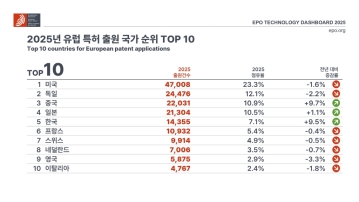
European Patent Applications Surpass 200,000 for the First Time… South Korea Maintains 5th Place, Led by Batteries and Telecommunications
According to the European Patent Office (EPO)'s 'Technology Dashboard 2025', European patent applications last year reached 201,974, surpassing 200,000 for the first time. Korean companies and inventors filed 14,355 applications, representing a 9.5% increase from the previous year and maintaining 5th place by country. Battery, digital communication, and semiconductor technologies led the growth, with Samsung ranking as the top EPO applicant for the second consecutive year and LG reaching 3rd place. The presence of major domestic cities such as Seoul, Suwon, and Yongin was also confirmed. It was also revealed that Korea's European patent strategy is expanding beyond individual technologies to span the entire industry.
2026.03.24by 명세환 기자
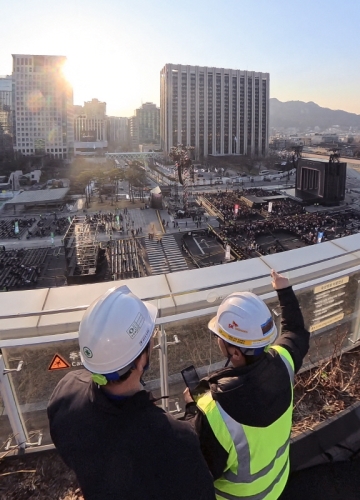
SK Telecom First Applies AI-Based Network Operations at Gwanghwamun K-Pop Concert
SK Telecom announced that it applied an AI-based network operation system for the first time at a large-scale K-pop concert held in the Gwanghwamun area of Seoul on March 21st, managing communication quality throughout the event. Mobile data usage during the three hours before and after the concert reached 12.15TB, approximately doubling compared to the same time slot the previous weekend. SK Telecom monitored traffic using the AI system 'A-One' in five-minute and 50-meter units to respond to potential overload situations, while also operating temporary communication facilities and on-site personnel in parallel. This case is interpreted as confirmation of the practical applicability of AI-based autonomous network operation in an environment where demand from dense events and foreign users increases simultaneously.
2026.03.23by 명세환 기자











