


3 Legal Issues Arising from the Application of Cryptocurrency to the Financial Industry
 Published2017.08.14 06:45
Each country is creating regulations and legal systems for reliability.
Unlike traditional centrally controlled currencies, what legal issues does cryptocurrency, which anyone can mine and acquire, need to resolve?
With the emergence of 'Bitcoin,' a cryptocurrency based on blockchain technology, in 2009, over 800 types of cryptocurrencies appeared by August 2017. While traditional currencies could be controlled, prevented from counterfeiting, and possessed enforcement power centered around governments and central banks, cryptocurrencies allow anyone to acquire currency through mining without a central server. Transaction records are transparently disclosed while anonymity is guaranteed.
Cryptocurrency is a new type of 'something' that combines various legal characteristics, such as a means of payment, a means of circulation, an object of transaction or investment, and a store of value. Currently, the dominant view is to regard it as an investment target for assets or products, but due to the difficulty of legal judgment, there is no concrete definition yet.

Each country is implementing regulations and supervision to foster the continuous growth of cryptocurrency. The United States recognizes Bitcoin as an asset and imposes income tax on it, and has introduced a licensing system for virtual currency service providers. Service providers are required to hold a certain amount of digital currency. Japan imposes taxes on profits generated from Bitcoin transactions. Regular audits are conducted on virtual currency exchange companies, and measures such as the separate management of customer assets and the mandatory explanation of contract details are enforced. Germany treats virtual currency as a financial product, imposing transaction taxes and implementing a registration system with supervisory authorities. It has also permitted the closure of accounts and seizure of virtual currency service providers if they are used for money laundering or illegal transactions.
Issue 1: Legal and Regulatory Issues, Problems in Interpreting Blockchain as a Decentralized Computer System Concept
To legally regulate cryptocurrencies, it is first necessary to examine how blockchain can be legally analyzed. The Electronic Financial Transactions Act is based on the premise of a centralized computer system. In contrast, since blockchain is a concept of a decentralized computer system, issues arise in interpretation. While the Electronic Financial Transactions Act stipulates that financial companies or operators providing electronic financial services bear responsibility in the event of an accident, the subject of responsibility is unclear in the case of blockchain.
Unlike the Electronic Financial Transactions Act, which specifies technical standards in detail to ensure stability, blockchain involves participants jointly forming a single system. The most practical problem is that it is inappropriate to apply the regulation requiring the destruction of electronic financial transaction records within five years of the termination of a transaction relationship directly to blockchain. With the introduction of blockchain, it is necessary to revise the relevant legislation centered on financial companies and operators, which is fundamentally assumed by the Electronic Financial Transactions Act.
Issue 2: Payment network issues; private blockchain discussed due to lack of suitability for stability.
Then, what about the application of blockchain technology to payment networks? Since the payment process is divided into settlement, clearing, and settlement, the approach depends on which stage it is applied to. In the case of public blockchains, considering whether distributed ledger technology applies to all members participating in the payment process, whether they can be recognized as a payment network under current laws, and whether individual provisions of current laws apply, they are not suitable in terms of stability. Consequently, this is being discussed in the context of private blockchains.
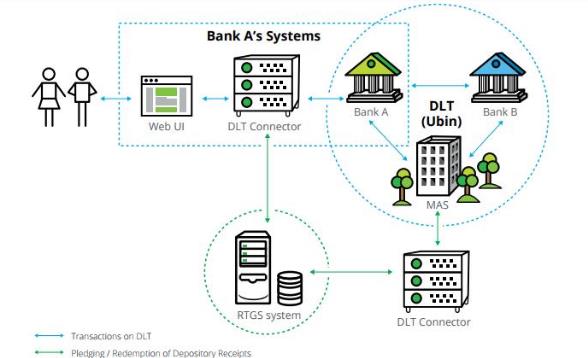
Project Ubin, a payment system envisioned by the Central Bank of Singapore, is based on a private blockchain. Ubin is a payment system developed on a blockchain foundation that links the Singapore Dollar to a digital token. It eliminates the delinquencies, payment failures, fees, and brokerage charges that occur in traditional currency transactions. Since it is based on the Singapore Dollar managed by the Central Bank, there are no issues with the net currency supply even with the application of this token, and it has the advantage of being interchangeable with the current system.
To introduce Woobin domestically, the legal nature of the token must be examined. First, for a token to be recognized as legal tender, it must be recognized as a Bank of Korea note issued by the Bank of Korea. If it is not in general circulation and is used solely for payment settlements, it is not strictly necessary to be recognized as legal tender. However, tokens are characterized more as a means of payment agreed upon among participants rather than as currency. Furthermore, there are issues regarding the finality of payment settlements and the possibility of equivalent exchange with the country's general currency.
Issue 3: Smart Contract Issues – Legal Validity of Contracts Composed Only of Code Is Ambiguous
Finally, an issue arises regarding smart contracts, an indispensable component of blockchain. From a legal perspective, they are viewed as the automated execution of contracts based on predetermined rules, but there is no specific legal concept that has undergone concrete discussion.
Attorney Kang Hyun-gu of Kwangjang Law Firm explained, “For a smart contract to be legally valid, there must be a mutual agreement between the parties regarding the contract concluded through an automated method using code.” He added, “Since the determination of whether there is a mutual agreement between the parties can be based on the interpretation of the code content, it is difficult for a contract composed solely of code to be recognized as legally valid without a unified method for interpreting the code.”
He pointed out, “While there are legal issues that could arise if blockchain technology is applied to the financial sector, nothing has materialized yet and it is still in the initial review stage,” adding, “There will be many legal problems once it takes shape.”
Comments
Related news
Samsung SDS Presents Future Vision of Blockchain in Europe
Samsung SDS introduced its blockchain technology and presented future business vision at "Money 20/20 Europe," Europe's largest global fintech conference. "Money 20/20 Europe" is a global financial innovation and fintech event where more than 1,500 global companies participate, including financial institutions such as banks and card companies, as well as companies from mobile and retail sectors. President Hong Won-pyo took the stage as a keynote speaker at "Money 20/20 Europe" and introduced Samsung SDS's blockchain platform NexledgerTM under the theme "Commercialization of Blockchain, Beyond Digital Finance." He presented blockchain expansion models including insurance claim processing and payment automation, which are types of smart contracts, as well as digital logistics.
2017.06.28by 김지혜 기자

KT Fasters Electronic Signature Image Processing with Blockchain
KT announced on the 4th that it has developed the world's first Electronic Data & Signature Capture (ESC) management system utilizing blockchain technology and applied it to BC Card. Blockchain is a technology that prevents data forgery and hacking by distributing and storing transaction information in blocks rather than storing it in a centralized server. For example, when A transmits electronically signed data, financial companies B and C connected via blockchain verify the transmitted data and share identical data. In this way, data is jointly (P2P) verified, recorded, and shared (Chain), which prevents data deletion and tampering or falsification. KT, in partnership with BC Card, independently developed an Electronic Signature Image (ESC) management system utilizing blockchain, which is evaluated as a next-generation security technology.
2017.07.04by 김자영 기자
What blockchain needs to be applied to the financial industry
A forum has been prepared to discuss how blockchain, a technology gaining worldwide attention, is being applied to the financial industry and how it will be applied to the domestic financial industry. The Ministry of Science and ICT and the Korea Information Society Development Institute (NIA) hosted the 'Blockchain Technology and the Future of the Financial Industry Workshop' on the 9th at Sangam Nuri Dream Square. Lee Hyun-dong, team leader of the ICT Convergence Division at the Korea Information Society Development Institute, said, "The value of hyper-distribution and connectivity of blockchain aligns with the IoT activation foundation-building project that has been ongoing since 2015." The event proceeded with topics including cryptocurrency market prospects and legal status, the future of blockchain technology and the financial industry, and IoT pilot projects utilizing blockchain technology.
2017.08.10by 김지혜 기자

The financial services industry is the most active in adopting hybrid cloud.
Nutanix announced the cloud adoption status and outlook for the financial services industry through its Enterprise Cloud Index report. According to a survey of current hybrid cloud adoption rates by industry, the financial services industry's hybrid cloud adoption rate was 21%, which was higher than the industry average of 18.5%. Financial services companies are facing the challenge of providing differentiated experiences to customers through methods such as leveraging emerging technologies like blockchain, while simultaneously simplifying operations.
2019.04.02by 이수민 기자

IBM Blockchain World Wire… Real-time global financial payment network expands to over 50 countries worldwide
IBM announced on the 19th the expansion of IBM Blockchain World Wire, a real-time global financial settlement network for financial institutions. World Wire was developed to accelerate and optimize foreign exchange transactions and cross-border payment and remittance speeds. Additionally, it integrates payment message transmission, clearing, and settlement procedures into a single network while supporting network participants in selecting various types of digital assets for settlement. Starting from the 19th, the payment service area will be expanded to 72 countries, including 47 global currencies and 44 financial endpoints. Busan Bank became the first domestic bank to join World Wire.
2019.03.19by 이수민 기자











