


Universities are developing practical skills by opening semiconductor equipment training courses.
 Published2017.08.24 12:26
The Korea Semiconductor Industry Association (KSIA) announced that Myongji University, Korea Polytechnic University, Inha University, and Daerim University will be the first domestic universities to launch a 'Semiconductor Equipment Specialization Track Program.'
All four universities will begin offering this program starting this fall semester. A "major track" refers to a specialized educational system within a department's curriculum. The "Semiconductor Equipment Major Track" is a more specialized program within the semiconductor equipment field, allowing new college graduates hired by semiconductor equipment companies to immediately enter the workforce without additional training.
On the 24th, the Semiconductor Association held a launch ceremony for the Semiconductor Equipment Specialized Track Program at the Korea Semiconductor Industry Association building in Pangyo, Gyeonggi Province, with the attendance of Park Ki-young, Director General of the Materials and Components Industry Policy Department of the Ministry of Trade, Industry and Energy; Jeong Jae-hoon, President of the Korea Institute for Advancement of Technology; Lee Jong-myeong, Vice President of Myongji University; Lee Jae-hak, Dean of the Graduate School of Sanggi University; Choi Soon-ja, President of Inha University; Hwang Un-kwang, President of Daerim University; and Park Gyeong-su, CEO of PSK. Park Kyung-soo, CEO of PSK, attended as the chairman of the equipment division of the Korea Semiconductor Industry Association and as a representative of a semiconductor equipment company.
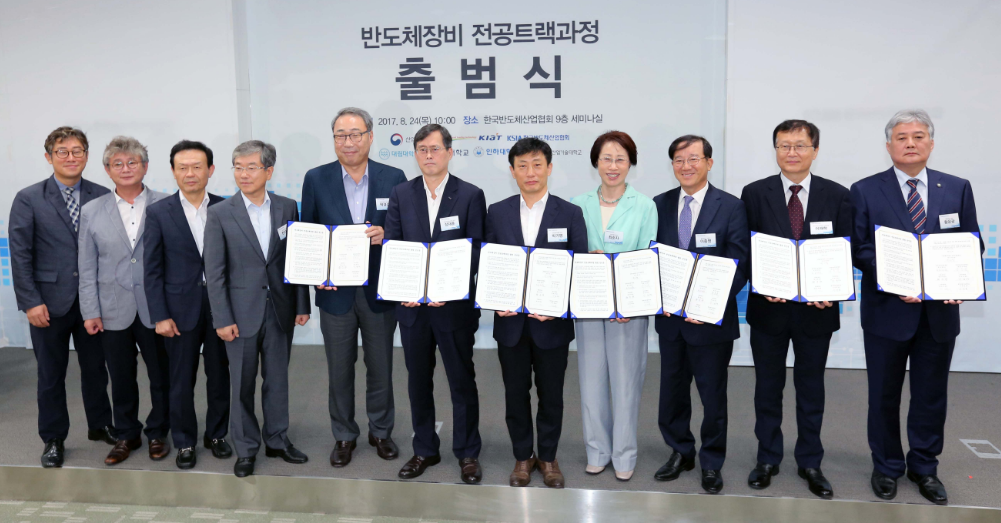
To establish a new semiconductor equipment major track at universities, the Semiconductor Association conducted a survey and in-depth interviews with the semiconductor equipment industry in April. The goal was to understand the industry's needs and research and analyze the curriculum needed to cultivate semiconductor equipment professionals. The industry's voices, gathered through this survey, were summarized as follows: 1) fostering a customized workforce immediately applicable to the field by specializing in semiconductor equipment; and 2) fostering talent with convergent and interdisciplinary knowledge, considering the industry's multidisciplinary nature.
Based on the common needs of the semiconductor equipment industry, the association began developing a curriculum and teaching materials together with external experts, including professors and teaching materials development committee members from Myongji University, Sanggi University, Inha University, and Daerim University who expressed their interest in participating in the semiconductor equipment specialized track course. As a result, we developed a semiconductor equipment specialized track program with the following main tracks: ▲ Mechanical Design Analysis ▲ Plasma Process ▲ Software ▲ Equipment Maintenance, Repair, and Overhaul.
Starting this fall semester, Myongji University, Korea University of Science and Technology, Inha University, and Daerim University will operate a semiconductor equipment major track program by combining departments related to the semiconductor equipment industry. △Myongji University's Department of Electronic, Mechanical, Industrial, New Materials, and Information and Communication Engineering; △Korea University of Science and Technology's Department of Mechatronics and Nano-Optical Engineering; △Inha University's Department of Electronic, Mechanical, Chemical, New Materials, and Information and Communication Engineering; and △Daerim University's Department of Mechatronics. These programs aim to cultivate talents with convergent and interdisciplinary knowledge.
Nam Ki-man, executive vice president of the Korea Semiconductor Industry Association, said, “The first batch of about 100 undergraduate students who completed the semiconductor equipment major track will graduate in 2018. We plan to expand the number of participating universities so that more than 500 semiconductor equipment professionals can be produced within the next five years.” He added, “Through customized human resource development, we will expand the technological prowess and supply capacity of domestic semiconductor equipment companies, further supporting the demand from domestic large corporations and further strengthening export competitiveness. Equipment competitiveness will become the new weapon for our semiconductors that has created a significant gap.”
Comments
Related news
KSIA Provides One-Stop Services to Semiconductor Companies
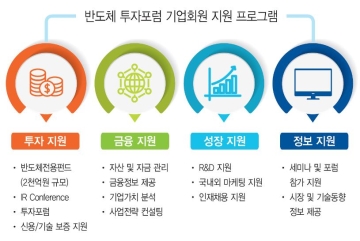
The Korea Semiconductor Industry Association is recruiting member companies to participate in the 'Semiconductor Investment Forum,' which provides customized one-stop services including smooth funding acquisition support, financial consulting, and marketing and R&D support for domestic semiconductor companies. Applications will be accepted until the 18th of next month. The recruitment targets domestic semiconductor design, manufacturing, equipment, materials, and component companies that require investment attraction and growth support, as well as small and medium-sized, mid-sized, and early-stage startup companies engaged in semiconductor businesses such as sensors and embedded software. Additionally, industries where semiconductors are applied, such as the Internet of Things (IoT), autonomous vehicles, artificial intelligence (AI), virtual reality (VR), augmented reality (AR), robots, and drones, are also included. Member companies registered with the Semiconductor Investment Forum will be provided with growth support programs including: △ investment attraction support through IR conferences, semiconductor growth funds, and VCs, and investor connection △ participation in domestic and international exhibitions and overseas roadshow support △ R&D support linked to Semiconductor Association projects (MPW, patterned wafers, semiconductor equipment and material performance evaluation, joint R&D promotion, etc.) △ participation in university visiting recruitment roadshows. Additionally, financial support programs including corporate value analysis, asset management, and IR consulting through Samsung Securities will also be provided.
2017.07.26by 김지혜 기자
ISO26262 2nd Edition Expands to Semiconductors, Difficulties in Responding to Domestic Standards
A venue was prepared to actively inform domestic semiconductor companies about ISO26262 2nd, which will be officially announced in May of next year. The second revision expands the scope of application to the semiconductor sector, requiring responses from the automotive industry. On the 26th, the 'ISO26262 2nd Vehicle Semiconductor Safety Design International Standard Guideline Seminar' was held at Yang Jae El Tower, organized by the Korea Semiconductor Industry Association and sponsored by the National Institute of Standards and Technology. Jeong Dong-hee, Director of the National Institute of Standards and Technology, stated, "Domestic standard proposals have been stagnating significantly. Looking at IEC and ISO, the number of standard proposals from our country has been declining since 2009," and added, "In the era of the fourth industrial revolution, we need to lead with advanced standards rather than follow existing ones," commenting on awareness regarding standards.
2017.07.27by 김지혜 기자
SEMI: North American Semiconductor Equipment Shipments Up 32.8% Year-on-Year
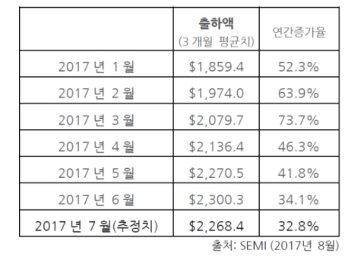
SEMI (Semiconductor Equipment and Materials International) announced that North American semiconductor equipment shipments in July totaled $2.27 billion. SEMI reports semiconductor equipment manufacturer shipments in the North American region on a three-month average basis. July shipments declined 1.4% compared to June equipment shipments of $2.3 billion, while showing a 32.8% increase compared to July of the previous year at $1.71 billion. July front-end equipment shipments reached $1.99 billion, up 0.2% from $1.97 billion in June, and up 37.1% compared to July of the previous year at $1.45 billion. Front-end equipment includes wafer processing, mask/reticle manufacturing, wafer fabrication, and fab equipment.
2017.08.24by 김지혜 기자
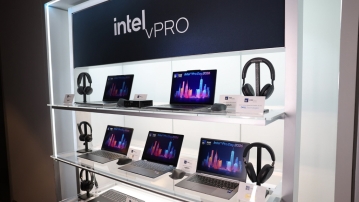
Intel Unveils Next-Generation 'Core Ultra Series 3' and vPro Platform for Enterprise PCs
Intel has officially unveiled the "Intel Core Ultra Series 3" for next-generation enterprise PCs and the latest vPro platform, addressing a wide range of demands from enterprise notebooks to high-performance workstations.
2026.03.26by 배종인 기자
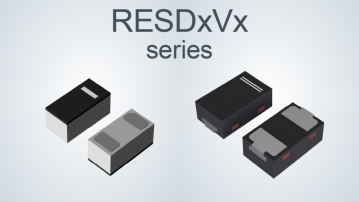
ROHM Launches ESD Protection Diode Compatible with High-Speed Interfaces of 10Gbps or Higher
Semiconductor specialist ROHM has developed the 'RESDxVx series' of ESD (electrostatic discharge) protection diodes capable of responding to next-generation high-speed data communication environments exceeding 10Gbps, simultaneously enhancing both signal quality maintenance required in high-speed interfaces and IC protection performance.
2026.03.26by 배종인 기자











