


[Discussion] Why Korea, Home to the Largest Blockchain Exchange, Cannot Create Cryptocurrency
 Published2017.09.04 18:03
There is a need for new definitions and regulations divided by sector.
"Looking at the trading volume rankings of blockchain exchanges worldwide, Korean exchanges occupy three spots in the top 10. However, when looking at the rankings of cryptocurrencies, there are no Korean projects within the top 100."
Regarding the reason why South Korea, home to the world's largest exchange, does not have cryptocurrency, Attorney Jeong Ho-seok of Law Firm Seum stated, "One might think it is because the technology has not yet developed, but that is not the case," adding, "It is because the legal system and environment are not in place to support it."
Last month, an amendment to the Electronic Financial Transactions Act was proposed by Representative Park Yong-jin. The bill includes provisions requiring virtual currency handlers to have capital of at least 500 million won and obtain authorization from the Financial Services Commission to operate, as well as prohibiting the use of virtual currency for illegal activities such as market manipulation and money laundering.
Concerns are being raised regarding the necessity of regulation, given that the amendment is closer to regulation than promotion and blockchain has not even been defined as currency. Accordingly, a forum was organized to discuss the issues surrounding blockchain regulation.
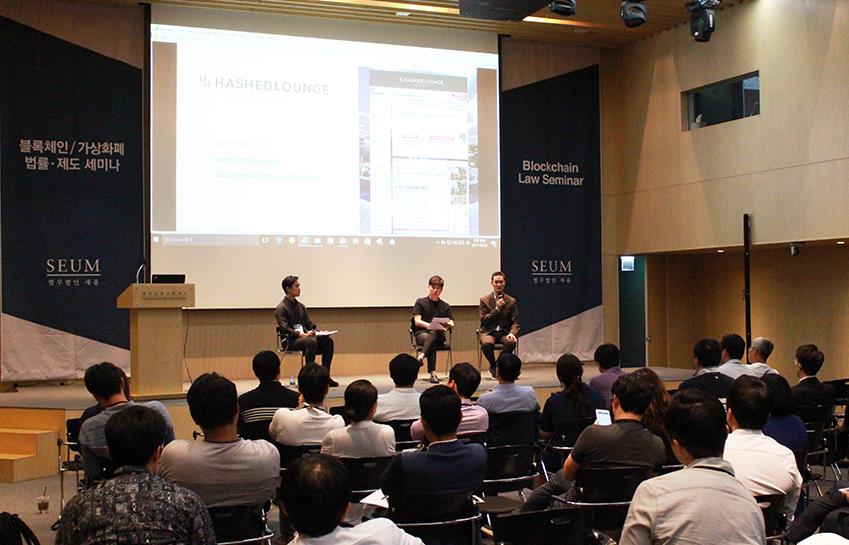
First, we heard their position on the Electronic Financial Transactions Act. Seo-joon Kim, Vice President of Hashed Lounge, a blockchain-specialized meet-up group, said, “It has the largest trading volume in the world, and there was room for growth due to the lack of regulations. It is necessary to approach this by maintaining the current state.”
Attorney Jeong stated, “The legal definition of cryptocurrency is important, and if it remains ambiguous, fear may outweigh freedom. In this regard, it is significant that it has entered the institutional framework,” adding, “This has served as an opportunity to change perspectives on whether or not ICOs can be conducted domestically. It seems that the law can serve as a means of activation rather than a regulation.”
Decentralization is a key aspect of the blockchain concept. When discussing institutionalization, government intervention cannot be excluded; thus, a point of contention has arisen regarding how the government, as a centralized entity, should embrace decentralization to benefit the blockchain industry.
The development of institutions does not necessarily lead to the revitalization of the market.
Vice Representative Kim viewed it as natural for the government to feel burdened, given the unpredictable nature of social change and the situation where it appears to be entrusting networks of trust. However, he pointed out that considering the market has become more active during the political vacuum, the government should move toward negative regulation, while incidents and accidents within the market must be regulated. He stated that recognizing that the government cannot unilaterally control decentralized projects, systems must be established in a direction of coexistence.
In response to this, Attorney Jeong explained that while Europe has developed systems, its market has not been 활성화 (activated), advising that the development of systems does not necessarily lead to market activation. However, he said that from the government's perspective, equity must be considered, and while the market's role is significant, there are still things the government needs to do.
There was an incident in which the personal information of members was leaked after an employee's PC at Bithumb, the largest exchange in Korea, was hacked. Discussions also arose regarding how to regulate security. Attorney Jeong emphasized that it is crucial to clearly distinguish whether the regulation concerns the blockchain itself or the blockchain environment. This is because he believes that the requirements for physical and human resources, as well as security requirements, constituting the blockchain should be regulated within the environment.
Blockchain is a project designed to avoid the judgment of mediators, so having a review body make a judgment runs counter to that goal.
Vice President Kim likewise believed that regulations regarding blockchain and the environment require different approaches. “Personal information leakage is a problem not only for blockchain but for all online services. Strict regulation where necessary will serve as the driving force for market development,” he said.
Opinions were also expressed regarding the regulation of ICOs (Initial Coin Offerings), which are currently the most contentious issue concerning cryptocurrencies. The United States and China are moving in the direction of regulating ICOs. Vice President Kim explained, “Blockchain itself is a project designed to avoid the judgment of intermediaries, so having review bodies make judgments runs counter to that goal,” adding, “The emergence of nonsensical ICO projects is due to the market being in its early stages. As the market matures, they will naturally be filtered out.”
Concluding the discussion, Attorney Jeong stated, “The laws enacted to date were created on the premise that identity is verified.” "As a result, there are still many problems with applying laws that are not based on blockchain," he pointed out, adding, "It is desirable to redefine virtual currency and regulate it through new legislation as needed for each sector."
Comments 1
1 Comments:
Related news
What blockchain needs to be applied to the financial industry
A forum has been prepared to discuss how blockchain, a technology gaining worldwide attention, is being applied to the financial industry and how it will be applied to the domestic financial industry. The Ministry of Science and ICT and the Korea Information Society Development Institute (NIA) hosted the 'Blockchain Technology and the Future of the Financial Industry Workshop' on the 9th at Sangam Nuri Dream Square. Lee Hyun-dong, team leader of the ICT Convergence Division at the Korea Information Society Development Institute, said, "The value of hyper-distribution and connectivity of blockchain aligns with the IoT activation foundation-building project that has been ongoing since 2015." The event proceeded with topics including cryptocurrency market prospects and legal status, the future of blockchain technology and the financial industry, and IoT pilot projects utilizing blockchain technology.
2017.08.10by 김지혜 기자
Samsung SDS to Apply Blockchain to Manufacturing
Samsung SDS has entered into a contract to apply its proprietary blockchain platform Nexledger to Samsung SDI's electronic contract system. Samsung SDS stated that it is significant that the company is the first domestic enterprise to apply blockchain to manufacturing, following finance and logistics. Samsung SDS commercialized its blockchain platform Nexledger with a financial institution for the first time earlier this year, and has been proceeding with its application to a maritime logistics blockchain consortium that includes leading domestic private, public, and research organizations in the logistics sector—including the Korea Customs Service, the Ministry of Oceans and Fisheries, the Korea Maritime Institute, Busan Port Authority, and Hyundai Merchant Marine—since the end of May.
2017.08.10by 김지혜 기자
3 Legal Issues Arising from the Application of Cryptocurrency to the Financial Industry
When 'Bitcoin,' a virtual currency based on blockchain technology, emerged in 2009, over 800 types of virtual currencies appeared by August 2017. While existing currencies could be controlled through governments and central banks, with forgery prevention and enforcement capabilities, virtual currencies allow anyone to acquire currency through mining without a central server. Transaction records are disclosed transparently while anonymity is guaranteed. Even when attacked by ransomware, attackers demanded Bitcoin. Because transaction anonymity is guaranteed, there is concern that it could become a means for money laundering and tax evasion. Governments of various countries are attempting to regulate virtual currencies, but no definitive policy has yet been established. Cryptocurrencies are a new type of 'entity' with mixed legal characteristics—serving as a means of payment, medium of circulation, target of transactions and investment, and store of value. Currently, the prevailing view treats them as investment targets for assets or commodities, but due to the difficulty of legal determination, there is still no concrete definition.
2017.08.14by 김지혜 기자

The financial services industry is the most active in adopting hybrid cloud.
Nutanix announced the cloud adoption status and outlook for the financial services industry through its Enterprise Cloud Index report. According to a survey of current hybrid cloud adoption rates by industry, the financial services industry's hybrid cloud adoption rate was 21%, which was higher than the industry average of 18.5%. Financial services companies are facing the challenge of providing differentiated experiences to customers through methods such as leveraging emerging technologies like blockchain, while simultaneously simplifying operations.
2019.04.02by 이수민 기자

IBM Blockchain World Wire… Real-time global financial payment network expands to over 50 countries worldwide
IBM announced on the 19th the expansion of IBM Blockchain World Wire, a real-time global financial settlement network for financial institutions. World Wire was developed to accelerate and optimize foreign exchange transactions and cross-border payment and remittance speeds. Additionally, it integrates payment message transmission, clearing, and settlement procedures into a single network while supporting network participants in selecting various types of digital assets for settlement. Starting from the 19th, the payment service area will be expanded to 72 countries, including 47 global currencies and 44 financial endpoints. Busan Bank became the first domestic bank to join World Wire.
2019.03.19by 이수민 기자












투기자본에 대한 제재와 화폐가치 보장 없이는 발전이 요원한 산업이라고 생각합니다