



Sualab, Achieving Smart Factories with AI
 Published2017.09.05 14:52
SUALAB, an AI-based smart factory solution provider, officially launched its textile AI inspection solution, the 'TAS (Textile AI Solution) Dyeing Machine,' on the 14th of last month.
The TAS dyeing machine, which incorporates machine vision technology into the dyeing process of the textile industry where automated inspection processes were previously non-existent, is based on image interpretation technology and artificial intelligence technology.
In the dyeing process, the conventional visual inspection method inevitably resulted in slow overall speeds because judgment criteria varied from inspector to inspector. It was also impossible to detect "continuous defects" occurring during the process in real time. Furthermore, the difficulty in securing inspectors led to excessive labor and outsourced inspection costs.
The TAS printing machine has overcome this limitation. By generating and registering reference images of normal products, it detects differences from the standard images in real time through image analysis technology. Since various types of defects occur during the manufacturing process, it is the role of deep learning technology to classify them by type. It is also capable of flexible responses even when product patterns change frequently. This is because the generation of new references is possible within minutes by incorporating enhanced GPU technology.
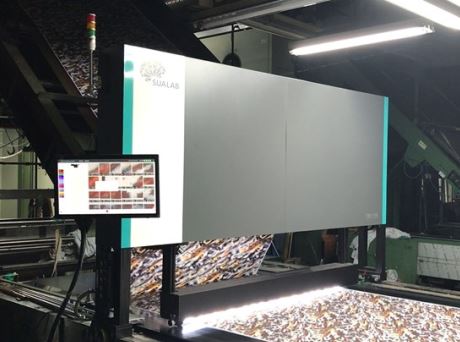
The TAS dyeing machine is receiving recognition for its performance by detecting continuous defects at Donghwan Mulsan in Ansan and Jungwoo Vina's Vietnam factory in Ho Chi Minh City. In addition, we are steadily improving our defect detection capabilities by conducting continuous research and development in collaboration with various clients.
There is also keen interest from sewing and brand companies regarding this. This is because minimizing defects at dyeing and finishing companies not only ensures the delivery of high-quality products, but Suah Lab's solutions can also be fully utilized for full inspection before cutting and delivery.
Suara Lab is currently preparing to launch solutions applicable to the dyeing process and various final defect inspection processes. It is expected that if all these solutions are implemented in the field, the textile industry will be one step closer to adopting smart factories.
Suaralab CEO Song Ki-young stated, "Having introduced inspection automation to the dyeing process—which previously relied on traditional inspection methods—for the first time in the world, we will rapidly expand the scope of inspection automation across the entire textile industry and take the lead in the adoption of smart factories."
Comments
Related news
AI Startup SUALAB Wins Grand Prize at Innovator Awards
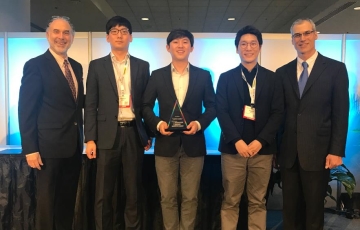
SoA Lab received the Platinum award in the 'Innovators Awards' presented by Vision Systems Design at the 2017 North America Robotics and Automation Exhibition (Automate 2017) held in Chicago. Automate 2017 is the world's most comprehensive automation conference that brings together robots, artificial intelligence, machine vision, motion control, and other cutting-edge automation technologies. The Innovators Awards have been held annually at global automation or machine vision conferences such as VisionShow and Automate.
2017.04.07by 김지혜 기자
SUA Lab Overcomes Machine Vision Limitations with AI
SUALAB, an AI-based smart factory solution provider, has officially launched SuaKIT, a deep learning-based machine vision inspection software. SuaKIT is based on image interpretation technology and has significantly improved inspection accuracy and speed in various domains where conventional machine vision technology was difficult to apply. Traditionally, engineers had to manually define defects in images one by one and set defect characteristic values by hand. As a result, machine vision technology could only be utilized in fields with standardized surface shapes, such as semiconductors and LCDs. Conversely, in fields with non-standardized surface shapes, such as textiles and natural leather, it was difficult to manually set defect characteristic values, so most operations relied on visual inspection.
2017.07.05by 김지혜 기자

If you were to define the smart factory keyword in one word, it would be ( ).
What keyword should be most emphasized for smart manufacturing processes in small and medium-sized enterprises? Experts from Bosch, SAP, Rockwell, the Institute for Advanced Engineering, and the Seoul Industrial Promotion Agency provided answers. It was the SBA Seoul Innovation Forum. Ha Hee-tack, Director at Bosch Korea: 'The Return of the King' Manufacturing, once positioned at the ultimate center, seemed to be overlooked for a time. Companies were busy relocating abroad. However, changes in the technology market are the turning point of the Fourth Industrial Revolution. Consider how to utilize the technology that has been disseminated. Factories will become capable of customized manufacturing, and the processes will become simpler and easier. This is an opportunity for manufacturing facilities to return to Korea. The approaches to take are endless.
2017.07.31by 김자영 기자

Korea Instrument, KOLAS Accredited Calibration Agency First to Simultaneously Acquire ISO/IEC 27,001·27,701
Korea Instrument has become the first among KOLAS accredited calibration agencies to simultaneously acquire ISO/IEC 27,001 and ISO/IEC 27,701 certifications. Through its proprietary platforms CWIZ Enterprise and CWIZ Partners, the company has embedded information security and personal data protection requirements across all business processes including customer information, equipment data, and calibration reports, with plans to continuously advance its management system through regular audits and security inspections.
2026.10.12by 배종인 기자
TeamViewer One, IT Incident Automation Workflow and Resolution Center Enhanced
TeamViewer has added IT incident automation capabilities and an advanced Resolution Center to its integrated digital workplace management platform 'TeamViewer ONE'. Recurrent service disruptions, configuration errors, and capacity shortages are automatically handled according to preset policies, and device status verification through script deployment can be managed in a unified interface, significantly reducing repetitive tasks for IT teams.
2026.10.12by 배종인 기자











