


The Backlash of IoT Security: Intact Drones Crash and Moving Cars Stop
 Published2017.09.07 16:23
Network environments are diverse, including public networks, private networks, and 3G/4G LTE. Performance is limited due to reduced CPU and memory capabilities. It is difficult to apply existing security technologies because software management is restricted. There is a possibility of information leakage at any stage, from data storage to transmission and processing.
This is why IoT security is vulnerable. Let's examine in which areas and how security can be exposed and remain vigilant.
There have been cases where refrigerators, which are opened and closed several times a day, vacuum cleaners that sweep through every corner of the house, and TVs that we sit face-to-face to watch have been hacked. In 2014, when IoT security was being discussed, Proof Point, an American security company, revealed that hundreds of thousands of malicious emails were being sent three times a day not only to businesses and individuals but also to home appliances. The level of hacking went beyond simply receiving emails; it was now possible to control the cameras attached to these devices. Cameras on vacuum cleaners and TVs could become the eyes of hackers, filming every corner of the house.
What about a smart factory that uses sensors to detect the lower levels of the plant, assess the current situation, and even halt operations if problems arise? While it can increase factory availability and enhance convenience through real-time management, it also presents a wide range of threats. Local Area Networks are susceptible to Denial of Service (DOS) attacks, data leakage, and command tampering. Gateway segments allow unauthorized personnel to remotely control the facility or eavesdrop on data. These issues stem from various problems, such as insufficient security coding during application installation and errors arising from the diverse product manufacturing processes.
To date, hacking incidents have predominantly resulted from a lack of awareness among internal factory personnel. The German Federal Office for Information Security suffered losses when the blast furnace control system at a German steel plant was attacked. At the time, hackers stole login accounts using the email addresses of officials and seized control of the process control system. A security official attending an IoT security forum stated for the same reason, “There have been cases where domestic companies have had corporate know-how leaked due to hacking, but they have not disclosed it publicly.”


Security consultant Planet Zuda's drone hacking video
Autonomous vehicle sensors lack the situational adaptability of the human eye and can misidentify objects. Professor Yongdae Kim of KAIST, who researched actual threat factors, stated that sensors from Google's Velodyne and Mobileye can also use bright lasers to render objects invisible, and that sensors can even be used to induce hallucinations, making it appear as if objects are present when they are not.
Professor Kim stated that he caused the drone to fall by controlling the MEMS through resonance sent to the gyroscope, which determines the drone's speed. The accompanying video showed a drone experiment in which it fell when a MEMS signal was sent while it was flying well, and then took flight again when the signal was stopped. The video of a drone falling while flying is similar to footage released on YouTube by an American security consultant in 2015. However, the security consultant reported that they were able to hack 'AR. Drone' because the drone used unencrypted Wi-Fi and its SSID was not hidden.
Cases of damage caused by drone hacking have primarily occurred in the United States, a country with vast land and advanced military training. In some instances, information captured by the U.S. military was leaked as is, while others hijacked "state-of-the-art" drones by hacking them to change their destinations. The acquired drones were even disassembled and reverse-engineered for development.
Comments
Related news
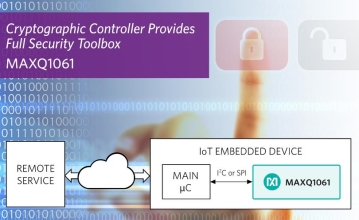
Can Encryption Key Protection Be Secured with Hardware?
Last year, a hacking incident occurred in the United States due to a DDoS attack on DNS services. The cause was the exploitation of webcams and IoT products. How should security be handled in the IoT industry, which is drawing attention as a future growth area? Hacking attacks through networks are a threat, but there is also a high possibility that IoT devices themselves could be physically manipulated and used as a route for cyber attacks. The Korea Internet & Security Agency (KISA) took this into consideration and selected "hardware-based (TPM) IoT terminal security technology" as one of the top 10 information security technologies that the industry should focus on in 2017. Software encryption has the advantages of cost-effectiveness and ease of updates, but it is only as secure as the security level of the device operating system. If the OS has security vulnerabilities, it can be easily breached. Software is also ineffective for protecting encryption keys, which are critical to security. To attack hardware-based security, a secure microcontroller (MCU) must be used, and software must be executed from within its immutable memory to prevent internal modifications.
2017.07.27by 김지혜 기자
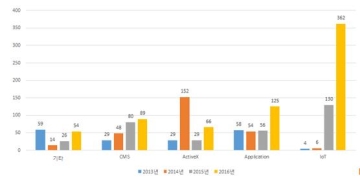
KISA Accepts Reports of IoT Device Vulnerabilities to Prepare for Security Threats
The Korea Internet & Security Agency (KISA) announced that it will operate an 'IoT Security Vulnerability Intensive Reporting Period' for two months starting in August, focusing on receiving and processing vulnerabilities in IoT devices in preparation for emerging security threats to IoT devices. As part of the 'Software New Vulnerability Reporting Reward Program (Bug Bounty)', newly discovered security vulnerabilities that could affect the latest version software (firmware, etc.) of smart home devices, drones, AI speakers, and other IoT devices frequently used in everyday life are subject to reporting. Any Korean residing both domestically and internationally can participate.
2017.08.04by 김지혜 기자

Chronic software awareness shortage extending to security issues; Government to actively address
The 9th 'Secure Korea 2017' hosted by the Korea Hacking and Security Association was held on the 5th at the National Assembly Library Auditorium. Song Seong-soo, Director General of the Ministry of Science and ICT, stated in his keynote speech, "In a hyper-connected society where all devices are connected, efforts are needed to collect software and hardware vulnerabilities and prepare security patches. We are constructing a vulnerability management center at the national level." KISA (Korea Internet & Security Agency) is collecting software and hardware vulnerabilities through consultation with the private sector to build vaccine programs, and is consulting with the Cyber Threat Alliance (CTA), known as the U.S. KISA. In particular, it stated, "Since IoT must be embedded differently from computer security, advance preparation is important."
2017.09.05by 김자영 기자
.png)
Databricks Unveils Open AI Security Monitoring 'Lakewatch'
Databricks entered the security market on March 24 by unveiling LakeWatch, an open-source agentic SIEM. The core functionality of this product is to integrate and analyze security, IT, and business data in a single environment to support AI-based threat detection and investigation. The company explained that it reduces the limitations of existing security operations centers, which have had to forgo some data due to high cost structures, and enables large-scale data analysis and automation based on open formats and ecosystems. LakeWatch is currently offered as a private preview, with Adobe and Dropbox mentioned as early customers. Databricks also announced an expanded partnership with Anthropic as well as the acquisition of Antimatter and SiftD.ai.
2026.03.26by 배종인 기자

Kaspersky Unveils Revamped 'NEXT' Combining SOC Integrated Management and AI Analytics
As enterprises increase demand for integrated management and automation in the construction and operation of Security Operations Centers (SOC), Kaspersky has disclosed updates to its B2B security product suite 'Kaspersky Next'. This update expands EPP, EDR, XDR, and SIEM integration through a single console based on OSMP, incorporates AI capabilities such as DLL hijacking detection and suspicious account takeover behavior identification, and includes integration with generative AI assistant tool KIRA. The company stated that in large-scale deployment environments, EDR Expert can reduce resource requirements by up to 30%, and XDR Expert by up to 60%.
2026.03.25by 배종인 기자











