



The Semiconductor Association held the Korea Semiconductor Design Competition awards ceremony.
 Published2017.09.12 15:42
The Korea Semiconductor Industry Association (KSIA) held the '18th Korea Semiconductor Design Competition' awards ceremony at the KSIA Hall in Pangyo, Gyeonggi Province on the 12th.
A total of 13 winning teams were awarded in the presence of Ahn Se-jin, Director of the Electronic Components Division of the Ministry of Trade, Industry and Energy, Heo Yeom, CEO of Silicon Mitus, Son Bo-ik, CEO of Silicon Works, and officials from related organizations such as the Korean Sensor Society and the Korean Institute of Electrical Engineers.
Starting this year, the association opened the design competition to undergraduate students in addition to master's and doctoral students. Furthermore, a special corporate award was created, with Samsung Electronics, SK Hynix, Silicon Mitus, and Silicon Works participating this year. The association plans to expand the number of corporate awards in the future.
A total of 40 teams from 25 universities and graduate schools across the country competed in this design competition. The grand prize, the Minister of Trade, Industry and Energy Award, went to the Braid Team (Lee Yeon-ho, Choi Yun-jae, and Choi Jong-hyeok) of the Korea University Integrated Systems Laboratory for their design of a "high-efficiency, low-power transmitter and receiver using braid signaling." 'Braid' means twisting and braiding hair, and a transmission signal that can implement ultra-high-speed, high-performance, and low-power transmission and reception was designed using a cross-transmission method called 'Braid Signaling' in the ultra-high-resolution 8K UHD.
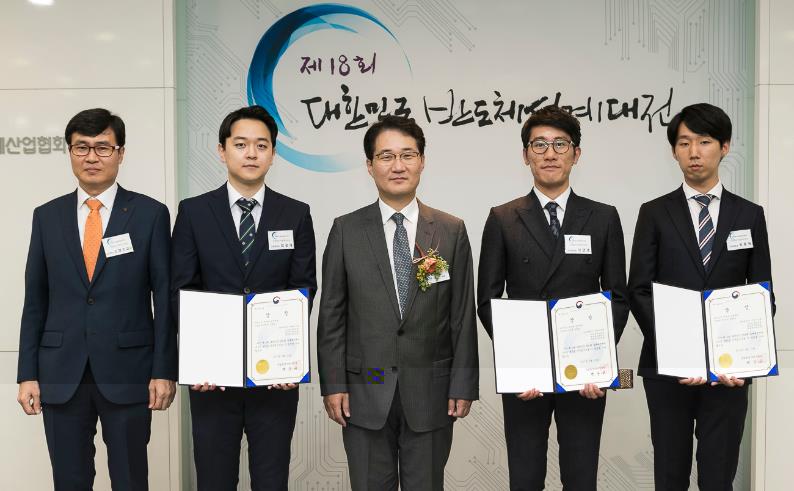
The judges unanimously agreed that the "Braid Signaling" design was worthy of the grand prize for its creativity, completeness, and marketability. The design has currently completed primary patent registration in Korea and the US, and is currently in the process of refining the idea and applying for a secondary patent.
The 13 winning teams at this year's Semiconductor Design Competition will receive technology transfer and promotional support for their winning designs, access to related technology forums and seminars to showcase their design technology and winning designs, and access to prototype production and investment support. Furthermore, they will have the opportunity to participate in a special exhibition at the Semiconductor Exhibition (SEDEX) at COEX from the 17th to the 19th of next month, where visitors can view the winning designs and consult with the winning teams.
Nam Ki-man, executive vice president of the Korea Semiconductor Industry Association, which hosted the Korea Semiconductor Design Fair, said, “Compared to the world-class domestic memory semiconductor industry, the biggest challenge for the relatively weak system semiconductor industry is securing design personnel.” He added, “We will make the Korea Semiconductor Design Fair a place for advancement and development in the semiconductor design field.”
Comments
Related news
Universities are developing practical skills by opening semiconductor equipment training courses.
The Korea Semiconductor Industry Association (KISA) announced that Myongji University, Korea University of Technology and Education, Inha University, and Daelim University have launched the 'Semiconductor Equipment Major Track Program' for the first time at domestic universities. All four universities will begin the program starting this second semester. The 'Major Track Program' refers to a specialized educational system by field within the departmental curriculum. The 'Semiconductor Equipment Major Track Program' is a more specialized educational curriculum in the semiconductor equipment field, through which new graduate employees who join semiconductor equipment companies can be immediately assigned to practical work without additional separate training. On the 24th, the semiconductor association held the launch ceremony for the Semiconductor Equipment Major Track Program at the Korea Semiconductor Industry Association headquarters in Pangyo, Gyeonggi Province, with attendance from Park Ki-young, Policy Director of Materials and Parts Industry at the Ministry of Trade, Industry and Energy; Jung Jae-hoon, President of the Korea Industrial Technology Promotion Agency; Lee Jong-myung, Vice President of Myongji University; Lee Jae-hak, Dean of Graduate School of Korea University of Technology and Education; Choi Soon-ja, President of Inha University; Hwang Un-gwang, President of Daelim University; and Park Kyung-soo, CEO of PSK. Park Kyung-soo, CEO of PSK, attended as the Chair of the Equipment Division of the Korea Semiconductor Industry Association and as a representative of semiconductor equipment companies.
2017.08.24by 김지혜 기자
China, Riding a Semiconductor Boom: 3 Things Domestic Fabless Companies Need to Enter the Market
The Chinese government has actively supported the semiconductor industry through the "Semiconductor Industry Development Promotion Initiative," resulting in improved technological capabilities. With the increase in electronic device production and manufacturing equipment, the consumer market is also expanding rapidly. As a result, the entry of domestic fabless companies into China has become inevitable. So how should we prepare for market entry in China? When examining China's semiconductor industry by sector, the fabless industry has a relatively low share but shows the fastest growth rate. Both consumption scale and domestic production scale in China are increasing, and notably, half of total consumption is produced domestically in China. According to the China Software Industry Association (CSIA), domestic production is accelerating, and it is projected that more than 60% of total consumption will be produced in China by 2018. Influenced by tax incentives from the Chinese government, the number of fabless companies increased from 681 in 2014 to 715 in 2015. Among these, 20% of companies are recording revenues ranging from 16 million dollars to 2.3 billion dollars. Along with quantitative growth, qualitative growth is also occurring at a rapid pace.
2017.08.28by 김지혜 기자
Q2 semiconductor equipment shipments increase 36% compared to same period last year
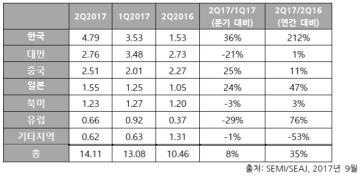
The Semiconductor Equipment and Materials International (SEMI) announced that global semiconductor manufacturing equipment shipments in Q2 2017 totaled $14.1 billion. The Q2 2017 shipment value of $14.1 billion exceeded the record of $13.1 billion set in Q1 this year. Compared to Q1 shipments, this represents an 8% increase, and compared to Q2 last year, a 35% increase. Looking at shipments by region, the distribution is almost similar to Q1, and once again, South Korea remains the world's largest semiconductor equipment market. Korea showed a 36% increase compared to the previous quarter and 212% growth compared to the same period last year. Taiwan and China followed in that order. SEMI prepares reports based on data compiled on a monthly basis from 95 global equipment companies in cooperation with the Semiconductor Equipment Association of Japan (SEAJ). The following table is presented in US dollars and shows quarterly shipments by region, quarter-over-quarter growth rates, and year-over-year growth rates.
2017.09.12by 김지혜 기자

Intel Unveils Next-Generation 'Core Ultra Series 3' and vPro Platform for Enterprise PCs
Intel has officially unveiled the "Intel Core Ultra Series 3" for next-generation enterprise PCs and the latest vPro platform, addressing a wide range of demands from enterprise notebooks to high-performance workstations.
2026.03.26by 배종인 기자

ROHM Launches ESD Protection Diode Compatible with High-Speed Interfaces of 10Gbps or Higher
Semiconductor specialist ROHM has developed the 'RESDxVx series' of ESD (electrostatic discharge) protection diodes capable of responding to next-generation high-speed data communication environments exceeding 10Gbps, simultaneously enhancing both signal quality maintenance required in high-speed interfaces and IC protection performance.
2026.03.26by 배종인 기자











