


I asked my home appliance "What should I eat today?" and the IoT kitchen answered back.
 Published2017.09.21 07:45
Temperature sensors, weight sensors, and touch LCD installation for smart cooking
"Kitchen appliances have many analog aspects, so simply embedding IoT doesn't make them IoT appliances. There are limitations in providing convenience as a standalone product. Customers also show negative reactions regarding the benefits when connected via WiFi."
Park Mi-jeong, part manager at Coochen, who attended the System-Semiconductor Forum breakfast seminar held in Yangjae on the 20th, said this.
With the boom in artificial intelligence and IoT, "smart appliances" are increasing among home appliances. As the growth of the domestic smart home market is anticipated, large companies such as Samsung and LG Electronics are focusing on smart homes. LG Smart Home connects a hub robot or SmartThinQ Hub 2.0 with appliances such as refrigerators, washing machines, robot vacuums, and air purifiers via WiFi, enabling users to use and control functions.
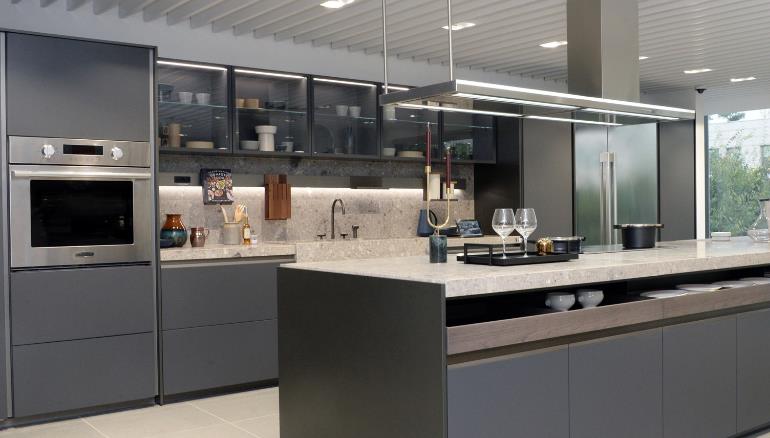
Small appliance manufacturers face limitations in independently building IoT implementation platforms since they produce a limited variety of appliances and customers frequently use products from other companies in combination. Coochen, which manufactures electric rice cookers and electric ranges, is currently researching an open-source hardware platform and seeking ways to connect with products from other companies.
Park Mi-jeong said, "We are developing an open-source hardware platform for IoT appliances with the Korea Electronics and Information Communications Industry Promotion Agency (KEA)," and announced plans to foster an ecosystem for small and medium-sized enterprises to enter the IoT market through the development of modules for smart home IoT appliances.
Coochen is also making efforts in sensor development to plan its own IoT products. Park noted, "In Korean cuisine, the range of temperatures used in food varies widely from low to high temperatures," and mentioned that they are expanding the scope of sensors that measure subtle temperature variations.
She explained, "Through accurate temperature sensors, we will be able to improve the quality of cooking not only in high-temperature frying pan and deep-frying dishes that were previously done in high-temperature ranges, but also in low-temperature cooking such as porridge and steaming through precise temperature control."
Additionally, weight sensors are being developed to determine the location of cooking utensils. Touch LCD will also be installed to display the location and cooking method of utensils. Park said, "Domestic products do not yet have touch LCD installed. We are planning a launch around May next year," and added, "We are attempting to convert recipes into MP3 files. We plan to use this to enable automatic cooking on electric ranges."
Coochen sees the potential to pioneer new markets with smart cooking solutions to improve customer cooking convenience. To this end, the company plans to equip appliances with sensors and system semiconductors, enable machine-to-machine communication through communication networks, and collect data to the operating system. The collected data will be used to provide intelligent services in connection with big data.
Park said, "By combining sensors, control, and monitoring, within 20 years an ecosystem will be implemented based on artificial intelligence that can analyze user patterns and propose 'what to eat today,'" she explained.
Comments
Related news

[Photo News] LG SIGNATURE Welcomes You to IFA 2017
LG Electronics will install a large number of flags advertising its ultra-premium home appliance brand 'LG SIGNATURE' at the entrance of 'Messe Berlin' where Europe's largest electronics trade show 'IFA 2017' will be held from the 1st to the 6th of next month, and will await visitors. LG Electronics plans to showcase various innovative products and technologies including ultra-premium 'LG SIGNATURE', OLED TVs, Knock On MagicSpace refrigerators, TwinWash, and smart home solutions under the theme of 'Innovation for a Better Life' at this year's IFA trade show.
2017.08.30by 신윤오 기자
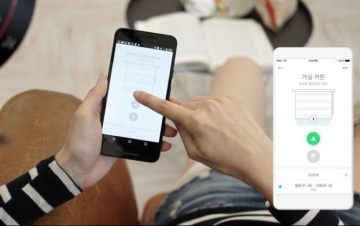
What products, including electric curtains and IoT lighting, are being crowdfunded?
Wadiz (CEO Shin Hye-sung), a leading crowdfunding platform, announced that crowdfunding projects in the IoT technology sector, which help turn ideas into reality, are attracting significant investor interest. As the Internet of Things (IoT) era is entering full swing, it is already bringing substantial changes to consumer experiences. In particular, the three major sectors leading the global IoT market are smart homes, smart cities, and connected cars. IoT, which had previously remained confined to the consumer market, is rapidly expanding and developing into B2B applications such as industrial sites and smart buildings.
2017.08.31by 신윤오 기자

LG Electronics Expands Smart Homes with AI and IoT
LG Electronics H&A (Home Appliance & Air Solution) Business Division President Song Dae-hyun held a press briefing in Berlin, Germany on the 2nd local time and unveiled the company's business strategy to lead the global home appliance market. President Song Dae-hyun stated, "We will focus on creating tangible customer value that smart homes can provide based on connectivity," and emphasized, "To achieve this, we will significantly expand the smart home ecosystem centered on AI (Artificial Intelligence) home appliances, IoT, and robots through continuous technology accumulation and open innovation." LG Electronics plans to expand its annual investment scale by approximately two times the current level by 2020 in order to significantly strengthen its smart home business based on AI home appliances, IoT, and robots, and also plans to increase related research and development personnel by more than 50% within three years.
2017.09.04by 김지혜 기자
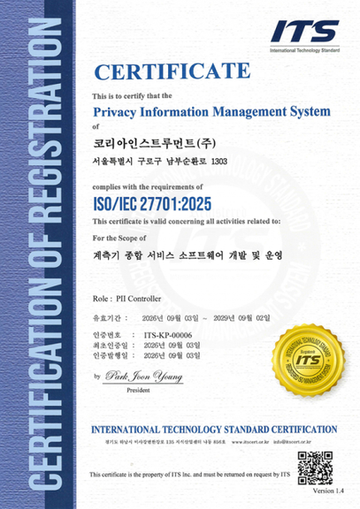
Korea Instrument, KOLAS Accredited Calibration Agency First to Simultaneously Acquire ISO/IEC 27,001·27,701
Korea Instrument has become the first among KOLAS accredited calibration agencies to simultaneously acquire ISO/IEC 27,001 and ISO/IEC 27,701 certifications. Through its proprietary platforms CWIZ Enterprise and CWIZ Partners, the company has embedded information security and personal data protection requirements across all business processes including customer information, equipment data, and calibration reports, with plans to continuously advance its management system through regular audits and security inspections.
2026.10.12by 배종인 기자

TeamViewer One, IT Incident Automation Workflow and Resolution Center Enhanced
TeamViewer has added IT incident automation capabilities and an advanced Resolution Center to its integrated digital workplace management platform 'TeamViewer ONE'. Recurrent service disruptions, configuration errors, and capacity shortages are automatically handled according to preset policies, and device status verification through script deployment can be managed in a unified interface, significantly reducing repetitive tasks for IT teams.
2026.10.12by 배종인 기자











