


Silicon Labs Launches High-Performance Clock Generator Based on Floating-Point Clock Synthesis Technology
 Published2017.09.26 11:56
Silicon Labs announced the launch of a new family of high-performance clock generators that provide high-density timing solutions for 10/25/100G applications.
Based on Silicon Labs' proven MultiSynth fractional clock synthesis technology, the new Si5332 clock family is a timing solution that provides best-in-class frequency flexibility and 230fs rms jitter performance. Various Si5332 options, scalable to 6, 8, or 12 clock outputs, provide integrated clock trees for demanding applications including hyperscale data center switches, servers, storage, networking, small cells, broadband, broadcast video, multifunction printers, and other industrial applications.
James Wilson, Senior Marketing Director for Timing Products at Silicon Labs, said, “Hyperscale data centers are rapidly moving from 10G to 25G, 50G, and 100G Ethernet to accelerate data transfer speeds and network efficiency. "This new investment cycle is driving equipment manufacturers to upgrade switches and access ports at a faster pace and adopt higher-performance timing solutions," they stated, explaining that "by selecting Silicon Labs' Si5332 any-frequency clock, system designers can optimize their clock tree designs without compromising timing performance."
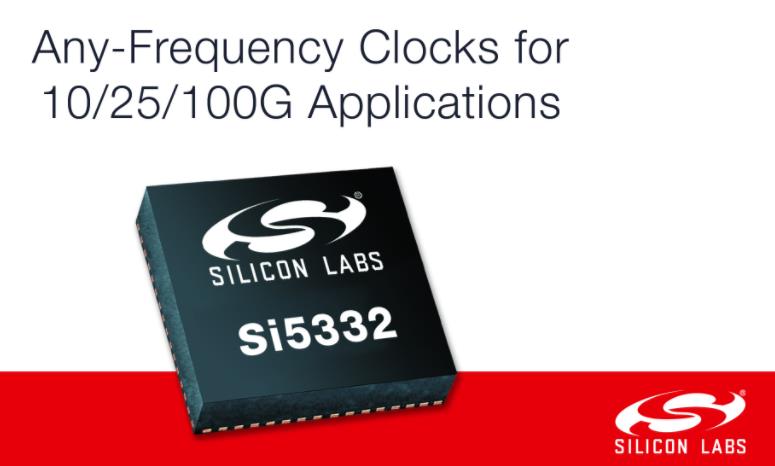
The Si5332 family is optimized to provide reference timing for high-speed serial interconnects used in next-generation data centers. The new product supports PCI Express, the standard that has long dominated the market for interconnecting microprocessors, networking, storage, and memory.
Other industry consortia, including CCIX, Gen-Z, NVLink, and OpenCAPI, are actively developing serial interconnect replacement technologies that support data transfer speeds of up to 25 GT/s. In addition to requiring low jitter clocks, some of these solutions also require spread-spectrum reference clocks.
Since spread-spectrum clock generation is possible for each individual output, a single clock device can simultaneously support a combination of spread and non-spread clocks. Consequently, due to these features, the Si5332 family can be considered the best solution for providing reference timing for high-speed serial interconnects.
The Si5332 clock generator was designed to simplify clock tree design without compromising system performance or increasing power consumption. The new product family combines two MultiSynth floating-point clock synthesizers with five independent integer dividers, eliminating the need for a fixed-frequency clock and oscillator for clock generation.
With jitter performance of 230fs rms, the Si5332 Clock provides 2 to 5 times lower jitter than competing solutions and offers margin for 10/25/100G SerDes timing requirements. The Si5332 Clock integrates extensive on-chip power supply regulation, eliminating the need for expensive discrete LDO (low dropout) regulators required by competing solutions. The Si5332's MultiSynth-based architecture is optimized for power consumption, consuming 50 to 60 percent less power than competing solutions.
Comments
Related news
Mouser Supplies Silicon Labs Blue Gecko Bluetooth 5 SoC
Mouser Electronics supplies Silicon Labs' EFR32BG12 and EFR32BG13 Blue Gecko SoCs. The products now being supplied belong to the wireless Gecko portfolio as low-power Bluetooth SoCs with improved performance including enhanced RF performance, increased cryptographic acceleration, expanded memory options, on-chip capacitive touch control, and added low-power peripherals and sensor interfaces. The EFR32BG12 and EFR32BG13 Blue Gecko SoCs supplied by Mouser Electronics integrate a high-performance 32-bit 40MHz ARM Cortex-M4 core with 2.4GHz and sub-1GHz wireless transceivers.
2017.08.07by 김자영 기자

Silicon Labs Announces Highly Scalable Automotive Radio Solution
Silicon Labs has announced the industry's most scalable, flexible, and cost-effective automotive radio solutions for the global automotive infotainment market. Silicon Labs' new Global Eagle and Dual Eagle AM/FM receivers and digital radio tuners, along with the Digital Falcon coprocessor, enable OEMs and Tier 1 suppliers to serve all market segments and cost and performance levels while complying with stringent automotive quality standards and supporting digital radio standards. OEM and aftermarket radio designs based on Silicon Labs' new product family are scalable from low-cost single-tuner AM/FM radios to high-performance systems supporting multiple tuners and antennas, allowing automotive radio suppliers to leverage common software APIs to apply their R&D efforts across diverse product lines.
2017.08.10by 김지혜 기자
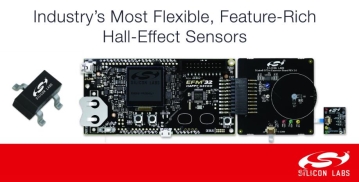
Silicon Labs Launches Magnetic Sensors for Comprehensive Open/Close and Position Sensing
Silicon Labs has announced opening a new chapter in the hall-effect sensor field by introducing a magnetic sensor product family that delivers industry-leading power efficiency, best-in-class sensitivity, flexible I2C configuration, built-in tamper detection and temperature sensing capabilities. Silicon Labs' new Si72xx portfolio includes the most advanced and feature-rich magnetic sensor product family that surpasses reed switches and conventional hall-effect sensor products currently used in a wide range of open/close and position sensing applications. The Si72xx magnetic sensors provide robust reliability for white goods appliances, flow meters, cordless power tools, dial-type controls for consumer electronics, industrial alarms, motor control, and door/window security applications. These sensors guarantee AEC-Q100 quality for automotive applications and are designed to withstand harsh industrial environments.
2017.09.07by 김지혜 기자

Intel Unveils Next-Generation 'Core Ultra Series 3' and vPro Platform for Enterprise PCs
Intel has officially unveiled the "Intel Core Ultra Series 3" for next-generation enterprise PCs and the latest vPro platform, addressing a wide range of demands from enterprise notebooks to high-performance workstations.
2026.03.26by 배종인 기자

ROHM Launches ESD Protection Diode Compatible with High-Speed Interfaces of 10Gbps or Higher
Semiconductor specialist ROHM has developed the 'RESDxVx series' of ESD (electrostatic discharge) protection diodes capable of responding to next-generation high-speed data communication environments exceeding 10Gbps, simultaneously enhancing both signal quality maintenance required in high-speed interfaces and IC protection performance.
2026.03.26by 배종인 기자











