



Carssum, it's the era of mobility now, so try car sharing.
 Published2017.09.29 06:05
Providing unmanned rental car services and an integrated management platform
Last July, Socar's cumulative reservations reached 10 million. Usage rates are increasing for car-sharing companies, including not only Socar but also Green Car.
Ha Ho-seon, CEO of Korea Car Sharing, said, “Car sharing was introduced as we entered an era of low growth and the sharing economy,” adding, “It is not simply a concept of renting cars, but rather a mobile-based convergence service centered on automobiles that will usher in an era of automotive mobility.”
Carssum, a subsidiary of Korea Car Sharing, is realizing e-mobility by establishing a car-sharing platform and promoting the use of connected rental cars. It provides corporate business vehicles for B2B use, and unmanned rental car services and integrated rental car management platform services for B2C use.
Carssum provides an unmanned brokerage service for member rental car users and rental car operators. While existing rental cars allowed for long-term rentals and use by non-members, they were typically based on long-distance travel. By introducing the concept of car sharing, Carssum has enabled usage for both short and long distances. Since the service operates unmanned, users can utilize vehicles located at rental offices or parking lots, making it available 24 hours a day, 365 days a year without time constraints.
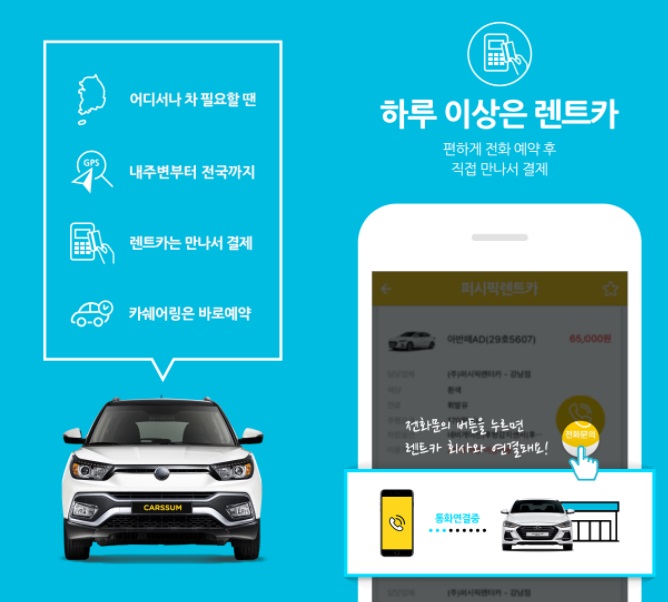
Rental car reservations are automatically recorded, and the reservation status of all vehicles can be managed while past usage records are also saved. The service can be operated simply by installing an unmanned rental terminal in the vehicle, and since it operates on a membership basis, it is advantageous for securing loyal customers. Through the control screen, the status of vehicles used across the country can be checked in real time, and if a problem occurs with a vehicle, the manager is notified immediately.
Carssum's unmanned car rental service is available not only to member companies looking to start a car rental business but also to individual customers. Reservations, payments, and contracts are all completed via a smartphone app. Since vehicle access is controlled by the app and RFID cards, real-time vehicle location tracking and administrator emergency control authority can be granted.
Carsum Enterprise, a corporate business vehicle management and sharing service, enables not only the sharing of corporate vehicles among employees but also vehicle location tracking, optimization of the number of vehicles in operation, improvement of vehicle management costs such as fuel expenses, and remote vehicle control and diagnostics.
Company H introduced a business vehicle sharing system, allowing all employees to share and use 25 vehicles. The vehicles were utilized for purposes such as sales activities and employee commuting, while personal use was permitted, allowing only the fuel costs incurred for personal use each month to be treated as expenses. As a result, operating costs and fuel expenses were reduced.
Real-time vehicle operation information is automatically monitored, and the vehicle's location can be determined by the opening and closing of the doors. Usage status can be monitored as usage data accumulates by period, individual, and vehicle.
CEO Ha stated, “Future cloud-based transportation systems will provide optimal travel routes using user location, networks, and artificial intelligence. Not only cars, but also trains, buses, and airplanes will be connected and utilized as a single system,” adding, “New business and service cultures will be created based on mobility. Car sharing is one of them.”
Comments
Related news
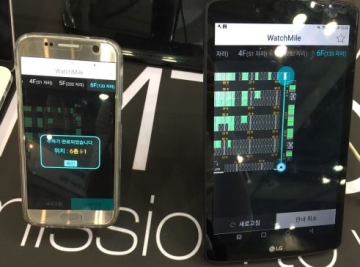
Mtube develops indoor navigation system that finds empty parking spaces.
We've arrived at our destination, and the navigation has ended guidance. "Look carefully for an empty spot," I tell the person next to me. There are multiple reasons to pay careful attention when parking: to secure a spot close to the entrance, to find a wider space because we have a lot of luggage to unload, to avoid missing an empty spot because a car is closely following behind, and so on. While shopping mall parking lots can show available spaces with green and red lights, it's difficult to pinpoint the exact location of a spot—which row it's in—as you turn corners. "The world's first indoor navigation system."
2017.09.11by 김자영 기자
Irience Develops Iris Recognition That Authentications in the Blink of an Eye
The newly unveiled 'iPhone X' features facial recognition. Samsung also equipped its Galaxy Note 7 with iris recognition capability. Now fingerprint recognition is used not only for unlocking smartphones but also for door locks. In contrast to fingerprint recognition, which has the disadvantages of being easily altered and subject to forgery, the iris is formed from the most complex and intricate fibrous tissue in the human body, making authentication forgery difficult. Since each eye also has different patterns, it can be used for identity verification. Irisense is a company that develops and manufactures products based on iris recognition technology. It has created access control systems and management programs based on iris recognition algorithms. Irisense's iris recognition algorithm features a fast frame rate for extracting iris characteristics and enables accurate 1:N matching. Iris information registration is possible regardless of iris color, and since data extracted from iris images rather than video materials is stored, it blocks authentication using photographs, videos, and artificial imitations. The company has developed a ultra-compact iris recognition module and is commercializing products based on this technology.
2017.09.13by 김지혜 기자

Olive Union helps ease hearing loss concerns with a hearing aid that connects to your phone.
In a variety show, a close-knit grandson and grandmother went out together. Their destination was an otolaryngology clinic. One of the hearing aids fitted several years ago wasn't fitting well in grandmother's ear, so the family's voices were gradually becoming louder, and they decided to get a hearing test and have the hearing aid checked. After hearing the doctor's negative opinion, the grandson tried to get a new one fitted on the other ear, but grandmother raised her voice sharply. The reason was, as expected, the high cost. While wearing both hearing aids can slow down hearing loss, many people only wear one. Into this hearing aid market with such high costs, a hearing aid in the 100,000 won range—significantly lower in price—has been launched. It is the startup 'Olive Union (http://www.oliveunion.com/ko/)'.
2017.09.22by 김자영 기자

[e4ds Tech Day 2026 ⑨] Sim Sang-gyu, Autocrypt CTO: "In the Physical AI Era, Automotive Security Must Extend Beyond the Vehicle"
At e4ds Tech Day 2026, Sim Sang-gyu, CTO of Autocrypt, explained automotive cybersecurity strategies in the era of Physical AI and SDV (Software-Defined Vehicle). Automobiles are evolving as part of an ecosystem connected to AI, cloud, chargers, IoT, and robots, and he emphasized that the scope of security must expand beyond the vehicle interior to the entire connected environment. In particular, AI model tampering, adversarial attacks, OTA updates, and EV charger hacking were identified as major threats. He explained that response measures require zero trust, AI model integrity protection, intrusion detection, Security by Design and Default, and full lifecycle security management, and that proactive security system establishment beyond regulatory compliance is critical for securing future mobility competitiveness.
2026.10.12by 배종인 기자

Practical HIL Construction Strategy for Automotive and Off-Highway Controller Validation
As vehicle E/E architecture transitions to zonal structures and shifts to software-defined vehicles (SDV), the number of controllers (ECUs) requiring validation and software complexity are surging dramatically. Meanwhile, real vehicle testing cannot provide repeated verification under identical conditions and entails lead time and safety concerns. This white paper explains the principles of HIL (Hardware-in-the-Loop) validation and the structure of the NI platform composed of PXI, SLSC, and VeriStand, and through two actual implementation cases—Camera Record & Replay HIL for In-Cabin Monitoring Controller (ICMU) and Forklift Controller (VCU) HILS—describes how controller-level regression testing becomes possible. Additionally, it explicitly states application boundaries and limitations, such as lack of A2B support.
2026.10.12by 편집부











