


Cybersecurity is also a battlefield; domestically, there is no information sharing among relevant agencies.
 Published2017.10.10 06:25
The public bears the brunt of the conflict between related agencies; 'information exchange' is the solution.
According to announcements from various agencies, the number of people engaged in hacking in North Korea reaches 6,800. Relevant domestic organizations include KISA, the National Intelligence Service (NIS), and the Financial Services Commission (FSC). At a forum hosted by National Assembly member Yoo Seung-hee, the serious state of North Korea's cyber security was discussed.
The National Police Agency's Cyber Security Bureau tracked the activities of North Korean employees who hacked domestic systems by accessing North Korean IP addresses. Chief Investigator Jeong Seok-hwa stated, "Their work was identical to that of government officials." They arrived at work in the morning, clipped news articles, and collected information. They then sent malicious and phishing emails impersonating government officials. They primarily used portal site accounts and showed a trend of steadily increasing the frequency of email sending.
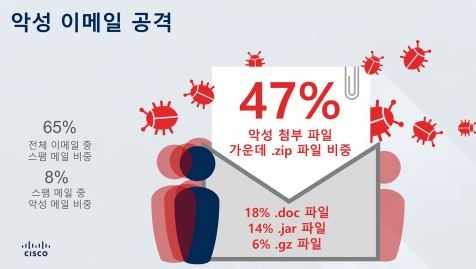
Photo source: Cisco
Initially, this was carried out primarily by government agencies, but recently it has spread to public and private entities as well. This includes the personal information hacking cases involving SK and Hanjin, the Interpark Bitcoin demand case, and the ATM electronic financial transaction information theft incident in September. The objective of the attack itself is money.
It has also been pointed out that due to the nature of the cyber security ecosystem, the scale of damage is greater than that of natural disasters, yet immediate recovery is not taking place.
Colonel Kim Han-sung of the Cyber Command also stated that while the United States accepts cyber as a battlefield domain and is preparing for it just like the land, sea, and air domains, the domestic response is inadequate.
He continued by warning, “There was a request to ‘provide the current status of state attacks,’ but the scope of action available to the Cyber Command is determined by whether the North Korean attack targets banks or virtual currency,” adding that the damage caused by the mixing of state agencies ultimately lies with the lives and assets of the people.
Domestic security has also advanced since 2009 as the police, the National Intelligence Service, and other related agencies have each experienced security incidents. However, because the Financial Services Commission, which is responsible for investigations, and private companies have different objectives, there are limitations in recovery and prevention of recurrence. This results in a situation where, even if the cause of a breach is identified, it remains unknown who committed the breach.
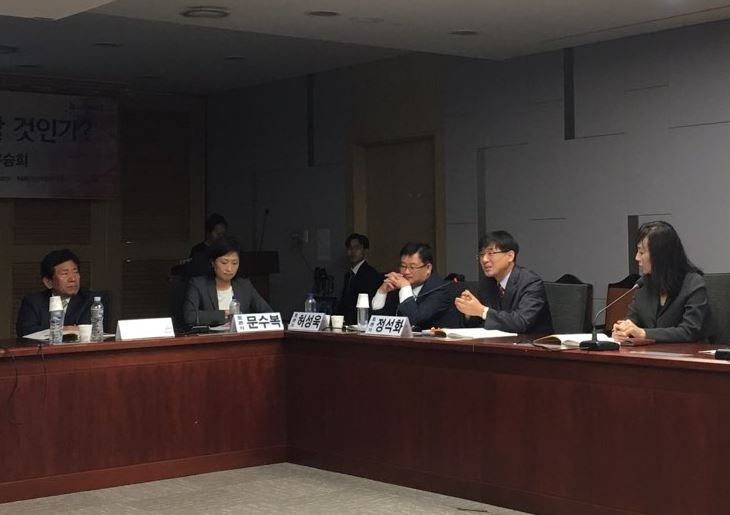
Jeong Seok-hwa, Head of the Investigation Division at the Cyber Terrorism Response Center, is speaking.
Chief Secretary Jeong said, “Only connections with each agency remain. How to connect them is important,” citing the U.S. National Council of Homeland Security (NCCIC), which changed after the 9/11 attacks, as an example.
In the United States, the Cyber Security and Communications Integration Center works together and naturally shares information. Although there are information sharing systems among the Ministry of Science and ICT, the National Intelligence Service, the Ministry of National Defense, investigative agencies, and military investigative agencies, information sharing carried out through systems has limitations. For real-time or sensitive information to be exchanged, they must be in the same space (platform).
Comments
Related news

[Planning - Autonomous Vehicles⑧] Cybersecurity is the key to preventing autonomous vehicles from becoming "running weapons."
Security technology is garnering attention for realizing autonomous driving technology at level 4 or higher, where vehicle control is transferred from the driver to the vehicle. This is because drivers must be assured that autonomous vehicles remain safe even when exposed to threat factors such as vehicle system errors or hacker intrusions. Automotive semiconductor companies such as Renesas, Infineon, NXP, and Maxim have been applying Hardware Security Modules (HSM). The HSM supports key management functions by centrally storing keys and transmitting them in encrypted form.
2017.07.17by 김자영 기자
Chronic software awareness shortage extending to security issues; Government to actively address
The 9th 'Secure Korea 2017' hosted by the Korea Hacking and Security Association was held on the 5th at the National Assembly Library Auditorium. Song Seong-soo, Director General of the Ministry of Science and ICT, stated in his keynote speech, "In a hyper-connected society where all devices are connected, efforts are needed to collect software and hardware vulnerabilities and prepare security patches. We are constructing a vulnerability management center at the national level." KISA (Korea Internet & Security Agency) is collecting software and hardware vulnerabilities through consultation with the private sector to build vaccine programs, and is consulting with the Cyber Threat Alliance (CTA), known as the U.S. KISA. In particular, it stated, "Since IoT must be embedded differently from computer security, advance preparation is important."
2017.09.05by 김자영 기자

Schneider Unveils Integrated Solutions for Design, System Operations, and Cybersecurity
Schneider Electric has launched a new 'EcoStruxure Software Solution' that delivers tangible asset profitability and operational reliability. This integrates Schneider's robust Industrial Internet of Things (IIoT) technology including the EcoStruxure architecture and platform. It enables real-time control and improvement of efficiency, asset reliability, and operational profitability in actual industrial environments. Schneider Electric's 'EcoStruxure' is a system architecture and platform that supports IoT and is characterized by openness and interoperability. It delivers 'Innovation at Every Level' across connected products, edge control, and applications, analytics, and services. The EcoStruxure architecture supports scalable design and operation of connected systems, and implements best-in-class cybersecurity at every level.
2017.09.22by 김자영 기자
.png)
Databricks Unveils Open AI Security Monitoring 'Lakewatch'
Databricks entered the security market on March 24 by unveiling LakeWatch, an open-source agentic SIEM. The core functionality of this product is to integrate and analyze security, IT, and business data in a single environment to support AI-based threat detection and investigation. The company explained that it reduces the limitations of existing security operations centers, which have had to forgo some data due to high cost structures, and enables large-scale data analysis and automation based on open formats and ecosystems. LakeWatch is currently offered as a private preview, with Adobe and Dropbox mentioned as early customers. Databricks also announced an expanded partnership with Anthropic as well as the acquisition of Antimatter and SiftD.ai.
2026.03.26by 배종인 기자
Kaspersky Unveils Revamped 'NEXT' Combining SOC Integrated Management and AI Analytics
As enterprises increase demand for integrated management and automation in the construction and operation of Security Operations Centers (SOC), Kaspersky has disclosed updates to its B2B security product suite 'Kaspersky Next'. This update expands EPP, EDR, XDR, and SIEM integration through a single console based on OSMP, incorporates AI capabilities such as DLL hijacking detection and suspicious account takeover behavior identification, and includes integration with generative AI assistant tool KIRA. The company stated that in large-scale deployment environments, EDR Expert can reduce resource requirements by up to 30%, and XDR Expert by up to 60%.
2026.03.25by 배종인 기자











