



Xilinx Integrates RF Signal Chain into SoC for 5G Wireless Communications
 Published2017.10.10 12:12
Xilinx announced the launch of the Zynq® UltraScale+™ RFSoC product family, an innovative architecture that integrates RF signal chains into SoCs for 5G wireless, cable remote-PHY, and radar applications.
The fully programmable RFSoC based on a 16-nanometer UltraScale+ MPSoC architecture integrates RF data converters capable of reducing system power and size by up to 50-75%, and also integrates SD-FEC (soft-decision Forward Error Correction) that meets 5G and DOCSIS 3.1 standards as a single unit. Silicon samples are currently being provided to various customers, and an Early access program for the Zynq UltraScale+ RFSoC product family is also available.
The Zynq RFSoC combines RF data converters and SD-FEC cores with high-performance 16-nanometer UltraScale+ programmable logic and ARM multiprocessing systems, enabling the construction of an integrated signal chain from analog to digital.
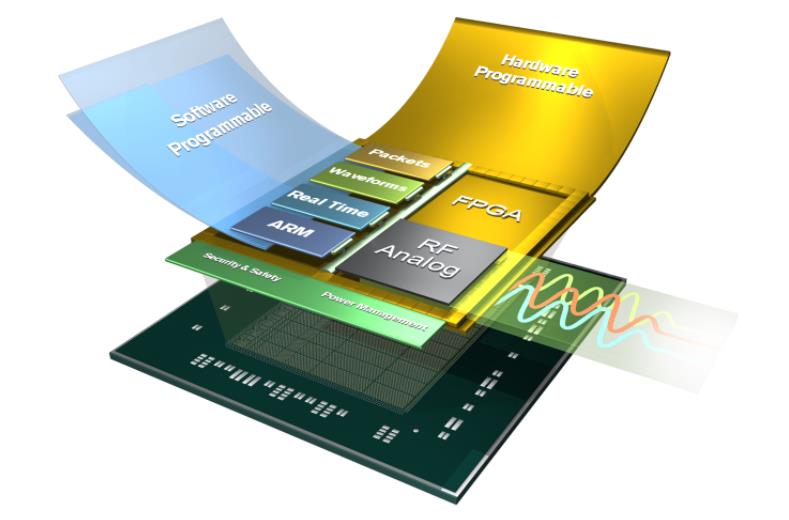
Applications implemented with the Zynq RFSoC product family include remote radio heads for massive-MIMO, millimeter-wave mobile backhaul, 5G baseband, fixed wireless access, remote-PHY nodes for cable, electronic warfare/radar, test and measurement, SATCOM, Milcom/Airborne radio, and other high-performance RF applications.
The Zynq UltraScale+ RFSoC devices currently enable the most bandwidth-intensive systems for next-generation wireless infrastructure. 5G essentials—reaching 5 times bandwidth, 100 times faster user data rates, and 1,000 times greater network capacity—cannot be achieved without revolutionary changes at the system level.
By integrating discrete RF data converters and signal chain optimization into the Zynq UltraScale+ RFSoC, remote radio heads for massive-MIMO, wireless backhaul, and fixed wireless access achieve 50-75% reductions in power and size, realizing high channel density. Multiple integrated SD-FEC cores enable soft-core execution for 5G baseband within strict power consumption and thermal limits, with system throughput increasing by 10-20 times.
The Zynq RFSoC also drives remote-PHY systems in next-generation cable broadband services, combining compact form factor, power efficiency, and hardware flexibility. The distributed access architecture pushes DOCSIS 3.x PHY functions of centralized headend equipment to remote-PHY nodes located closer to consumers. By replacing inefficient analog optical transmission with ubiquitous Ethernet transmission, network capacity, scalability, and performance have been improved. RFSoC with RF integration and LDPC FEC-driven signal chains ensures flexible R-PHY deployment to enhance spectrum efficiency as specified in DOCSIS 3.1.
Comments
Related news

Xilinx Unveils Scalable Storage Solutions at Flash Memory Summit
Xilinx will showcase reconfigurable storage acceleration solutions at the Flash Memory Summit 2017, being held from August 8-10 (local time) in Santa Clara, California, USA. Xilinx and ecosystem partners will highlight high-performance storage solutions applicable to current and next-generation enterprise and data center applications through presentations and demonstrations. The Xilinx NVMe-over-Fabrics reference design introduced at this summit provides designers with a useful platform to implement scalable storage solutions and integrate customized acceleration capabilities into their storage arrays. This reference design enables highly integrated, reliable, and cost-effective solutions as it requires neither a dedicated x86 processor nor an external NIC. Solutions and detailed information are available at the Xilinx booth (#126) at the venue.
2017.08.09by 김지혜 기자

Huawei Selects Xilinx for FPGA-Accelerated Cloud Servers
Xilinx announced at 'HUAWEI CONNECT 2017' that Huawei has adopted the high-performance Virtex UltraScale+ FPGA to power the first FP1 instance as part of Huawei's new accelerated cloud service. Huawei's FPGA Accelerated Cloud Server (FACS) is a platform that enables users to develop, deploy, and publish new FPGA-based services and applications on Huawei's public cloud. Huawei is equipped with a team of FPGA experts and is a global center with more than 15 years of experience in FPGA system development for the telecom and data center markets. Steve Langridge, Director of Huawei Canada Research Center and Central Hardware Association, stated, "Huawei FACS is a fully integrated hardware and software platform that provides industry-leading tool chains and Huawei's critical FPGA engineering expertise ranging from developers to deployment support," and added, "Xilinx is the industry leader in FPGA acceleration, and through close collaboration with both research institutes and standards groups, we are able to create the highest value for our customers."
2017.09.12by 김지혜 기자

Xilinx Provides Environment to Accelerate Amazon Web Services Data Centers
Xilinx's software-defined development environment, SDAccel, is now available on Amazon Web Services (AWS) with Amazon Elastic Compute Cloud (EC2) F1 instances. Amazon EC2 F1 instances are equipped with 16nm Virtex UltraScale+ FPGAs and reconfigurable custom hardware acceleration, enabling customers to meet the demands of compute-intensive workloads such as data analytics, video processing, and machine learning.
2017.09.18by 김지혜 기자

Intel Unveils Next-Generation 'Core Ultra Series 3' and vPro Platform for Enterprise PCs
Intel has officially unveiled the "Intel Core Ultra Series 3" for next-generation enterprise PCs and the latest vPro platform, addressing a wide range of demands from enterprise notebooks to high-performance workstations.
2026.03.26by 배종인 기자

ROHM Launches ESD Protection Diode Compatible with High-Speed Interfaces of 10Gbps or Higher
Semiconductor specialist ROHM has developed the 'RESDxVx series' of ESD (electrostatic discharge) protection diodes capable of responding to next-generation high-speed data communication environments exceeding 10Gbps, simultaneously enhancing both signal quality maintenance required in high-speed interfaces and IC protection performance.
2026.03.26by 배종인 기자











